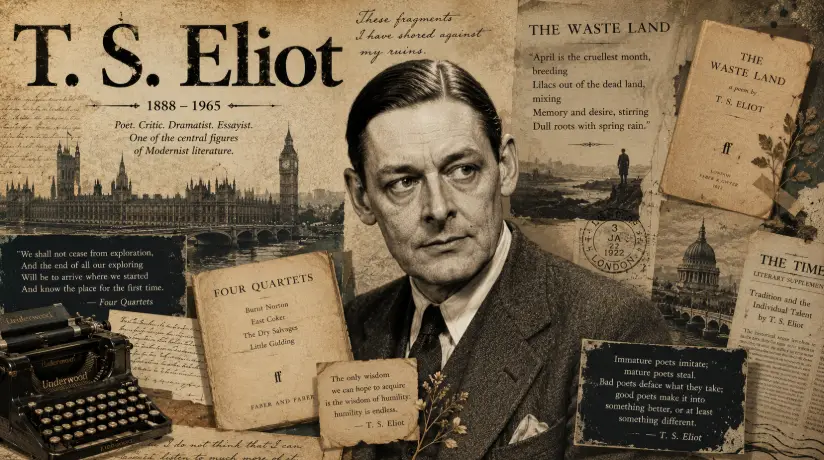
T. S. Eliot以深沉而碎片化的詩風改變二十世紀文學,他的作品描寫現代人的孤獨、信仰危機與精神荒涼。
T. S. Eliot transformed twentieth century literature through modernist poetry that captured spiritual emptiness, fractured identity, and the uncertainty of the modern world.
中文
托馬斯·斯特爾那斯·艾略特出生於美國密蘇里州聖路易斯,成長於重視教育與宗教傳統的家庭,他自幼便對哲學、文學與語言產生濃厚興趣,後來進入哈佛大學深造,接觸歐洲哲學與古典文學,這些學術背景深深影響他日後的創作風格,青年時期的艾略特前往歐洲求學與生活,最終定居英國,並逐漸融入倫敦的文學圈,他所處的年代正值第一次世界大戰後的動盪時期,社會價值崩解,人們對宗教、文明與未來充滿懷疑,這種時代氣氛成為他創作的重要養分,他最具代表性的作品《荒原》被視為現代主義文學的重要里程碑,詩中以大量片段、典故與多重聲音交錯構成一個破碎而空虛的世界,描繪戰後文明的精神枯竭與人類內在的迷失,他引用神話、宗教、莎士比亞與東方哲學等元素,讓作品充滿複雜層次,也展現他對文化傳承的深刻思考,雖然《荒原》表面晦澀難懂,但其核心其實是對現代人精神危機的描寫,艾略特認為現代社會失去了穩定的信仰與秩序,人們在都市與日常生活中逐漸感到孤立與空洞,除了詩歌,他也是重要的文學評論家,他提出「客觀對應物」等概念,強調情感應透過具體形象與場景表達,而非直接宣洩,這些理論深刻影響後世文學與戲劇創作,艾略特後期逐漸轉向宗教與精神探索,作品風格也從冷峻走向沉思與平靜,《四重奏》便展現他對時間、記憶與救贖的成熟思考,他在詩中融合哲學、信仰與個人經驗,使語言具有音樂般的節奏與深度,艾略特不僅改變了詩歌形式,也重新定義現代文學如何呈現人的內心世界,他的作品要求讀者主動思考與感受,並在碎片之中尋找意義與連結,他的影響遍及全球文學界,無論在詩歌、評論還是戲劇領域,都留下無法忽視的痕跡,他讓現代文學從傳統敘事中解放出來,成為探索精神與存在問題的重要藝術形式,即使歷經時代變遷,他的作品仍然能觸動現代人的焦慮與孤獨感,成為理解二十世紀精神世界的重要窗口
English Version
T. S. Eliot emerged as one of the defining literary voices of the twentieth century, shaping modern poetry through a style that reflected fragmentation, uncertainty, and emotional isolation, born in St. Louis and educated in an intellectually rigorous environment, he developed an early fascination with philosophy, classical literature, and comparative culture, studies that later informed the dense symbolic layers of his writing, after leaving the United States he settled in England, where he became deeply connected to the literary circles of London during a period marked by war, social upheaval, and spiritual disillusionment, these historical conditions profoundly influenced his artistic vision, his landmark poem The Waste Land captured the atmosphere of a civilization struggling with exhaustion and loss of meaning, weaving together shifting voices, literary references, religious imagery, and mythic structures into a portrait of cultural fragmentation, rather than offering a straightforward narrative, Eliot created a mosaic of impressions and memories that mirrored the instability of modern consciousness, readers encountered ruined cities, broken conversations, and moments of longing that reflected the psychological landscape of postwar society, despite its complexity the poem resonated widely because it expressed anxieties that many people could feel but not easily articulate, Eliot believed that modern individuals had become disconnected from spiritual foundations and communal traditions, leaving them trapped within routines that felt emotionally empty, beyond poetry he became one of the most influential literary critics of his era, introducing ideas about impersonality, symbolism, and the relationship between emotion and artistic structure, his concept of the objective correlative reshaped critical approaches to literature and performance, encouraging writers to express emotion indirectly through carefully constructed imagery and atmosphere, in later years Eliot turned increasingly toward spiritual reflection and religious thought, producing works such as Four Quartets that explored time, memory, mortality, and redemption with a quieter yet profound intensity, his mature style combined philosophical depth with musical rhythm, creating poetry that invited contemplation rather than immediate interpretation, Eliot’s influence transformed not only poetry but the entire direction of modern literature, inspiring generations of writers to experiment with structure, voice, and symbolism, his works continue to be studied because they capture the tensions of modern existence with remarkable precision, revealing how alienation, doubt, and the search for meaning remain enduring aspects of human life, through his writing Eliot established modernism as more than a literary movement, turning it into a powerful exploration of consciousness and cultural identity