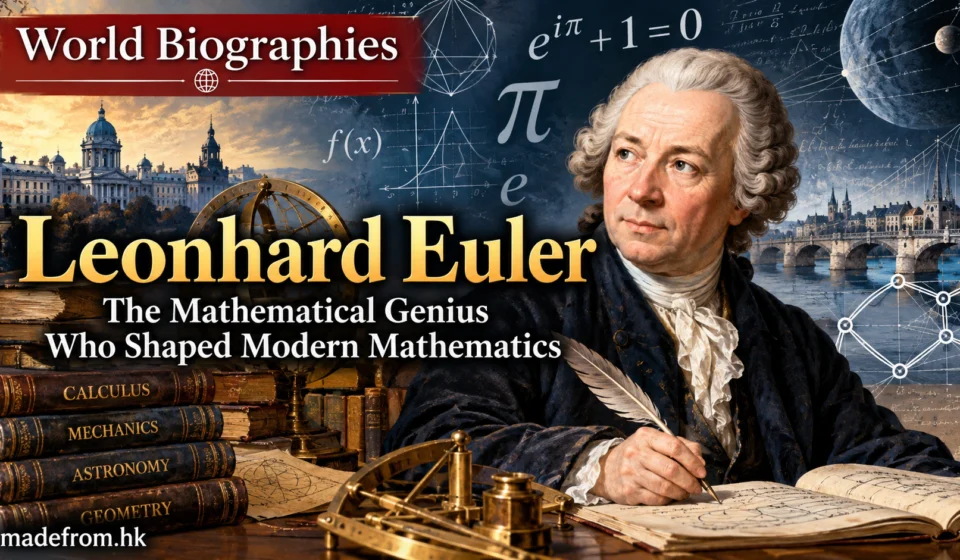
Leonhard Euler: The Mathematical Genius Who Shaped Modern Mathematics
Leonhard Euler was one of the most influential mathematicians in history. Born in Basel, Switzerland, in 1707, he made major contributions to mathematics, physics, astronomy, engineering and scientific notation. His work helped shape modern calculus, number theory, mechanics and mathematical analysis, while many symbols and methods associated with mathematics today can be traced to his ideas.
Leonhard Euler was born on April 15, 1707, in Basel, Switzerland. His father, Paul Euler, was a Protestant minister who had also studied mathematics, and he gave his son an early introduction to the subject. Euler entered the University of Basel at a young age, where geometry quickly became his favourite area of study. His mathematical ability attracted the attention of Johann Bernoulli, one of the leading mathematicians of the period, and Euler developed a close intellectual relationship with the Bernoulli family. Although his father initially hoped that he would enter the church, Euler’s passion for mathematics eventually became the central direction of his life. He also studied theology, Oriental languages, medicine and other subjects, giving him a remarkably broad intellectual background. In 1727, Euler travelled to Saint Petersburg after receiving an invitation to join the Imperial Russian Academy of Sciences. He initially worked in fields connected with medicine and physiology, while continuing his mathematical research. His early studies included work on sound and the mathematics of ship design. By 1730, he had become a professor of physics, and in 1733 he succeeded Daniel Bernoulli as professor of mathematics. During his years in Saint Petersburg, Euler produced an extraordinary number of mathematical papers and developed important ideas in calculus, trigonometry, geometry and analysis. His ability to solve difficult problems with remarkable speed became legendary. In 1735, he solved a particularly demanding mathematical problem in only a few days, although the effort seriously affected his health and contributed to the loss of sight in his right eye. His productivity nevertheless continued. Euler’s research extended far beyond pure mathematics. He worked on mechanics, astronomy, fluid dynamics, optics, navigation and other scientific problems, demonstrating how mathematical methods could be applied to the physical world. In 1741, Euler accepted an invitation from Frederick the Great and moved to Berlin, where he became a member of the Berlin Academy of Sciences and professor of mathematics. During his twenty-five years in Berlin, he continued to publish a remarkable stream of research. He investigated mathematical analysis, mechanics, astronomy and other areas of science, while also maintaining connections with the scientific community in Saint Petersburg. His reputation continued to grow throughout Europe, and he became a foreign member of the Paris Academy of Sciences. Euler later returned to Saint Petersburg in 1766, where he spent the final part of his life. By this time, his eyesight had deteriorated severely, and he eventually became almost completely blind. Yet blindness did not stop his mathematical work. With assistance from his sons and fellow mathematicians, he continued to dictate papers, perform calculations and develop new theories. His extraordinary memory allowed him to carry out complicated mathematical reasoning even when he could no longer rely on written calculations in the usual way. In 1771, a fire destroyed much of his property and nearly cost him his life, but his manuscripts were fortunately saved. Euler continued working despite these difficulties and remained remarkably productive until the end of his life. His contributions covered an astonishing range of subjects. In mathematics, he made fundamental advances in calculus, differential equations, number theory, geometry, complex analysis and mathematical notation. He helped popularise the use of π for the ratio of a circle’s circumference to its diameter and introduced or established notation that became standard in mathematics, including f(x) for functions and the use of i for the imaginary unit. The constant e, now known as Euler’s number, is also closely associated with his work. His research into infinite series, exponential functions and logarithms became an important foundation for later mathematics. Euler also played a pioneering role in graph theory through his famous investigation of the Seven Bridges of Königsberg, a problem that helped establish a new way of thinking about networks and connections. His influence was not limited to mathematics. His work in mechanics and fluid dynamics contributed to the mathematical description of physical systems, while his research in astronomy examined planetary and lunar motion. He also studied optics, shipbuilding and engineering problems, showing the practical power of mathematical analysis. Euler was an exceptionally prolific writer. More than two centuries after his death, mathematicians and scientists continue to encounter his name in equations, theorems, constants and mathematical concepts. He died in Saint Petersburg on September 18, 1783, at the age of 76. His legacy is unusual because it is present not only in specialised mathematical research but also in the basic language used to teach and communicate mathematics. Euler transformed mathematics into a more systematic and powerful language for understanding both abstract ideas and the physical world. His life demonstrated extraordinary persistence: even after serious illness, blindness and personal disasters, he continued to investigate problems and produce new knowledge. Today, Leonhard Euler is remembered as one of the central figures in the development of modern mathematics and as a scholar whose influence reaches across mathematics, physics, astronomy and engineering.
Leonhard Euler’s importance lies not in a single discovery but in the extraordinary breadth and lasting influence of his work. His notation, theories and methods became part of the foundation of modern mathematics, while his persistence in continuing scientific research despite severe personal difficulties remains an important part of his historical legacy.