安東尼·范·列文虎克:微生物世界的開拓者 / Antonie van Leeuwenhoek: Pioneer of the Microscopic World | 世界名人錄

安東尼·范·列文虎克是首位揭開微生物世界面紗的科學家,他的觀察改變了人類對生命的理解。
English: Antonie van Leeuwenhoek was the first to reveal the hidden world of microorganisms, transforming humanity’s understanding of life.
中文
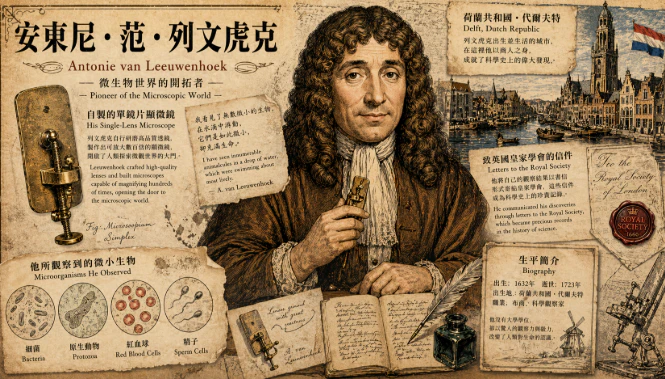
Antonie van Leeuwenhoek(安東尼·范·列文虎克)生於1632年的荷蘭共和國代爾夫特,是歷史上最早觀察並描述微生物的人,被譽為「微生物學之父」,他並非受過正規科學訓練的學者,而是一名布料商人,但正是這樣的背景讓他對放大鏡產生濃厚興趣,為了檢查布料品質,他開始製作高品質的單鏡片顯微鏡,並逐步提升放大倍率,最終達到當時前所未有的觀察能力,他的顯微鏡雖然結構簡單,卻能放大數百倍,使他得以觀察到肉眼無法看見的世界,列文虎克透過這些工具首次看見細菌、原生動物、紅血球以及精子等微觀結構,他將這些生命體稱為「微小動物」,這些觀察結果徹底顛覆了當時人們對生命的理解,因為在此之前,人們普遍相信生命只能以肉眼可見的形式存在,他將自己的發現以書信形式寄送給Royal Society,起初這些報告曾受到質疑,但隨著其他科學家成功重現他的觀察,他的成果逐漸被認可,並成為科學史上的重要里程碑,列文虎克一生並未出版正式的學術著作,而是透過數百封信件記錄其發現,這些信件詳實描述了他對微觀世界的探索過程,也展現出他對觀察與實驗的極大熱情,他的研究為後來的微生物學與醫學奠定了基礎,影響了Louis Pasteur與Robert Koch等後世科學家,推動了細菌學與疾病研究的發展,列文虎克的成就不僅在於技術上的突破,更在於他以好奇心與耐心探索未知世界的精神,他證明即使沒有傳統學術背景,只要具備觀察力與持續實驗的態度,也能對人類知識作出重大貢獻,他所開啟的微觀世界讓人類首次意識到生命的多樣性與複雜性,從而改變了科學、醫學乃至哲學對生命本質的理解,他的故事象徵著科學探索的本質不在於身分,而在於對未知的渴望與不懈追求
English Version
Antonie van Leeuwenhoek was born in 1632 in Delft in the Dutch Republic and is widely regarded as the “Father of Microbiology” for being the first person to observe and describe microorganisms, unlike many scientists of his time he did not receive formal academic training and instead worked as a draper, yet this profession sparked his interest in lenses as he used magnifying glasses to inspect fabric quality, driven by curiosity he began crafting his own single-lens microscopes, refining them to achieve unprecedented magnification, his instruments were simple in design but extraordinarily powerful, allowing him to observe a hidden world invisible to the naked eye, through these microscopes he became the first to document bacteria, protozoa, red blood cells, and sperm cells, referring to these entities as “animalcules,” his discoveries challenged the prevailing belief that life existed only in visible forms and opened an entirely new dimension of biological understanding, Leeuwenhoek communicated his findings through detailed letters sent to the Royal Society, where his claims were initially met with skepticism, however as other scientists verified his observations his work gained acceptance and recognition, over his lifetime he wrote hundreds of letters documenting his meticulous observations and experimental methods rather than publishing formal scientific books, these writings provide invaluable insight into his investigative process and dedication to empirical study, his contributions laid the groundwork for the development of microbiology and significantly influenced later scientists such as Louis Pasteur and Robert Koch, whose work advanced germ theory and medical science, Leeuwenhoek’s legacy extends beyond his technical achievements as he embodied the spirit of curiosity and perseverance, demonstrating that groundbreaking discoveries can emerge from keen observation and independent inquiry rather than formal credentials, by unveiling the microscopic world he transformed humanity’s understanding of life’s complexity and diversity, fundamentally altering scientific thought and paving the way for modern biology and medicine, his life stands as a powerful reminder that the pursuit of knowledge is driven not by status but by curiosity and relentless exploration