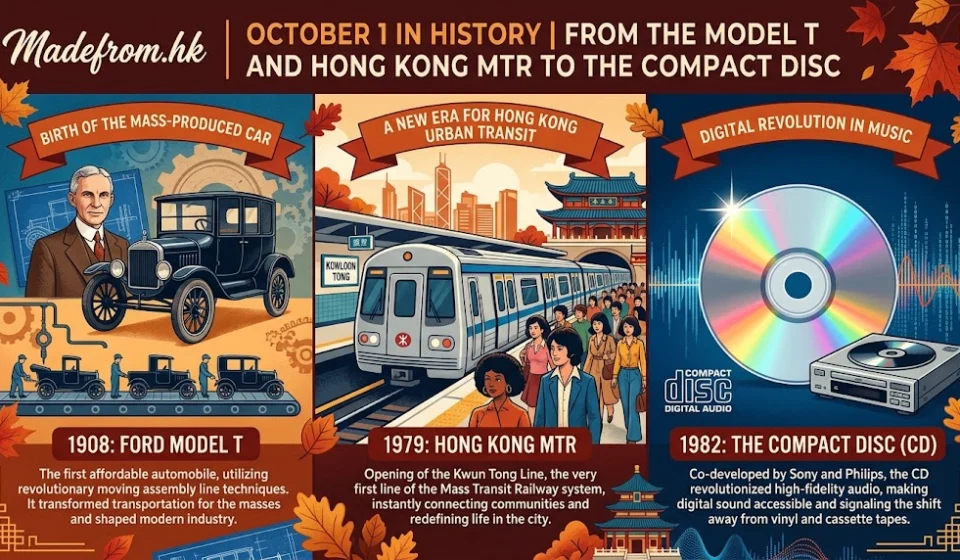
Today in History: October 1|From the Model T and Hong Kong MTR to the Compact Disc
October 1 marks several turning points in everyday life, from automobiles and railways to music technology, entertainment and medical imaging.
October 1 is a date that connects several important developments in modern everyday life. Rather than being remembered only for major political events, the day also offers a fascinating timeline of automobiles, transportation, entertainment, music technology and medical imaging. On October 1, 1908, the Ford Motor Company completed the first production Model T at its Piquette Avenue plant in Detroit. The Model T was not the first automobile in history, but its later success through mass production helped transform the automobile from an expensive novelty into a product that could reach a much broader public. Ford eventually produced around 15 million Model Ts between 1908 and 1927, making the car one of the defining products of the early automobile age. The same date also has an important place in the history of professional sport. On October 1, 1903, the Pittsburgh Pirates defeated the Boston Americans in the first game of the first modern World Series. The event helped establish the championship tradition that would become one of the most recognizable parts of American professional baseball. Transportation continued to appear in the October 1 timeline. In 1928, Newark Airport opened and became an early major airport serving the New York metropolitan region. Three years later, on October 1, 1931, the George Washington Bridge opened, connecting New Jersey and New York. These developments reflected a broader transformation in which cities were becoming increasingly connected by roads, bridges, railways and aviation. Hong Kong has its own important October 1 transportation milestone. On October 1, 1979, the MTR officially opened. Hong Kong’s railway system at that time was much smaller than the extensive network people know today, but the opening marked the beginning of a transportation system that would become deeply integrated into everyday urban life. For generations of Hong Kong residents, the railway has influenced the way people travel to work, attend school, shop and move between different parts of the city. October 1 is also closely connected with the history of recorded music. In 1982, Sony introduced the CDP-101 compact disc player in Japan, while Sony and Philips launched the compact disc format commercially in the Japanese market. The arrival of the CD helped change how people bought, collected and listened to recorded music. Looking back today, the transition from vinyl records to cassette tapes, then to CDs, MP3 files and streaming services reveals how rapidly the physical form of music has changed. Yet each format also created its own listening culture. For people who grew up with records, tapes and CDs, buying an album once meant bringing a physical object home, opening the case, reading the booklet and placing the disc into a player. Today, a song can be selected instantly on a smartphone, making the old ritual seem almost distant. October 1 also marks an important moment in medical technology. In 1971, an early CT brain scanner was used to examine a patient at Atkinson Morley Hospital in London. Computed tomography represented a major development in medical imaging because computers could process X-ray information to create detailed cross-sectional images of the body. The technology eventually became an important part of modern diagnostic medicine. Entertainment history has its own October 1 milestone. Walt Disney World officially opened in Florida on October 1, 1971. The resort represented more than a collection of rides; it developed a form of entertainment that combined storytelling, architecture, characters, music and customer experience into one large environment. The theme-park model would later become an important part of popular culture around the world. October 1 also carries major national and historical significance. Nigeria became independent from British rule on October 1, 1960, and the date is now celebrated as the country’s Independence Day. In China, October 1, 1949 marked the formal proclamation of the People’s Republic of China in Beijing. Mao Zedong announced the establishment of the new government, with Zhou Enlai becoming premier. The event became a major turning point in modern Chinese history. Taken together, these events create an unusual October 1 timeline. The day connects the mass automobile, modern transportation, medical imaging, theme-park entertainment and the evolution of recorded music. History is often taught through wars, governments and famous political figures, but another way to understand history is to look at ordinary life. The car we drive, the railway we take, the music format we once used and the medical technology used in hospitals are all products of historical change. Many things that feel completely normal today were once experimental, expensive or even unimaginable. The story of October 1 therefore is not simply a list of events from different years. It is a reminder that technological and cultural changes rarely transform everyday life overnight. They begin as new ideas or products, enter the lives of a limited number of people, become more widely available and eventually turn into things that future generations take for granted. Looking back at October 1 allows us to see that history is not only about what happened in government buildings or on battlefields. It is also about the gradual transformation of the way ordinary people travel, listen, work, receive medical care and spend their leisure time. Sometimes the most interesting history is hidden inside the everyday objects and systems that we eventually stop noticing.
October 1 reveals how automobiles, railways, CDs, medical imaging and entertainment gradually reshaped everyday life, turning once-new ideas into familiar routines.