Today in History: September 14 – Missing Calendar Days, OPEC, and The Golden Girls
September 14 reflects changing calendars, energy systems, popular culture and remarkable lives that shaped everyday society.
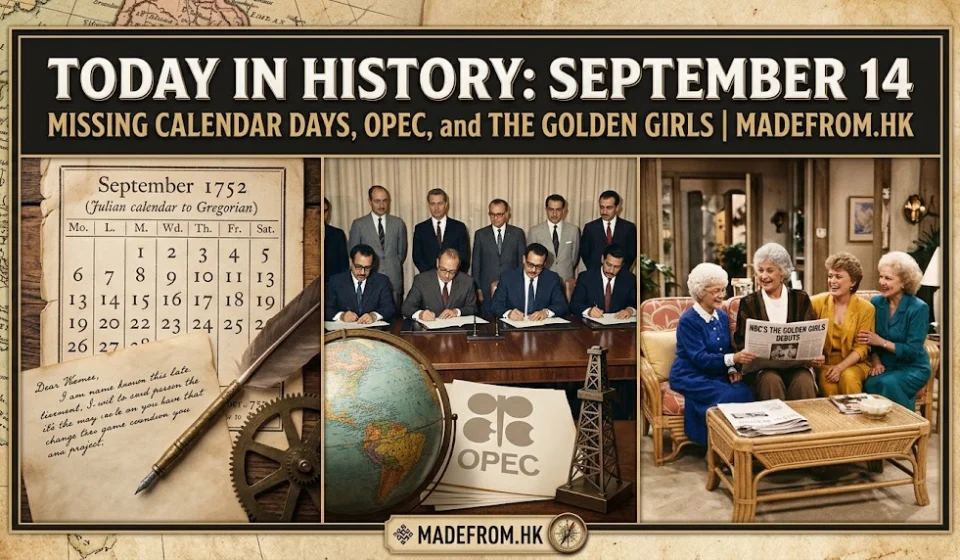
September 14 offers a different kind of historical story. Instead of focusing on battles, political crises or dramatic conflicts, the date provides a fascinating look at the systems, technologies, cultural changes and personalities that have shaped everyday life. One of the most unusual examples came in 1752, when Britain and its colonies adopted the Gregorian calendar. The change required eleven calendar dates to be removed in order to correct the accumulated difference between the old Julian calendar and the new system. As a result, the day after September 2 was officially recorded as September 14. Eleven dates simply disappeared from the calendar. To people today, a calendar adjustment may seem like a technical detail, but for people living through the change it affected ordinary life in a very direct way. Appointments, business transactions, legal documents, religious observances and personal records all depended on dates. A calendar is more than a printed grid of numbers; it is a social system that allows millions of people to organise their lives according to a shared understanding of time. The change in 1752 therefore reminds us that even something as familiar as “today’s date” is not entirely natural or permanent. It is something societies create, maintain and occasionally reform. More than two centuries later, September 14 became associated with another system that has had an enormous effect on everyday life: the modern global energy economy. In 1960, representatives of Iran, Iraq, Kuwait, Saudi Arabia and Venezuela established the Organization of the Petroleum Exporting Countries, better known as OPEC, in Baghdad. OPEC’s own historical records identify September 14, 1960, as the date on which the organisation was founded, following meetings in Baghdad between September 10 and 14. The creation of OPEC reflected the growing importance of oil to modern industrial societies and the desire of major oil-producing countries to coordinate their interests and exercise greater control over their natural resources. Oil was no longer simply another commercial product. It had become essential to transport, manufacturing, electricity generation and economic development. Cars, aircraft, factories, shipping networks and countless everyday products were increasingly connected to the availability and price of energy. The founding of OPEC therefore helped establish an international structure that would eventually have an enormous influence on the global economy. Whenever changes in oil prices affect transport costs, household expenses or the prices of goods, the consequences can be traced back to the development of this wider energy system. September 14 also has an important place in popular culture. On September 14, 1985, the American sitcom “The Golden Girls” premiered on television. The series centred on four older women living together in Miami and was unusual for its time because older women were rarely placed at the centre of mainstream television comedy. Beatrice Arthur, Betty White, Rue McClanahan and Estelle Getty played the four principal characters, and the programme eventually ran for seven seasons and 180 episodes. Its importance went beyond ratings. “The Golden Girls” offered a different image of later life. Instead of presenting older women mainly as parents, grandparents or supporting characters, the series allowed them to have their own friendships, relationships, financial concerns, disagreements, ambitions and personal choices. They were funny, independent and fully involved in life. The programme helped demonstrate that getting older did not mean that a person’s story had ended. There could still be new friendships, new challenges and new beginnings. That idea helped give the programme a cultural significance that went beyond ordinary television entertainment. The date is also connected with one of the most recognisable figures of twentieth-century popular culture. On September 14, 1982, Grace Kelly, the American-born actress who had become Princess Grace of Monaco, died from injuries following a car accident. She was 52. Before entering royal life, Kelly had become one of Hollywood’s best-known actresses, appearing in films including “Rear Window.” In 1956 she married Prince Rainier III of Monaco and left her film career to become a member of the European royal family. Her life became an extraordinary meeting point between Hollywood, fashion, celebrity and European royalty. Grace Kelly’s story has remained part of popular culture for decades because it seemed to connect two very different worlds. She began as an American film star, reached the height of her career and then stepped away from Hollywood to enter royal life. Her image has continued to influence photography, fashion and the public imagination long after her death. September 14 also provides examples of technological change. In 1956, IBM introduced the 305 RAMAC system, an early business computer notable for its use of magnetic disk storage. The machines of the period were enormous compared with today’s personal computers and were designed mainly for organisations rather than ordinary households. Yet the basic idea of storing information on a disk would become a fundamental part of computing. In 2000, Microsoft released Windows Millennium Edition, commonly known as Windows Me, the final member of the Windows 9x family. Its name reflected the excitement surrounding the beginning of a new millennium and the widespread belief that personal computing would continue to transform everyday life. Looking at these events together reveals something important about the nature of history. Major changes do not always arrive with dramatic headlines. Sometimes they appear in ordinary objects and systems that people gradually stop noticing because they become part of daily life. A calendar tells us what day it is. Energy systems determine how much it costs to travel or produce goods. Computers store information that businesses depend upon. Television programmes influence how societies think about family, friendship and ageing. Public figures such as Grace Kelly can become cultural symbols whose influence lasts for generations. September 14 brings all these elements together. The calendar reform of 1752 shows that even our understanding of time can be redesigned. The founding of OPEC in 1960 shows how natural resources can become central to international economics. The arrival of “The Golden Girls” in 1985 demonstrates how entertainment can challenge familiar ideas about age and identity. Grace Kelly’s life illustrates the powerful relationship between celebrity and public culture. The history of technology, meanwhile, reminds us that the devices we now regard as ordinary were once extraordinary innovations. There is a tendency to think of history as something that happens somewhere else—to kings, presidents, governments and famous institutions. But much of history happens in the background of ordinary life. It happens in the calendar on a wall, in the price displayed at a petrol station, in the computer sitting on an office desk, and in the television programmes families watch together. These systems and cultural habits become so familiar that we forget they were once new. September 14 is valuable precisely because it allows us to look at history from this everyday perspective. The disappearance of eleven calendar dates may sound strange today, but it shows how deeply official systems can shape personal life. The creation of OPEC may appear to belong to the world of international economics, yet its consequences eventually reach transport, manufacturing and household spending. “The Golden Girls” may seem like simple entertainment, yet its portrayal of older women helped broaden the kinds of lives that television audiences could imagine. Grace Kelly may have been a movie star and princess, but her life also demonstrates how modern celebrity culture crosses borders between entertainment, fashion and public life. When viewed together, these stories suggest that history is not simply a list of major events. It is the gradual accumulation of changes that eventually creates the world we recognise today. September 14 therefore becomes a day about the evolution of everyday life: how people organise time, how societies manage resources, how technology stores information, how television reflects changing attitudes and how individuals can become cultural symbols. The most interesting historical changes are sometimes the ones that become invisible because they succeed so completely. We no longer think twice about the calendar system we use, the energy networks that keep cities moving, the computers that store our information or the entertainment that fills our evenings. Yet every one of these things has a history. September 14 reminds us to look beyond the dramatic events and notice the quieter transformations that gradually become part of ordinary life. History is not only about what happened in the past. It is also about understanding why the present looks the way it does.
September 14 shows how calendars, energy, technology and popular culture can quietly transform ordinary life and shape the modern world.