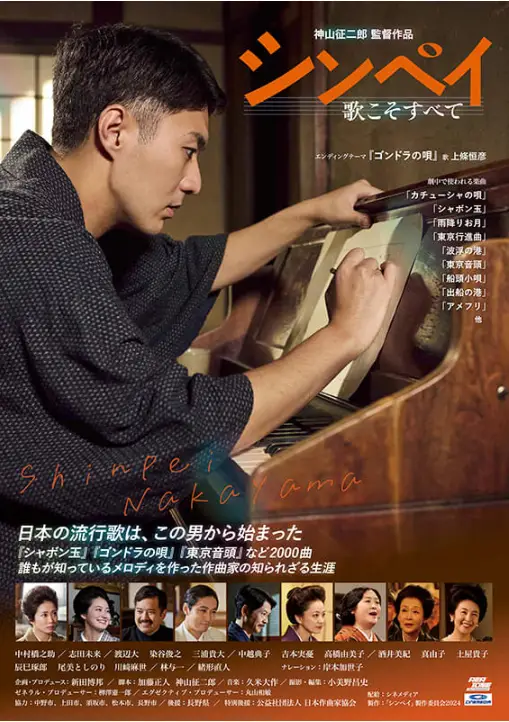
《新平:歌就是一切》是一部描寫日本作曲家中山晉平一生的傳記劇情電影。
中山晉平出生於明治時代,經歷大正與昭和時代,一生創作了約2,000首作品,涵蓋童謠、流行歌曲、音頭與民謠等不同音樂類型。《搖籃曲之歌》(ゴンドラの唄)、《東京音頭》、《肥皂泡》(シャボン玉)與《晴天娃娃》(てるてる坊主)等作品,至今仍然廣為人知。
電影透過他的生命與音樂創作,描繪一位作曲家如何在時代變遷之中尋找屬於自己的音樂道路。
電影內容|中文版本
中山晉平出生於信州。
長大後,他離開家鄉前往東京,進入東京音樂學校,也就是今天東京藝術大學音樂學部的前身,正式踏上音樂學習之路。
然而,他的音樂學業並不順利。
其中最大的問題,是鋼琴演奏能力未能達到畢業所要求的程度。
眼看著自己可能面臨留級甚至無法畢業的危機,中山晉平的未來似乎充滿不確定性。
就在這個關鍵時刻,幸田老師發現了他在演奏之外所擁有的才能。
這份才能讓晉平最終克服困境,順利完成學業。
畢業之後,他逐漸走進更廣闊的音樂與藝術世界。
其中,對晉平人生影響深遠的人物,是劇作家與演出家島村抱月。
島村抱月向他傳達了一個重要的思想:
「藝術不能離開大眾的支持。」
這句話成為中山晉平日後音樂創作的重要方向。
音樂不只是為少數人而存在,也可以走進普通人的生活。
於是,晉平開始創作各種不同類型的歌曲。
從流行一時的歌曲《喀秋莎之歌》、《船頭小調》,到深受孩子們喜愛的童謠《肥皂泡》、《晴天娃娃》,他的創作範圍逐漸擴大。
他沒有把自己限制在單一音樂類型之中。
流行歌曲可以是他的音樂,童謠也可以是他的音樂;音頭與民謠,同樣可以成為他表達創作理念的方式。
這種跨越不同音樂類型的創作,也逐漸形成了中山晉平獨特的音樂世界。
他的作品並非只停留在舞台或音樂圈之內。
歌曲進入街頭、家庭以及普通人的日常生活。
音樂成為人們可以一起唱、一起記住的東西。
在音樂創作之外,晉平的人生也迎來重要的伴侶。
他與真正理解自己音樂的敏子結婚,兩人後來收養了兩名孩子。
對晉平而言,這是一段幸福的家庭生活。
一邊創作音樂,一邊與理解自己的伴侶共同生活,他似乎逐漸找到了人生的平衡。
然而,作曲家的道路並不會永遠平順。
時代不斷變化,社會也在改變。
而中山晉平則繼續創作,持續思考音樂與大眾之間的關係。
他所留下的大量作品,也成為日本近代音樂文化的一部分。
從流行歌曲到童謠,從音頭到民謠,他創作的歌曲跨越不同年齡層,也跨越不同生活場景。
這些歌曲之所以能夠長久流傳,不只是因為旋律容易記住,更因為它們進入了普通人的生活。
孩子可以唱童謠,大人可以唱流行歌曲,人們也可以在節慶與不同場合中唱起音頭與民謠。
音樂因此不再只是專業藝術家的作品,而成為大眾共同擁有的文化。
《新平:歌就是一切》正是從這樣的角度描寫中山晉平。
電影並不只著重於一位作曲家創作了多少作品,而是透過他的生命歷程,呈現他如何一步一步形成自己的音樂理念。
從信州來到東京,從差點無法畢業,到後來成為創作約2,000首歌曲的作曲家,他的一生與日本社會的變化緊密相連。
他的音樂道路,也是一段從學校教育走向大眾文化的歷程。
對中山晉平而言,歌曲並不是高高在上的藝術。
歌曲應該可以被普通人聽見、理解、記住,也可以成為生活中的一部分。
這種思想與他的創作一起,成為他音樂人生的重要核心。
English Version
Shinpei: Song Is Everything is a biographical drama about the life of Japanese composer Shinpei Nakayama.
Born during the Meiji era and living through the Taisho and Showa periods, Nakayama composed approximately 2,000 pieces across a wide range of genres, including children’s songs, popular songs, festival music and folk songs.
Among his best-known works are “Gondola no Uta,” “Tokyo Ondo,” “Shabondama” and “Teru Teru Bozu.”
The film follows his life and musical career, showing how he developed his own approach to music while Japan itself was undergoing major social and cultural changes.
Nakayama was born in Shinshu.
As a young man, he left his hometown for Tokyo and entered the Tokyo Academy of Music, the institution that later became the Faculty of Music at Tokyo University of the Arts.
His education, however, did not proceed smoothly.
His piano skills were not considered sufficient to meet the level required for graduation, placing him at risk of failing and having to repeat a year.
At this difficult moment, his teacher, Mr. Koda, recognised a talent in Nakayama that went beyond instrumental performance.
That discovery allowed him to overcome the difficulties and eventually graduate.
After leaving school, Nakayama entered a much broader world of music and art.
One of the most influential figures in his life was playwright and theatre director Hogetsu Shimamura.
Shimamura taught him an important principle:
Art should never become separated from the support of the public.
This idea became an important foundation for Nakayama’s musical career.
Music did not have to exist only for a small group of specialists or elite audiences. It could also become part of ordinary people’s everyday lives.
Nakayama therefore began composing across many different genres.
He created popular songs such as “Katyusha no Uta” and “Sendō Kouta,” while also writing children’s songs such as “Shabondama” and “Teru Teru Bozu.”
He refused to restrict himself to a single musical style.
Popular songs could be part of his music, but so could children’s songs, festival music and folk songs.
Through this wide-ranging creative work, Nakayama gradually developed a distinctive musical world of his own.
His music did not remain confined to concert halls or the professional music industry.
His songs entered streets, homes and everyday life.
Music became something ordinary people could sing together and remember together.
His personal life also entered a new chapter when he married Toshiko, a woman who understood and supported his music.
The couple later adopted two children.
For Nakayama, this became an important period of happiness and family life.
He continued composing while sharing his life with someone who understood his artistic world.
Yet the path of a composer could never remain completely smooth.
The times changed, society changed, and Nakayama continued to think about the relationship between music and ordinary people.
The enormous body of work he left behind eventually became an important part of modern Japanese musical culture.
From popular songs to children’s music, from festival songs to folk songs, his compositions reached different generations and became part of many different aspects of everyday life.
Children could sing his songs, adults could enjoy his popular music, and his festival and folk compositions could be heard in traditional celebrations and other settings.
Music was no longer simply something created by professional artists.
It became part of a shared culture belonging to ordinary people.
This is the perspective through which Shinpei: Song Is Everything portrays Nakayama.
The film is not simply concerned with how many songs he composed.
Instead, it follows the experiences that shaped his musical philosophy.
From leaving Shinshu for Tokyo, to nearly failing to graduate, and eventually becoming a composer responsible for around 2,000 works, Nakayama’s life developed alongside the transformation of Japanese society.
His musical journey was also a journey from formal music education toward popular culture.
For Nakayama, songs were not distant or inaccessible forms of art.
Songs should be heard, understood and remembered by ordinary people. They should become part of everyday life.
That belief, together with his extraordinary creative output, became one of the defining principles of his life in music.
電影簡介|Short Description
《新平:歌就是一切》描寫日本作曲家中山晉平從信州前往東京求學,到成為創作約2,000首歌曲的作曲家的一生。他跨越童謠、流行歌曲、音頭與民謠等不同領域,讓音樂走進普通人的生活。
Shinpei: Song Is Everything follows the life of Japanese composer Shinpei Nakayama, from his journey from Shinshu to Tokyo to his career as a composer of approximately 2,000 songs. Working across children’s songs, popular music, festival songs and folk music, he helped bring music into the everyday lives of ordinary people.
電影資料
作品:シンペイ 歌こそすべて
英文:Shinpei: Song Is Everything
導演:神山征二郎
類型:傳記、劇情、音樂
主角:中村橋之助
題材人物:中山晉平
主要演員
中村橋之助 —— 中山晉平
志田未來
渡邊大
染谷俊之
三浦貴大
中山晉平的音樂世界
童謠|Children’s Songs
《肥皂泡》、《晴天娃娃》等作品,成為日本廣為人知的童謠。
流行歌曲|Popular Songs
《喀秋莎之歌》、《船頭小調》等作品,反映當時大眾音樂文化。
音頭與民謠|Festival & Folk Music
他的創作並不局限於單一類型,也涉及音頭與民謠等不同形式。
約2,000首作品|Around 2,000 Works
中山晉平一生留下大量作品,創作範圍橫跨不同音樂類型與世代。
核心主題
音樂屬於大眾|Music Belongs to the People
受到島村抱月「藝術不能離開大眾支持」的思想影響,中山晉平將音樂帶進普通人的生活。
創作|Creativity
他沒有將自己限制於單一音樂形式,而是在不同類型之間持續創作。
時代|An Era of Change
他的生命橫跨明治、大正與昭和三個時代,音樂創作也與日本社會變化相互交織。
家庭|Family
與理解自己音樂的敏子結婚並收養兩名孩子,家庭生活也是他人生的重要部分。
總結
《新平:歌就是一切》透過中山晉平的一生,描寫一位作曲家如何從信州來到東京,在音樂學校面臨挫折,又在老師與藝術家的影響下找到自己的創作道路。他創作約2,000首歌曲,從流行歌曲到童謠、音頭與民謠,讓音樂真正進入普通人的日常生活。
Shinpei: Song Is Everything portrays the life of a composer who travelled from Shinshu to Tokyo, overcame difficulties during his musical education and eventually found his own creative path. With around 2,000 compositions ranging from popular songs and children’s music to festival and folk songs, Shinpei Nakayama helped make music a natural part of everyday life.