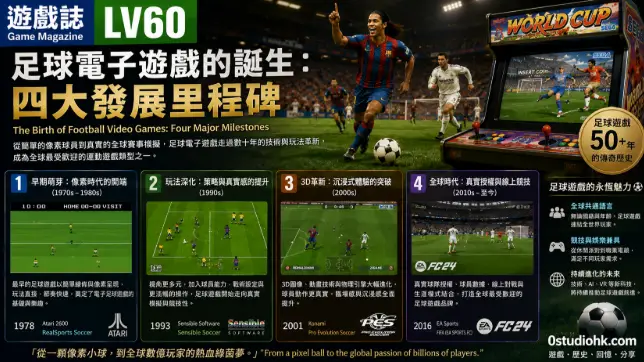
遊戲誌 LV60|足球電子遊戲的誕生:四大發展里程碑|Game Magazine LV60 | The Birth of Football Video Games: Four Milestones That Shaped the Genre
今天的足球遊戲已擁有逼真的球員動作、完整授權球隊及精密物理模擬,但它的發展歷程可追溯至五十多年前。從最初只有幾個方塊組成的街機,到今日高度擬真的足球模擬作品,每一次技術突破都改變了玩家體驗,也推動整個足球遊戲不斷進化。
Modern football games feature lifelike player animation, licensed clubs, and sophisticated physics, yet their origins were surprisingly simple. Over five decades, a series of groundbreaking titles transformed electronic football from basic arcade experiments into one of the world’s most successful sports game genres.
中文
足球電子遊戲的歷史,並沒有一款公認唯一的「第一作」,因為早期不少大學電腦已曾製作足球相關程式。然而,若以商業電子遊戲而言,1973年TAITO推出街機《Soccer》,普遍被視為足球街機的重要起點,更獲《Guinness World Records》列為最早的商業足球電子遊戲之一。作品由日後創作《太空侵略者》的西角友宏設計,玩法深受《Pong》影響,玩家利用旋鈕控制兩側方塊,把球擊進對方球門得分,雖然畫面極為簡單,但首次把足球概念帶進商業街機市場。1974年,全球第一部家用遊戲主機Magnavox Odyssey推出《Soccer》,由於主機只能顯示少量光點,因此玩家必須把透明足球場塑膠片貼在電視螢幕上,再配合遊戲進行比賽。這種利用實體Overlay補足畫面的設計,成為第一代家用遊戲機最具代表性的特色之一。1980年,Atari 2600推出《Pelé’s Soccer》,邀請巴西球王比利(Pelé)冠名代言,成為歷史上首批由世界級足球明星正式授權的足球遊戲。遊戲改採俯視角度,加入球員跑位、傳球及較完整的球場設計,相較早期作品更接近真正足球比賽,也讓足球遊戲逐漸脫離《Pong》式玩法,開始建立現代足球遊戲的雛形。1980年代末至1990年代初,足球遊戲迎來真正的高速發展。Anco推出《Kick Off》建立快速操作與精準控球概念,Sensible Software推出《Sensible Soccer》則以流暢節奏與高度娛樂性風靡全球,成為當時歐洲最受歡迎的足球遊戲之一。1993年,EA Sports推出《FIFA International Soccer》,正式開啟另一個新時代。遊戲採用等角斜視角(Isometric View),畫面更接近電視足球轉播,並首次取得國際足協(FIFA)官方授權,成功把真實球隊、正式賽事與足球模擬結合,建立往後《FIFA》系列三十多年的成功基礎。其後,Konami《Winning Eleven》(《實況足球》)憑藉更細膩的操控手感與戰術系統,與《FIFA》形成長達二十多年的雙雄競爭,共同推動足球遊戲不斷進步。回顧足球電子遊戲的發展,可以清楚看見四個重要里程碑:《Soccer》讓足球首次走進商業街機;Magnavox Odyssey把足球帶入家庭;《Pelé’s Soccer》開始建立真正足球比賽的雛形;《FIFA International Soccer》則成功把授權、模擬與電視轉播視角結合,成為現代足球遊戲的重要轉捩點。今日無論是《EA Sports FC》還是《eFootball》,都建立在這半個世紀累積而成的技術與設計基礎之上,也見證足球遊戲如何由幾個簡單方塊,發展成全球最受歡迎的電子競技與運動遊戲類型之一。
English Version
The history of football video games cannot be traced to a single definitive beginning. Although experimental football software existed on university computers during the early 1970s, TAITO’s arcade release Soccer in 1973 is widely recognized as one of the earliest commercial football video games and has been acknowledged by Guinness World Records as a landmark title in the genre. Designed by Tomohiro Nishikado, who later created Space Invaders, the game borrowed heavily from Pong’s mechanics, allowing players to control rectangular paddles and score goals using a simple electronic ball. While primitive by modern standards, it introduced football into commercial arcades for the first time. The following year, Magnavox Odyssey brought football into the home with its own version of Soccer. Because the console could display only a handful of moving dots, players placed a transparent football field overlay directly on the television screen, creating one of the earliest home football experiences. In 1980, Atari 2600 released Pelé’s Soccer, featuring legendary Brazilian football icon Pelé. Rather than simply adapting Pong, the game introduced a top-down field, recognizable player movement, passing mechanics, and more authentic match presentation, making it one of the earliest home football titles to resemble the sport itself. Football games advanced rapidly during the late 1980s and early 1990s. Kick Off introduced greater precision and faster gameplay, while Sensible Soccer became famous throughout Europe for its accessibility and fluid controls. The next major breakthrough arrived in 1993 with EA Sports’ FIFA International Soccer. Featuring an isometric broadcast-style camera and official FIFA licensing, it delivered an unprecedented level of authenticity and established the blueprint for licensed football simulations over the following decades. Soon afterward, Konami’s Winning Eleven (known internationally as Pro Evolution Soccer) emerged as FIFA’s greatest rival, creating a competitive rivalry that pushed football games to new levels of realism and gameplay quality. Looking back, football video games evolved through several defining milestones rather than a single invention. TAITO introduced football to arcades, Magnavox brought it into the living room, Pelé’s Soccer demonstrated how electronic football could resemble the real sport, and FIFA International Soccer transformed licensed football simulations into a global phenomenon. Modern titles such as EA Sports FC and eFootball continue to build upon the innovations established by these pioneering games more than fifty years ago.