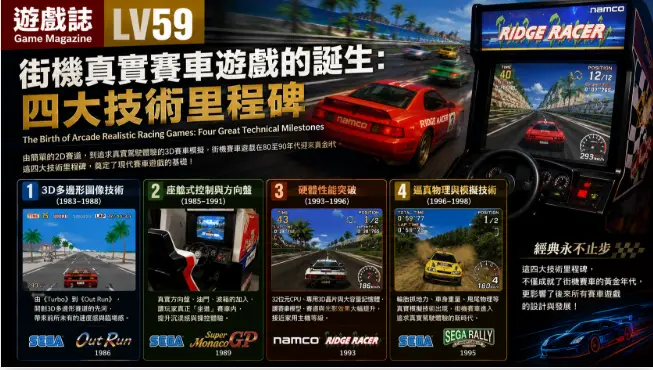
遊戲誌 LV59|街機真實賽車遊戲的誕生:四大技術里程碑|Game Magazine LV59 | The Birth of Realistic Arcade Racing Games: Four Milestones That Changed Racing History
今天的賽車遊戲擁有逼真的畫面、精密的物理模擬與完整的駕駛體驗,但這一切並非一夕之間誕生。從1980年代開始,多款經典街機作品不斷突破技術限制,逐步建立真實賽車遊戲的雛形,也改寫了整個競速遊戲的發展方向。
Modern racing games deliver stunning graphics, realistic physics, and immersive driving experiences, but their origins stretch back to a series of groundbreaking arcade titles during the 1980s. Each technological breakthrough pushed racing games closer to reality and laid the foundation for today’s driving simulators.
中文
「真實賽車遊戲」並沒有一個公認唯一的起點。隨著遊戲硬體不斷進步,真實性的定義也從真實賽道、3D圖形、模擬駕駛到物理運算逐步演化。因此,街機真實賽車遊戲的誕生,其實是由多部劃時代作品共同完成。1982年,NAMCO推出《Pole Position》,由Atari負責歐美市場發行,成為街機賽車史上的第一個重要里程碑。在它之前,大部分賽車遊戲皆採用虛構賽道,而《Pole Position》首次以日本富士國際賽車場作為設計藍本,並加入正式排位賽制度,玩家必須先完成排位賽才能進入正式比賽,大幅提升真實賽車的代入感。機台配備方向盤、油門、煞車及兩速排檔,同時運用Sprite Scaling圖像縮放技術營造高速前進的偽3D效果,成為1983年全球最受歡迎的街機遊戲之一,也奠定日後賽車遊戲的基本架構。1988年,NAMCO再次帶來革命性突破,推出《Winning Run》。這款作品採用即時3D Polygon多邊形繪圖,是最早全面使用即時3D多邊形技術的街機賽車作品之一,玩家透過第一人稱駕駛視角坐進大型F1座艙,體驗前所未有的臨場感。雖然後來SEGA《Virtua Racing》憑藉更成熟的技術大受歡迎,但《Winning Run》已率先展示3D賽車遊戲的未來方向。1989年,Atari推出《Hard Drivin’》,將街機賽車帶入真正的駕駛模擬時代。遊戲配備回饋式方向盤、離合器踏板及四速手排變速箱,玩家必須按照真實駕駛方式完成換檔操作,否則車輛甚至可能熄火。遊戲同時加入懸吊系統、輪胎抓地力及碰撞物理運算,並提供車禍重播功能,成為當時最具真實感的街機駕駛模擬作品,也被許多遊戲史研究者視為現代賽車模擬遊戲的重要先驅。1993年,NAMCO推出《Ridge Racer(實感賽車)》,正式把街機賽車帶進3D黃金年代。遊戲利用System 22大型街機基板,即時運算大量3D多邊形,配合Gouraud Shading光影處理、高速貼圖及流暢動畫,使車身呈現近似真實金屬質感。與前作偏向模擬不同,《實感賽車》採用容易上手但極具速度感的甩尾(Drift)系統,讓玩家能以華麗方式高速過彎,成功兼顧娛樂性與操作深度,很快便風靡世界各地遊戲機中心,成為90年代街機最具代表性的賽車遊戲之一。回顧街機真實賽車遊戲的演進,可以清楚看見四個重要階段。《Pole Position》建立真實賽道與排位賽概念;《Winning Run》正式開啟即時3D多邊形賽車時代;《Hard Drivin’》把物理模擬與駕駛操作推向新高度;《Ridge Racer》則成功融合3D畫面、速度感與娛樂性,讓街機賽車真正走向成熟。正因這四部經典作品的不斷突破,後來的《Gran Turismo》、《Forza Motorsport》、《Assetto Corsa》、《iRacing》等擬真賽車遊戲,才能建立在它們所奠定的技術與設計基礎之上。街機年代或許早已成為歷史,但這些經典作品留下的創新精神,至今仍深深影響全球賽車遊戲的發展。
English Version
The history of realistic arcade racing games cannot be traced to a single title. Instead, it evolved through a series of technological breakthroughs that gradually transformed arcade driving from simple entertainment into increasingly authentic simulation. The first major milestone arrived in 1982 with Pole Position, developed by NAMCO and distributed internationally by Atari. Unlike earlier racing games that relied on fictional circuits, Pole Position based its course on Japan’s Fuji Speedway and introduced a qualifying session before the main race, bringing real-world motorsport concepts into arcades for the first time. Its steering wheel, accelerator, brake pedal, and two-speed gear shifter created an immersive driving experience, while advanced sprite-scaling technology produced a convincing illusion of three-dimensional speed that captivated players worldwide. The next breakthrough came in 1988 with Winning Run. Running on NAMCO’s advanced polygon hardware, the game became one of the earliest arcade racers to render its circuits and vehicles entirely with real-time 3D polygons. Players climbed into a dedicated Formula One-style cockpit and viewed the race entirely from the driver’s perspective, offering an unprecedented level of immersion. Although later titles such as SEGA’s Virtua Racing refined the technology further, Winning Run clearly demonstrated the future direction of 3D racing games. In 1989, Atari raised realism even further with Hard Drivin’. Rather than focusing solely on visual presentation, the game emphasized authentic driving mechanics through a steering feedback system, clutch pedal, four-speed manual transmission, suspension simulation, tire grip calculations, and crash replay technology. Players were required to shift gears correctly, and poor driving technique could even stall the vehicle. These innovations made Hard Drivin’ one of the earliest arcade driving simulators and an important ancestor of modern simulation racing games. The fourth milestone arrived in 1993 with Ridge Racer. Powered by NAMCO’s System 22 arcade hardware, the game combined fast polygon rendering, Gouraud shading, detailed texture mapping, and exceptionally smooth animation to create one of the most visually impressive racing experiences of its era. Instead of pursuing strict realism, Ridge Racer balanced believable visuals with highly accessible drifting mechanics, allowing players to enjoy spectacular high-speed cornering without sacrificing excitement. The result was a worldwide arcade phenomenon that defined 3D racing throughout the 1990s. Looking back, realistic arcade racing did not emerge through a single revolutionary game, but through four distinct stages of innovation. Pole Position introduced authentic motorsport concepts, Winning Run pioneered large-scale real-time polygon racing, Hard Drivin’ elevated driving simulation through realistic vehicle mechanics, and Ridge Racer perfected the combination of immersive graphics and exhilarating gameplay. Together, these pioneering titles established the technological and design foundations upon which modern racing franchises such as Gran Turismo, Forza Motorsport, Assetto Corsa, and iRacing continue to build today. Even though the golden age of arcades has passed, their influence remains firmly embedded in every realistic racing game released today.