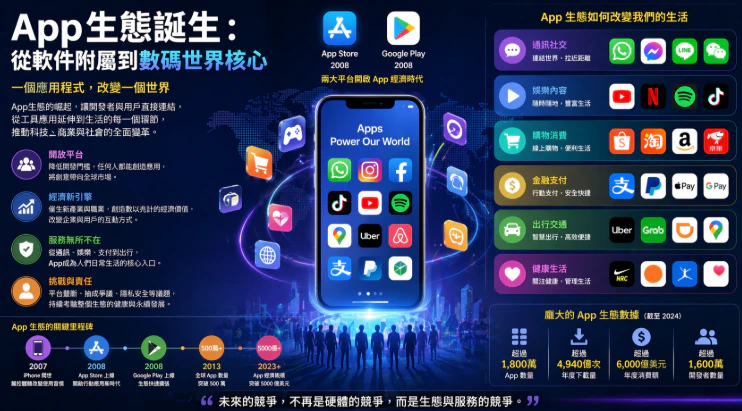
隨著iPhone與Android普及,App生態迅速崛起,從工具應用演變為主導數碼生活的核心力量,改變產業與日常。
English: As the iPhone and Android spread globally, the app ecosystem evolved from simple utilities into the central force shaping modern digital life and industries.
App生態的誕生,是智能手機真正改變世界的關鍵轉折點之一。當Apple在2008年推出App Store時,它不只是提供下載軟件的平台,而是建立了一個全新的數碼經濟模式,讓開發者與用戶之間形成直接連結。這種模式迅速被Google以Google Play複製並擴展,形成全球兩大App生態系統。過去,軟件多依附於電腦平台,更新緩慢且分發受限,而App生態則改變了這一切,任何開發者只需一台電腦與創意,就能將產品推向全球市場。這種低門檻與高擴展性,使應用程式數量爆炸式增長,從最初的工具類應用,迅速擴展至遊戲、社交、金融、娛樂與生活服務,最終構成一個完整的數碼世界。App生態的真正力量,在於它重新定義了「服務」的形式,人們不再透過單一設備完成任務,而是透過不同App組合完成生活中的每一個環節,例如通訊依賴WhatsApp,娛樂透過串流平台,購物透過電商應用,甚至日常出行也由手機App主導。這種變化使手機從工具轉變為生活入口,所有服務都被整合進掌中世界。App經濟亦催生了全新的職業與商業模式,例如獨立開發者、內容創作者與平台經濟,甚至出現以App為核心的企業,重新定義市場競爭方式。然而,隨著生態不斷擴張,問題亦隨之而來,包括平台壟斷、抽成機制爭議、隱私與數據安全問題,以及用戶對數碼世界的依賴程度日益加深。App生態同時改變了企業與用戶之間的關係,企業不再只是提供產品,而是持續透過App與用戶互動,形成長期數據與服務循環。從更宏觀角度看,App生態已成為現代經濟的重要基礎設施,影響金融、教育、醫療與娛樂等各個領域。它不僅是技術創新的結果,更是一種文化與生活方式的轉變,讓人類進入一個以「應用」為中心的時代。App生態的誕生,標誌著科技從硬體競爭轉向平台與服務競爭,而真正的價值,也從設備本身轉移到其背後的數碼生態之中。
English Version
The rise of the app ecosystem marks one of the most decisive turning points in the evolution of modern technology. When Apple launched the App Store in 2008, it did far more than create a marketplace for software—it established a new digital economy where developers and users could connect directly on a global scale. This model was rapidly expanded by Google through Google Play, forming two dominant ecosystems that would define the mobile era. Unlike traditional software distribution, which was tied to physical media or controlled channels, app platforms democratized access, allowing anyone with an idea to reach millions of users instantly. This accessibility triggered an explosion of applications, transforming software from a secondary feature into the primary driver of user experience. What began as simple utilities quickly evolved into a vast network of services spanning gaming, communication, finance, entertainment, and everyday life. The true impact of the app ecosystem lies in how it restructured daily behavior: instead of relying on a single device function, users now navigate life through a constellation of apps, each fulfilling a specific role. Communication is dominated by platforms like WhatsApp, entertainment is streamed on demand, shopping is conducted through e-commerce apps, and transportation is coordinated through mobile services. In this new paradigm, the smartphone becomes not just a device but a gateway to an interconnected digital environment. Economically, the app ecosystem gave rise to entirely new industries, including independent developers, digital creators, and platform-based businesses, reshaping how value is created and distributed. Companies are no longer defined solely by their products but by their ability to maintain ongoing relationships with users through apps, leveraging data and continuous engagement. However, this transformation also introduced complex challenges, including platform dominance, revenue-sharing controversies, data privacy concerns, and the growing dependence on digital systems. From a broader perspective, the app ecosystem has become a foundational layer of the modern economy, influencing sectors such as finance, education, healthcare, and entertainment. It represents not just a technological advancement but a cultural shift toward an application-driven world, where the true value of technology lies not in the hardware itself but in the services and experiences built upon it.