
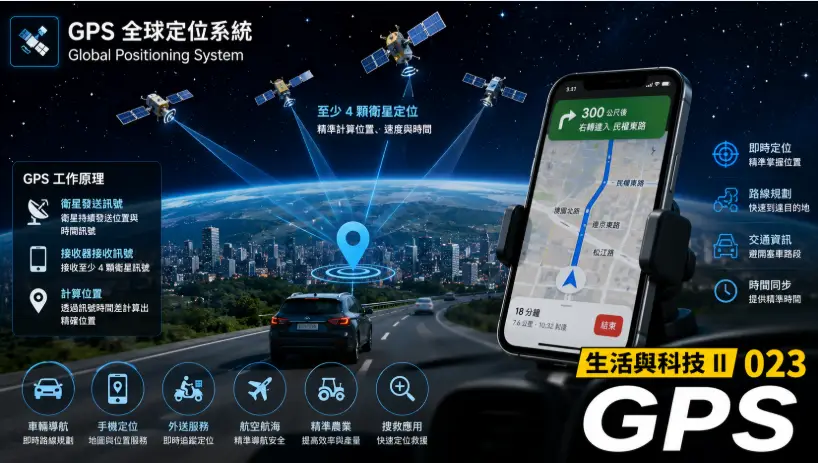

從紙本地圖到手機導航,GPS 改變了人類理解方向與移動方式。今天人們習慣即時定位與導航,但這套來自衛星的定位系統,其實是現代科技中最深刻影響日常生活的發明之一。
GPS transformed navigation from guesswork and paper maps into instant digital guidance. What once required planning, memory, and physical maps can now be done in seconds through satellites orbiting high above Earth.
中文
在智能手機尚未普及之前,人們外出時通常需要依靠紙本地圖、路牌甚至口耳相傳尋找方向。長途旅行可能需要提前研究地圖,而在陌生城市中迷路更是常見情況。直到 GPS 技術逐漸進入民間生活後,人類對「方向感」的理解開始徹底改變。GPS,全名為 Global Positioning System,即全球定位系統,是一種利用衛星進行定位與導航的技術。它最初由美國軍方於冷戰時期開發,目的是提供精準的軍事導航能力。隨著技術逐漸開放給民間使用,GPS 最終成為全球最重要的導航基礎之一。GPS 的核心原理,是透過地球上空多顆衛星不斷發送時間與位置訊號,接收器再根據訊號傳送時間計算自身位置。一般而言,只要接收到至少四顆衛星訊號,系統便能計算出精準位置。這種聽起來極為複雜的科技,今天卻已經存在於幾乎每一部智能手機之中。對現代人而言,GPS 已經變得像空氣一樣自然,甚至很少有人真正思考背後的運作原理。早期的 GPS 設備體積龐大,而且價格昂貴,多數只用於軍事、航空與專業導航領域。之後隨著電子技術進步,車用導航系統開始普及。很多人第一次接觸 GPS,便是汽車上的導航裝置。那種可以即時顯示位置與路線的感覺,在當年幾乎像科幻電影一樣。司機不再需要不停查看地圖,也能即時知道前往目的地的方法。GPS 的普及,徹底改變了人類駕駛與旅行方式。之後智能手機出現,GPS 更進一步融入日常生活。Google Maps、Apple Maps 與各種導航 App,讓即時定位變成人人皆可使用的服務。今天人們不只依靠 GPS 尋找方向,更會使用它搜尋餐廳、查看交通、叫車、運動紀錄與分享位置。外送平台、網約車與物流系統,也高度依賴 GPS 技術運作。可以說,現代城市的流動系統,很多都建立於定位技術之上。GPS 不只改變交通,也改變了人類與地圖的關係。過去地圖是一種需要閱讀與理解的技能,人們必須記憶街道與方向。但今天不少人已經逐漸依賴語音導航,即使對熟悉地區,也習慣開啟地圖應用程式。科技提升便利性的同時,也改變了人類的空間感與方向感。有人甚至認為,GPS 的普及讓人類「不再需要記路」。除了日常導航,GPS 亦廣泛應用於航空、航海、救援、農業與科學研究。飛機與船隻依靠定位系統進行航行,救援人員能快速找到事故位置,而農業機械甚至能利用 GPS 進行精準耕作。現代社會很多看不見的系統,其實都與衛星定位密切相關。GPS 甚至影響金融與通訊系統,因為部分網絡與交易需要精準時間同步,而 GPS 衛星本身便提供極高精度的時間訊號。今天除了美國 GPS 系統外,世界各地亦發展出不同衛星導航系統,例如俄羅斯的 GLONASS、歐洲的 Galileo 與中國的北斗系統。現代手機通常同時支援多種定位衛星,因此定位速度與精準度亦不斷提升。從紙本地圖到衛星導航,GPS 的出現象徵人類正式進入即時定位時代。它讓地球上的距離感逐漸縮小,也讓移動變得更安全、更快速與更有效率。科技改變的不只是交通工具,而是人類理解世界的位置方式。GPS 已經不只是導航工具,而是現代文明中最重要的無形基礎之一。
English Version
Before smartphones and digital maps became part of daily life, finding directions often depended on paper maps, road signs, local knowledge, or memory. Traveling to unfamiliar places required preparation, and getting lost was a common experience for drivers and tourists alike. The rise of GPS technology completely transformed humanity’s relationship with navigation and movement. GPS, short for Global Positioning System, is a satellite-based navigation technology that allows devices to determine precise locations almost anywhere on Earth. Originally developed by the United States military during the Cold War, GPS was designed to support military operations and precision navigation. Over time, the technology was opened to civilian use, eventually becoming one of the most important foundations of modern digital life. The basic principle behind GPS is surprisingly complex yet incredibly reliable. A network of satellites orbiting Earth continuously transmits signals containing timing and positioning information. A GPS receiver calculates its own location by measuring how long those signals take to arrive from multiple satellites. In most cases, signals from at least four satellites are needed to determine an accurate position. Although this process involves advanced mathematics and atomic clock precision, modern users experience it almost instantly through smartphones, watches, and navigation systems. Early GPS technology was expensive and mainly limited to military, aviation, and maritime industries. Over time, consumer electronics evolved and car navigation systems became increasingly common. For many people, the first experience with GPS came through in-car navigation devices that displayed moving maps and real-time directions. At the time, watching a digital map update live while driving felt futuristic, almost like science fiction. Drivers no longer needed to unfold paper maps or stop frequently for directions. GPS began changing how people traveled, explored cities, and planned journeys. The arrival of smartphones pushed GPS technology into everyday life on a massive scale. Applications such as Google Maps and Apple Maps transformed navigation into something available to nearly everyone. GPS quickly became more than a tool for driving directions. People started using it for restaurant searches, public transportation, ride-hailing services, exercise tracking, delivery systems, and social location sharing. Modern transportation networks, food delivery services, and logistics industries now depend heavily on accurate real-time positioning systems. GPS also changed humanity’s relationship with maps themselves. In the past, reading a map required spatial awareness and route planning skills. Today, many people rely entirely on turn-by-turn voice navigation, even in familiar areas. Technology made navigation more convenient, but it also reduced the need to memorize roads or develop traditional directional instincts. Some researchers and psychologists have suggested that heavy GPS usage may even alter how humans develop spatial memory and orientation skills. Beyond daily navigation, GPS plays a critical role in aviation, shipping, agriculture, scientific research, rescue operations, and emergency services. Aircraft and ships rely heavily on satellite navigation systems for safe operation. Rescue teams use GPS coordinates to locate people quickly during emergencies. Modern farming equipment can even perform highly precise automated planting and harvesting using GPS guidance. Many invisible systems that support modern society depend on accurate satellite positioning and timing information. GPS satellites themselves also provide extremely precise time synchronization, which is essential for telecommunications, financial systems, internet infrastructure, and global digital networks. Today, GPS is no longer the only global satellite navigation system. Other regions developed their own networks, including Russia’s GLONASS, Europe’s Galileo system, and China’s BeiDou navigation network. Modern smartphones often combine signals from multiple systems simultaneously, improving both accuracy and reliability. From folded paper maps to instant smartphone navigation, GPS represents one of the most significant technological transformations of the modern world. It reduced uncertainty in travel, increased efficiency in transportation, and reshaped how humans interact with physical space itself. GPS is no longer simply a navigation tool. It has become one of the invisible technological foundations supporting modern civilization.
總結
GPS 讓人類從紙本地圖時代進入即時定位年代。它不只提升導航便利性,更重新改變人類與空間、交通與城市之間的關係,成為現代生活不可或缺的重要科技。
Conclusion
GPS transformed navigation into an instant digital experience and became essential to transportation, communication, and modern infrastructure. More than a navigation system, it reshaped how humanity moves, travels, and understands the world around it.