
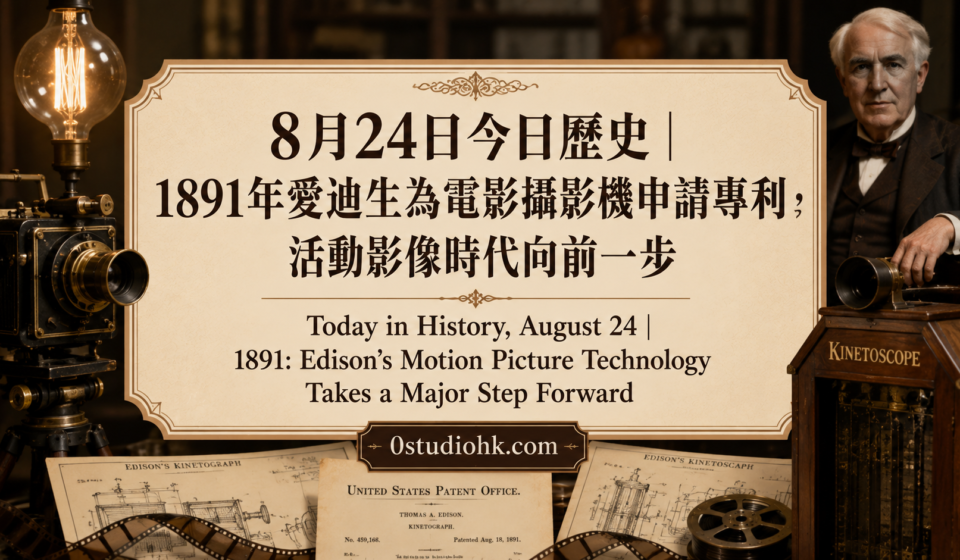
8月24日今日歷史|1891年愛迪生為電影攝影機申請專利,活動影像時代向前一步 | Today in History, August 24 | 1891: Edison’s Motion Picture Technology Takes a Major Step Forward
1891年8月24日,托馬斯・愛迪生及其團隊為活動影像攝影與觀看裝置提交專利申請,為早期電影技術發展留下重要一頁。當時的影像還不能像今天一樣在手機上即時拍攝和播放,但連續拍攝靜態畫面,再以高速方式觀看,已經開始讓人類真正接近「活動影像」的概念。
On August 24, 1891, Thomas Edison and his team filed patent applications connected with early motion-picture technology. The machines were very different from today’s cameras and screens, but they introduced an important idea: a rapid sequence of photographs could create the visual impression of movement. This early experiment helped lay part of the technological foundation for the modern moving-image industry.
中文版本
1891年8月24日,是電影科技發展史上一個值得記住的日子。這一天,托馬斯・愛迪生及其團隊為一套與活動影像有關的技術提交專利申請,其中包括後來被稱為Kinetograph的電影攝影機,以及Kinetoscope活動影像觀看裝置。 今天我們習慣用手機拍片、即時播放影片、剪接短片,再透過網絡傳到世界各地,但在十九世紀末,能夠把「動作」記錄下來並重新觀看,仍然是一個非常新鮮的科技概念。當時的攝影技術主要仍然以靜態照片為主。一張照片可以記錄一個人在某一瞬間的姿勢、一座建築物的外貌,或者一個風景的樣子,但如果希望把一連串動作完整保存下來,就需要解決另一個問題:如何在很短時間內連續記錄大量畫面,再讓人眼睛快速觀看,使原本分開的照片看起來像真正動起來。愛迪生的活動影像研究正是在這樣的背景下發展。Kinetograph的基本概念,是利用攝影技術快速記錄連續畫面,而Kinetoscope則讓觀看者透過裝置觀看這些連續影像。美國國會圖書館指出,相關專利申請於1891年8月24日提交,而這些技術後來成為愛迪生電影實驗的重要部分。 當然,1891年的裝置與今天的電影攝影機完全不同。它不是輕巧的數碼相機,也沒有高清螢幕,更沒有手機可以使用的即時預覽功能。當時使用的是感光膠片以及機械式結構,需要讓膠片以穩定速度移動,同時在正確時間完成曝光。這些看似簡單的動作,其實涉及攝影、機械工程、光學以及影像觀看等多方面技術。愛迪生團隊需要思考的不只是「如何拍攝」,還包括「如何讓人看到連續的畫面」。如果照片播放速度太慢,觀看者只會看到一張又一張靜止照片;如果速度足夠快,人眼的視覺暫留便會令連續畫面產生動態效果。這個原理成為早期活動影像技術的重要基礎。 Kinetoscope的設計尤其有意思。它並不是今天大家熟悉的電影院大銀幕,而是一個較大型的觀看裝置,觀看者需要靠近機器,從上方的觀看位置觀看裡面的影像。根據美國國會圖書館介紹,早期裝置內部使用一條連續的膠片,膠片經過一系列滾輪和機械結構移動,配合光源及快門,讓觀看者看到快速連續的畫面。 這種觀看方式與今天完全不同,但它已經抓住電影最核心的一個概念:把時間切割成許多影像,再重新組合成連續的視覺經驗。這是一個非常重要的轉變。人類過去可以畫畫、可以拍照、可以觀看戲劇,但活動影像把「時間」本身也保存下來。人物不再只是停留在一張照片中,而是可以行走、轉身、揮手,甚至完成一個完整動作。這意味着攝影不再只是記錄「某一刻」,而開始具備記錄「一段時間」的能力。1891年的這項專利申請,因此不只是某一部機器的技術文件,也反映了人類影像觀念正在發生變化。後來,電影技術不斷發展,攝影機變得更加實用,膠片格式逐漸標準化,放映方式也從個人觀看逐步走向公共放映。1893年,Kinetoscope曾在布魯克林藝術與科學研究院進行公開示範,讓更多人第一次接觸這種全新的活動影像觀看方式。 從今天回看,這些早期設備可能顯得笨重而且操作複雜,但它們代表了一個非常重要的開始。電影後來成為全球最具影響力的文化產業之一,紀錄片、新聞片、動畫、電視、音樂影片、廣告以及今天的網絡短片,都可以追溯到人類逐步掌握活動影像技術的歷史。更有趣的是,今天我們已經很少思考「影片為甚麼會動」。我們拿起手機,按下錄影鍵,就可以得到一段活動影像;打開社交平台,就可以連續觀看數十段短片;網站、串流平台和社交媒體更可以讓影像在幾秒鐘內跨越國界。對我們而言,影片已經成為日常生活的一部分。但如果回到1891年,人類仍然正在研究如何把一連串照片變成可以觀看的活動影像。這種差距正好說明科技發展的速度有多驚人。從機械膠片到數碼感光元件,再到今天由人工智能協助生成、修復和剪輯影片,人類一直在尋找更容易記錄、製作及分享影像的方法。愛迪生的早期活動影像研究並不是電影歷史中唯一的發展來源,電影科技其實是許多發明家、攝影師、工程師及企業長期研究的結果。不過,1891年8月24日的專利申請仍然是一個非常適合回望的歷史節點,因為它清楚展示了人類如何嘗試把靜態攝影推向活動影像。 今天我們再看電影、YouTube、短片或者手機影片時,可以想像一百多年前的人們第一次看到活動影像時的驚訝。畫面可能只有很短的時間,設備可能非常笨重,觀看方式也相當原始,但那一刻代表影像不再只是「一張照片」。它開始可以擁有時間、動作和連續性。8月24日因此不只是愛迪生提交專利文件的一天,也可以看成活動影像技術向前邁進的一個歷史節點。從一台需要膠片、機械齒輪和光源運作的早期裝置,到今天人人都可以用手機拍攝4K影片,影像科技已經徹底改變我們記錄生活和分享故事的方式。而我們每天觀看的每一段影片,都延續着一百多年前人類開始探索「如何讓照片動起來」的那條科技道路。
English Version
August 24, 1891, marks an important date in the early development of motion-picture technology. On that day, Thomas Edison and his team filed patent applications connected with devices designed to record and display moving images. The technology was still at an experimental stage, and the machines were very different from the cameras and screens used today, but the basic idea was revolutionary: a sequence of still photographs could be recorded and viewed rapidly enough to create the impression of continuous movement. Photography in the nineteenth century was already capable of preserving individual moments, but recording movement presented a much greater technical challenge. A single photograph could capture a person standing still or a landscape at a particular instant. To show someone walking, turning or performing an action, however, a camera needed to capture many images in rapid succession. Those images then had to be presented in the correct order and at sufficient speed for the viewer to perceive movement rather than a collection of separate photographs. This was one of the fundamental problems that early motion-picture inventors attempted to solve. Edison’s work became associated with two important devices: the Kinetograph, a motion-picture camera, and the Kinetoscope, a machine designed for viewing moving images. The Library of Congress records that the relevant patent applications were filed on August 24, 1891. The technology behind these machines depended on photography, film and mechanical movement. Unlike modern digital cameras, the early system required physical film to move through the camera and viewing apparatus. Exposure had to be carefully controlled, and the film needed to move at a consistent rate. The system therefore combined several different fields of technology, including optics, photography, mechanical engineering and lighting. The Kinetoscope was particularly different from the modern idea of cinema. Instead of a large screen showing a film to a room full of people, the early machine was designed for individual viewing. A person would look through a viewing opening and see the images moving inside the cabinet. The Library of Congress describes a system in which film travelled continuously through the machine, while a light source and shutter created the rapidly changing images seen by the viewer. Although the experience was primitive compared with modern cinema, the underlying concept was already remarkably familiar. A series of individual images could be transformed into an experience of movement. This was an important change in the history of visual communication because photography was beginning to record not only a moment, but a sequence of moments. In other words, images could now represent the passage of time. The development of motion pictures was not the achievement of one person alone. Many inventors, photographers, engineers and researchers contributed to the technologies that eventually became cinema. Edison’s work formed part of a much wider international development in photography and moving-image technology. Nevertheless, the August 24, 1891 patent applications provide a useful historical marker because they show how seriously engineers were beginning to approach the challenge of recording and reproducing motion. The technology continued to develop rapidly after this period. The Kinetoscope was apparently completed around 1892, and its first public demonstration took place at the Brooklyn Institute of Arts and Sciences on May 9, 1893. These early demonstrations helped introduce audiences to an entirely new type of visual entertainment. People were no longer simply looking at a photograph. They could watch an image change over time. That difference may seem obvious today, but in the late nineteenth century it represented a major technological and cultural shift. Eventually, moving pictures developed beyond individual viewing machines. Film cameras became more practical, projection technology improved, and audiences began watching films together on large screens. The cinema industry grew into a global form of entertainment and communication. Motion pictures later became important not only for entertainment but also for education, journalism, advertising, documentary production and cultural preservation. The basic idea of recording a sequence of images remains at the heart of all these forms. Today, the distance between early motion-picture technology and modern video is enormous. A smartphone can record high-resolution video instantly, store hours of footage digitally and send the result around the world within seconds. Modern cameras can capture images in conditions that would have been extremely difficult for nineteenth-century inventors. Editing software can cut, rearrange and enhance footage almost immediately, while online platforms allow millions of people to publish their own videos without owning a traditional film studio. Yet the basic principle remains surprisingly familiar. A moving image is still created from a sequence of visual information presented rapidly enough for us to perceive continuous action. What has changed is the speed, quality, convenience and accessibility of the technology. This makes August 24, 1891, an interesting date to remember. The patent applications connected with Edison’s early motion-picture system belonged to a period when inventors were beginning to transform photography into something capable of representing movement. More than a century later, moving images are everywhere. We watch films at home, follow short videos on social media, record family moments with smartphones and use video to communicate across continents. Many people create videos every day without thinking about the complicated mechanical problems that early inventors had to solve. The technology has become so convenient that motion pictures now feel like a natural part of everyday life. Looking back at 1891 reminds us that this convenience was not always possible. Someone had to discover how to capture successive images, move film accurately, control exposure, provide enough light and create a viewing system that could turn separate photographs into an apparent moving scene. Early machines may look large, slow and impractical by modern standards, but they represent the beginning of a technological journey that eventually transformed global culture. From mechanical film systems to digital cameras, smartphones and artificial-intelligence-assisted video production, the history of moving images is a story of continuous experimentation. August 24, 1891, belongs to that story as a moment when motion-picture technology took another significant step forward. It reminds us that the videos we now create in seconds are built on more than a century of ideas, inventions and engineering. The next time we watch a movie, a documentary or a short online video, it is worth remembering that the ability to make photographs appear to move was once a remarkable new technology. What began with machines, film and mechanical precision eventually became one of the most familiar forms of communication in modern life.
總結
1891年8月24日,愛迪生團隊為活動影像攝影及觀看技術提交專利申請,成為早期電影科技發展的重要一步,也為後來的影像世界留下歷史足跡。
On August 24, 1891, Edison’s motion-picture technology took an important step toward turning still photographs into moving images, helping shape the visual world that surrounds us today.