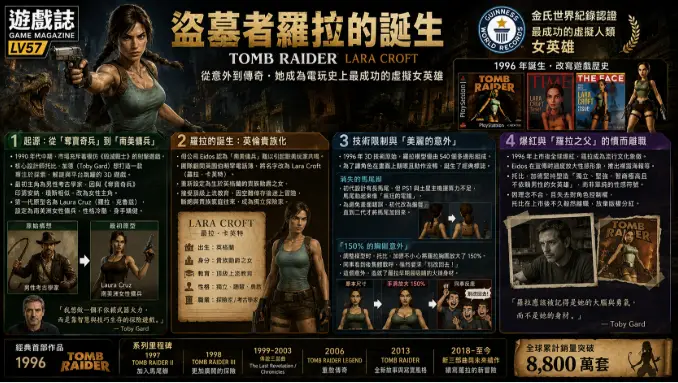
遊戲誌 LV57|盜墓者羅拉的誕生:一位遊戲女英雄如何改變電玩歷史|Game Magazine LV57 | The Birth of Lara Croft: How a Gaming Icon Changed Video Game History
1996年,《盜墓者羅拉》(Tomb Raider,台灣譯作《古墓奇兵》)正式登場。憑藉創新的3D冒險玩法與魅力十足的女主角羅拉·卡芙特,作品迅速風靡全球,不僅開創動作冒險遊戲的新時代,更塑造出電玩史上最具代表性的女性角色之一。
When Tomb Raider debuted in 1996, it introduced more than an exciting adventure—it created one of gaming’s greatest cultural icons. Lara Croft became a symbol of confidence, intelligence, and exploration, helping redefine both action-adventure games and the role of female protagonists in the industry.
中文
1990年代中期,3D遊戲開始迅速發展,市場上充斥著大量以射擊為主題的作品。來自英國Core Design的設計師托比·加德(Toby Gard)希望打造一款以探索古代遺跡、解謎與平台跳躍為核心的3D動作冒險遊戲,而不是單純依靠槍戰吸引玩家。最初,主角原本設定為一位手持長鞭、戴著帽子的男性考古學家,但由於形象與電影《奪寶奇兵》的印第安納·瓊斯過於相似,團隊決定重新設計角色,最終將主角改為女性,為遊戲開創全新的方向。羅拉最初的名字並不是Lara Croft,而是Laura Cruz,設定為一位來自南美洲、身手敏捷且個性冷靜的冒險家。隨著發行商Eidos Interactive加入開發,他們認為角色若擁有英國背景,更容易吸引歐美市場,因此重新塑造角色形象。據開發團隊回憶,他們翻閱英國電話簿尋找具有代表性的英國姓氏,最後確定「Lara Croft」這個名字。角色背景亦改為出身英國貴族家庭,自幼接受良好教育,一次空難意外改變了她的人生,使她放棄舒適生活,走上探索世界古文明的冒險旅程。1996年的3D硬體仍十分有限,初代羅拉的人物模型僅由約540個多邊形構成,因此不少設計都受到技術限制。原本托比·加德希望替羅拉加入招牌長馬尾,但當時PlayStation與Sega Saturn的運算能力難以流暢模擬頭髮物理效果,因此初代作品只能改用較短的髮型,直到續作《Tomb Raider II》才加入玩家熟悉的長馬尾。另一段廣為流傳的開發趣聞,是托比·加德在調整角色模型時,曾因操作失誤令角色胸部比例意外放大。雖然事件細節多年來眾說紛紜,但這次設計最終保留下來,亦令羅拉早期形象成為90年代最具辨識度的遊戲角色之一。不過,托比·加德一直強調,他希望塑造的是一位勇敢、獨立、聰明且能力出眾的女性探險家,而不是依靠性感形象吸引玩家。1996年《Tomb Raider》上市後迅速取得全球成功,除了遊戲銷量屢創佳績外,羅拉更登上《Time》及英國時尚雜誌《The Face》等媒體封面,成為90年代最具代表性的流行文化符號之一,甚至獲得《Guinness World Records》認證為最成功的電子遊戲女英雄。然而,隨著角色人氣持續攀升,發行商Eidos大量利用羅拉的性感形象進行市場宣傳,包括真人模特兒活動、雜誌拍攝及各種商業授權,逐漸偏離托比·加德最初對角色的創作理念。由於無法認同角色過度商業化與性感化的方向,加上失去對角色創作的主導權,托比·加德最終於1997年離開Core Design,放棄繼續參與《Tomb Raider》系列的發展。雖然多年後他曾短暫回歸協助新作開發,但羅拉早已從一位遊戲角色,成長為全球娛樂文化的重要象徵。其後,《Tomb Raider》系列歷經多次重啟與改革,由Core Design轉交Crystal Dynamics接手,逐步從早期強調平台跳躍與古墓探索,演變成融合電影敘事、生存元素與動作冒險的現代作品。無論遊戲技術如何進步,羅拉·卡芙特始終代表著勇氣、智慧與探索未知世界的精神,也證明一位成功的角色,不只是遊戲中的主角,更能跨越時代,成為全球玩家共同的文化記憶。
English Version
The creation of Lara Croft is one of the most fascinating stories in video game history. During the mid-1990s, as developers rushed to create action games inspired by the growing popularity of first-person shooters, British studio Core Design pursued a different vision. Lead designer Toby Gard imagined a three-dimensional adventure centered on ancient ruins, puzzles, platforming, and exploration rather than endless gunfights. His earliest concept featured a male archaeologist whose appearance closely resembled Indiana Jones. Concerned that the similarities were too obvious, the team abandoned the idea and began experimenting with a female protagonist instead. The earliest version of the character was named Laura Cruz, envisioned as a skilled South American adventurer. When publisher Eidos Interactive became involved, the company believed a British heroine would have broader international appeal. After searching through British names, the development team eventually chose Lara Croft, while rewriting her background as the daughter of an aristocratic English family whose life changed forever after surviving a plane crash. Rejecting the comforts of high society, Lara devoted herself to exploring forgotten civilizations and uncovering ancient mysteries. Hardware limitations strongly influenced her appearance. The original PlayStation and Sega Saturn could display only around 540 polygons for Lara’s character model, forcing designers to simplify many visual ideas. Toby Gard originally wanted Lara to wear a long ponytail, but contemporary hardware could not animate realistic hair movement smoothly, so the first game featured a shorter hairstyle before the iconic ponytail appeared in Tomb Raider II. Another famous story concerns Lara’s proportions. According to long-standing development anecdotes, an accidental adjustment enlarged parts of the character model during production. While the exact details have become part of gaming folklore and have been debated over the years, the final design remained unchanged and contributed to Lara becoming one of the most recognizable digital characters of the 1990s. Gard consistently maintained that his true goal was to create an intelligent, fearless, and independent heroine rather than a character defined by appearance alone. Tomb Raider became an international sensation following its 1996 release. Beyond its commercial success, Lara Croft appeared on the covers of magazines including Time and The Face, became a symbol of British popular culture, and was later recognized by Guinness World Records as the world’s most successful female video game character. As her popularity grew, Eidos increasingly emphasized glamorous marketing campaigns, promotional models, and commercial branding. Gard became uncomfortable with this direction, believing it conflicted with his original vision of Lara as a capable adventurer. Unable to influence the franchise’s future, he left Core Design in 1997 despite the enormous success of the series. Although he later returned briefly to contribute to newer Tomb Raider projects, Lara Croft had already evolved into a worldwide entertainment icon. Today, the franchise has passed from Core Design to Crystal Dynamics and has been successfully reinvented for modern audiences, combining cinematic storytelling, survival mechanics, and large-scale exploration. Yet despite decades of technological progress, Lara Croft continues to represent courage, intelligence, curiosity, and the spirit of adventure, securing her place as one of the most influential characters ever created in interactive entertainment.