
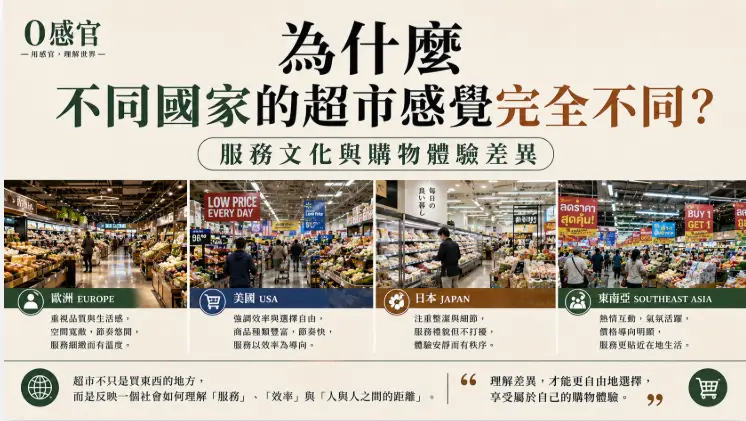
為什麼不同國家的超市感覺完全不同?|服務文化與購物體驗差異 | Why Supermarkets Feel Different Across Countries: Service Culture and Shopping Experience | 0感官
走進不同國家的超市,你會感覺完全不一樣。有些地方安靜、有些地方熱鬧,有些讓你慢慢選擇,有些讓你快速完成。這些差異,其實來自不同文化對「服務」的理解。
Supermarkets may look similar around the world, yet the experience inside can feel entirely different. These differences are shaped by how each culture understands service, space, and the role of the customer.
中文
當你走進不同國家的超市,第一個感覺往往不是商品,而是氣氛。有些地方很安靜,沒有人打擾,你可以慢慢走、慢慢看,甚至幾乎感覺不到服務的存在;有些地方則相反,節奏明顯更快,動線緊湊,人與人之間的距離也更近,整個過程像是在完成一個任務。這些差異,並不是設計上的偶然,而是來自不同文化對「人應該被怎樣對待」的理解。在一些地方,服務代表細緻與尊重,員工會主動提供協助,語氣與動作都有一套標準,讓顧客感受到被重視;在另一些地方,服務則意味著效率,最重要的是快速與準確,減少不必要的互動,讓顧客能夠在最短時間內完成購物;還有一些地方,服務被理解為一種距離感,員工存在,但不主動介入,讓顧客保有完整的選擇空間。這三種看似不同的方式,其實並沒有絕對的好壞,而是對應不同的生活節奏與社會習慣。在節奏較快的城市,人們習慣快速做決定,服務自然偏向簡潔直接;在重視禮儀的文化中,細節與態度變得重要,服務也會更加完整;而在強調個人空間的環境裡,過多的接觸反而會被視為壓力,因此服務會傾向保持距離。當我們習慣了其中一種方式,再接觸另一種,就會產生落差,例如習慣安靜購物的人,可能會覺得過多的推介是一種干擾,而習慣被照顧的人,則可能會覺得過於冷淡是一種缺乏服務。這種不適,其實並不是因為哪一種方式不好,而是因為我們帶著自己的期待進入不同的環境。超市在這裡變成一個很有趣的地方,它不只是販售商品,也在反映一個社會如何看待顧客與服務之間的關係。有些地方認為顧客需要被引導,有些認為顧客應該被尊重選擇,也有些認為顧客希望被有效率地處理。當這些觀點轉化成空間與行為,就形成了我們所感受到的差異。也許當我們開始理解這些背後的原因,就不會再用單一標準去評價不同地方的服務,而是會發現,每一種方式,其實都在回應當地人的生活方式。當你下一次走進一間陌生的超市,也許可以試著留意,不只是它賣什麼,而是它讓你怎樣被對待,而那種被對待的方式,往往比商品本身,更能反映一個地方的文化。
English Version
Walking into a supermarket in a different country often reveals something unexpected—the atmosphere feels different before you even notice the products. In some places, the environment is calm and quiet, allowing you to move at your own pace with minimal interaction. In others, the space feels more dynamic, with a faster rhythm and a stronger sense of urgency, as if the entire experience is designed for efficiency. These differences are not random design choices; they reflect how each culture defines the relationship between service and the customer. In certain societies, service is closely tied to attentiveness and formality, where staff play an active role in guiding and assisting, ensuring that customers feel acknowledged and respected. In contrast, other environments prioritize speed and practicality, where the goal is to minimize friction and complete transactions quickly, reducing unnecessary interaction. There are also places where service is expressed through distance, where the presence of staff is subtle, and the emphasis is placed on allowing individuals to navigate the space independently. None of these approaches are inherently better than the others; they simply respond to different expectations shaped by lifestyle, social norms, and cultural values. In fast-paced urban settings, efficiency becomes essential, and service adapts accordingly. In cultures that emphasize politeness and structure, the quality of interaction becomes a central part of the experience. In environments that value personal space, excessive engagement may feel intrusive rather than helpful. When individuals encounter a system that differs from what they are accustomed to, the contrast becomes more noticeable. What feels comfortable in one context may feel overwhelming or insufficient in another. This reaction is not a reflection of the system itself, but of the expectations we bring with us. The supermarket, in this sense, becomes more than a place of consumption; it becomes a lens through which we can observe how societies interpret care, efficiency, and autonomy. Some systems assume that customers need guidance, others assume they need freedom, and some focus on delivering results as quickly as possible. These assumptions shape the entire experience, from layout to interaction. Understanding this allows us to move beyond simple judgments and see each approach as a response to a specific way of living. The next time you find yourself in an unfamiliar supermarket, it may be worth observing not just what is being sold, but how you are being treated. That subtle difference often reveals more about a place than the products on its shelves.