
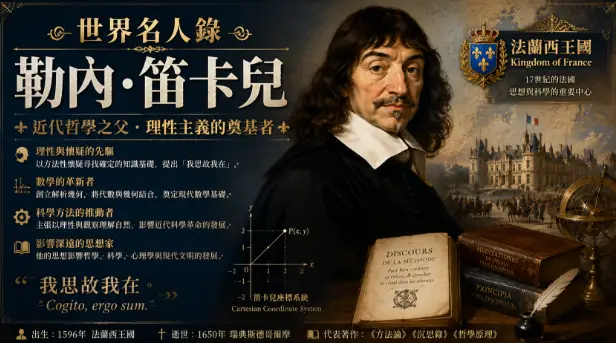
勒內·笛卡兒(René Descartes)與法蘭西王國:近代哲學之父如何改變世界思想 | René Descartes and the Kingdom of France: The Philosopher Who Reshaped Modern Thought | 世界名人錄
勒內·笛卡兒被譽為「近代哲學之父」,他以理性與懷疑精神重新建立人類思考方式,從哲學、數學到科學方法,都深深影響了後世文明發展,也讓法蘭西王國成為歐洲思想革命的重要中心。
René Descartes transformed the intellectual world by placing reason at the center of human understanding. His philosophical ideas, mathematical discoveries, and scientific methods laid the foundation for modern Western thought and helped shape the intellectual legacy of seventeenth-century France.
中文版本
勒內·笛卡兒出生於1596年的法蘭西王國圖賴訥地區,自幼身體虛弱,因此經常長時間獨處閱讀與思考。這種安靜而沉思的生活習慣,逐漸培養出他對知識與真理的強烈追求。年輕時的笛卡兒進入耶穌會名校拉弗萊什學院學習,在校期間接觸古典哲學、神學、數學與自然科學,但他對當時歐洲學界普遍依賴傳統權威的做法感到不滿。他認為許多知識建立在未經證實的假設之上,因此開始思考,是否存在一種真正可靠且不容懷疑的方法,可以讓人類重新建立完整的知識體系。成年後的笛卡兒曾加入軍隊,並遊歷歐洲各地。在長期旅行與觀察中,他逐漸形成自己的哲學思想。1619年的某個冬夜,他在德意志地區經歷一連串著名夢境,後來他認為這些夢象徵上天指引自己建立全新的知識方法。從此之後,他決心以理性為核心,重新整理人類對世界的理解。笛卡兒最重要的思想之一,就是「方法性懷疑」。他主張,人們應該先懷疑所有可能錯誤的事物,包括感官經驗、傳統知識甚至數學推理,直到找到絕對無法懷疑的真理。經過層層懷疑後,他提出了哲學史上最著名的一句話:「我思故我在」。這句話代表,只要一個人仍然能夠思考,就證明自己的存在無法被否定。這個觀念不僅改變了哲學方向,也開啟了近代主體思想與理性主義時代。1637年,笛卡兒出版《方法論》,正式提出自己對知識、理性與科學方法的看法。書中強調,人類應透過清晰、理性的分析逐步接近真理,而不是單純依賴古代權威。這本書迅速在歐洲知識界引起巨大影響,也成為近代哲學的重要起點。除了哲學之外,笛卡兒在數學上的成就同樣深遠。他創立了解析幾何,首次將代數與幾何結合,利用座標系統描述空間中的圖形與位置。今日人們熟悉的「笛卡兒座標系統」,正是以他的名字命名。這項發明後來成為微積分、工程學與現代物理學的重要基礎,也徹底改變數學發展方向。在自然科學方面,笛卡兒相信宇宙能以數學與機械原理解釋。他認為自然界像巨大機械般運作,所有現象皆可透過理性分析理解。這種機械論思想對近代科學革命產生巨大影響,並推動歐洲逐漸脫離中世紀神秘主義。雖然笛卡兒極度重視理性,但他同時也是虔誠信仰者。他試圖透過哲學證明上帝存在,並認為上帝賦予人類理性能力,使人們能夠認識真理。然而,他部分思想仍引起宗教界疑慮,尤其在當時宗教與科學衝突激烈的歐洲環境中,他不得不保持低調,甚至長期居住於思想較自由的荷蘭。晚年的笛卡兒接受瑞典女王克莉絲汀娜邀請,前往斯德哥爾摩教授哲學。然而北歐寒冷氣候與清晨授課習慣讓健康本就不佳的他迅速病倒。1650年,笛卡兒在瑞典因肺炎去世,享年53歲。雖然生命不算長久,但他的思想卻深刻改變了世界。後世哲學家幾乎都必須回應笛卡兒提出的問題,包括理性、意識、存在與知識來源等核心議題。從啟蒙運動到現代科學方法,笛卡兒的影響幾乎遍及整個西方文明。今日,他被視為近代哲學與理性主義最重要的奠基者之一。「我思故我在」也成為世界思想史上最具代表性的名言之一。即使數百年後,人類仍持續在哲學、科學與人工智慧等領域思考笛卡兒留下的問題,而他的理性精神也持續影響現代社會對知識與真理的追尋。
English Version
René Descartes was born in 1596 in the Kingdom of France during a period of political change and intellectual transformation across Europe. From childhood, he was known for his fragile health and reflective personality, often spending long hours reading and thinking in solitude. These early habits shaped his lifelong fascination with certainty, logic, and the search for truth. He later attended the Jesuit college of La Flèche, one of the most respected schools in France, where he studied philosophy, theology, mathematics, and classical sciences. Although he excelled academically, Descartes became dissatisfied with the educational traditions of his time. He believed that much of human knowledge relied too heavily on ancient authorities rather than careful reasoning and evidence. This dissatisfaction inspired him to search for a new intellectual foundation based entirely on rational thought. In early adulthood, Descartes traveled widely across Europe and briefly served in military campaigns. During these journeys, he encountered different cultures, scientific ideas, and political systems, experiences that broadened his perspective on human knowledge. In 1619, while staying in Germany, he reportedly experienced a series of vivid dreams that convinced him he had discovered a universal method for understanding reality. From that moment forward, he dedicated himself to building a philosophical system grounded in reason. One of Descartes’ most revolutionary contributions was the idea of methodological doubt. Instead of accepting inherited beliefs, he argued that people should question everything that could possibly be false, including sensory perception, traditional teachings, and even mathematical assumptions. Through this process of radical skepticism, he searched for one truth that could not be denied. His conclusion became one of the most famous statements in intellectual history: “Cogito, ergo sum,” or “I think, therefore I am.” Descartes argued that the very act of thinking proved the existence of the self. This idea transformed philosophy by placing human consciousness at the center of inquiry and became the starting point for modern rationalism. In 1637, Descartes published “Discourse on the Method,” a groundbreaking work that outlined his approach to reason and scientific investigation. The book encouraged readers to rely on clear logic and systematic analysis instead of unquestioned tradition. It quickly gained attention throughout Europe and helped shape the intellectual movement that later became the Enlightenment. Beyond philosophy, Descartes made extraordinary contributions to mathematics. He developed analytic geometry, a system that united algebra and geometry through the use of coordinates. The Cartesian coordinate system, named after him, allowed mathematicians to represent geometric shapes through numerical equations. This innovation became one of the foundations of calculus, physics, engineering, and modern computer science. Descartes also contributed to the scientific revolution by promoting a mechanical understanding of nature. He believed the universe operated according to mathematical laws and could be explained through rational principles rather than mystical forces. His mechanistic worldview influenced generations of scientists and philosophers who sought to explain natural phenomena through observation and logic. Despite his commitment to reason, Descartes remained deeply interested in religion and theology. He attempted to reconcile faith with rational inquiry, arguing that God granted humans the capacity for clear and rational understanding. Nevertheless, some religious authorities viewed his ideas with suspicion, especially during an era of tension between scientific discovery and church doctrine. To avoid controversy, Descartes spent much of his later life living in the Dutch Republic, where intellectual freedom was more widely tolerated. Near the end of his life, Queen Christina of Sweden invited him to Stockholm to teach philosophy at the royal court. The harsh northern climate and demanding early-morning lessons weakened his already fragile health. In 1650, Descartes died of pneumonia at the age of fifty-three. Although his life was relatively short, his influence on world history became enormous. Modern philosophy, mathematics, and scientific reasoning all carry the mark of his ideas. Later thinkers such as Spinoza, Leibniz, Kant, and countless Enlightenment philosophers were shaped by the questions Descartes introduced about existence, knowledge, and consciousness. Today, he is widely regarded as the father of modern philosophy and one of the central architects of rational thought. His emphasis on logic, self-awareness, and systematic inquiry continues to influence science, technology, psychology, and even debates surrounding artificial intelligence. More than three centuries after his death, René Descartes remains one of the most important intellectual figures in the history of Western civilization.