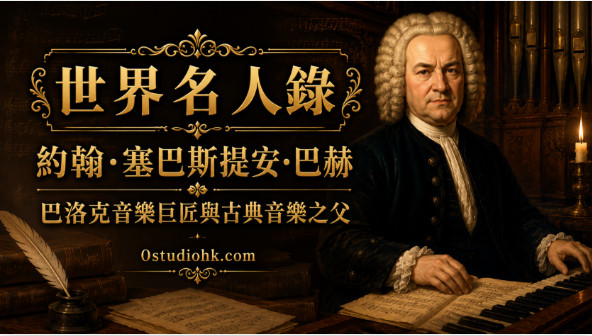
約翰·塞巴斯提安·巴赫|巴洛克音樂巨匠與古典音樂之父 Johann Sebastian Bach | Baroque Master and Pillar of Western Classical Music
約翰·塞巴斯提安·巴赫是巴洛克音樂最重要的代表人物之一,以精湛複調技巧創作大量宗教及器樂作品,後世重新發掘其價值後,更成為西方音樂史的核心人物。
Johann Sebastian Bach brought extraordinary depth and precision to Baroque music. Though his reputation faded after his death, later generations rediscovered his masterpieces and recognized his lasting importance to Western musical history.
中文版本
約翰·塞巴斯提安·巴赫(Johann Sebastian Bach)於1685年3月31日出生於神聖羅馬帝國薩克森-艾森納赫的愛森納赫,來自一個延續數代的音樂世家。巴赫家族在圖林根地區擁有深厚的音樂傳統,從教堂管風琴師、宮廷樂師到作曲家,家族中有大量成員以音樂為業,這個環境為巴赫日後成為偉大音樂家奠定了基礎。巴赫年幼時便接受音樂教育,但他的童年並不平順,父母早逝後,他由長兄照顧,生活並不富裕。十五歲時,他前往呂訥堡求學並開始逐步建立自己的音樂道路。年輕時的巴赫已經展現出非凡的管風琴演奏能力,同時不斷研究前人的樂譜與作曲方法。他並不是只依靠天賦創作,而是透過長期閱讀、抄寫、模仿及研究不同作曲家的作品,不斷磨練自己的音樂語言。1703年至1708年間,他先後在阿恩施塔特及米爾豪森擔任管風琴師,之後進入威瑪宮廷工作,並逐漸建立作曲家及管風琴演奏家的聲譽。1717年,他前往克滕擔任宮廷樂長,這段時期的創作環境相對適合器樂作品發展,因此留下大量重要作品。1723年,巴赫來到萊比錫,出任聖多馬教堂音樂總監,直到1750年逝世為止。萊比錫時期是他創作生涯最重要的階段之一,他需要負責教堂音樂、合唱團訓練及音樂教育,同時創作大量宗教作品。在長期創作中,巴赫幾乎涉獵當時主要音樂類型,除了歌劇之外,清唱劇、受難曲、神劇、經文歌、彌撒曲、聖詠、管風琴曲、鍵盤作品、室內樂、組曲及協奏曲等,都留下重要作品。他最令人稱道的地方,是對複調音樂及對位技巧的高度掌握。多條旋律可以同時進行,各個聲部既保持獨立,又能在整體結構中彼此呼應,形成非常複雜而精密的音樂世界。《平均律鋼琴曲集》、《布蘭登堡協奏曲》、《哥德堡變奏曲》、《馬太受難曲》、《無伴奏大提琴組曲》、《無伴奏小提琴奏鳴曲與組曲》、《聖誕神劇》、《賦格的藝術》及《b小調彌撒》等作品,至今仍是世界音樂舞台上的重要經典。巴赫的音樂並不是單純追求技巧上的複雜,他同時把德國、意大利及法國等不同音樂傳統融入自己的創作,將宗教精神、數學般的結構與豐富的情感結合起來,使作品既嚴謹又具有深厚感染力。然而,巴赫生前的聲譽與今日並不相同。他在當時主要以管風琴演奏家、教師及教堂音樂家聞名,雖然受到專業人士尊重,但他的作品並沒有在身後立即成為歐洲音樂的中心。十八世紀後期,音樂潮流逐漸轉向較簡明、輕巧的風格,巴赫複雜的複調作品一度被視為過時,大量作品亦沒有得到廣泛演出。直到十九世紀浪漫主義時代,巴赫的音樂才重新受到重視。1829年,年輕的孟德爾頌在柏林重新編排並指揮《馬太受難曲》,這場演出成為巴赫復興的重要轉折點。音樂界開始重新研究他的作品,後來的作曲家亦逐漸認識到巴赫在和聲、對位、結構及音樂思想上的巨大價值。莫札特、貝多芬等人都對巴赫十分推崇,而十九世紀以後的作曲家更從他的作品中吸收養分。巴赫於1750年7月28日在萊比錫逝世,享年65歲。他沒有留下以自己名字命名的音樂流派,卻留下了一座極其龐大的音樂寶庫。今天,巴赫已被普遍視為西方音樂史上最重要的作曲家之一。他的作品不只代表巴洛克音樂的高度,更成為後世作曲家研究音樂結構與創作技巧的重要基礎。巴赫的一生也提醒後人,藝術家的歷史地位未必在生前便能完全被理解;有些作品需要經過時間重新聆聽,才能真正看見它們的價值。從一位在德國教堂與宮廷中工作的音樂家,到後來被世界音樂界奉為大師,巴赫的故事本身,就是一段跨越時代的音樂復興史。
English Version
Johann Sebastian Bach was born on March 31, 1685, in Eisenach, within the Holy Roman Empire, into a remarkable family whose musical tradition extended across generations. The Bach family produced organists, court musicians, composers, and church musicians for many decades, creating an environment in which music was not simply entertainment but a profession and a way of life. Bach’s early years were difficult. After losing his parents, he was raised by his older brother, and at the age of fifteen he left for Lüneburg to continue his education and begin building an independent career. From an early age, Bach showed extraordinary ability as an organist and an intense curiosity about composition. He studied music constantly, examining the works of earlier composers and absorbing different European traditions. Rather than relying only on natural talent, he developed his craft through years of disciplined practice, copying scores, studying musical structures, and experimenting with different forms. His early professional career took him to Arnstadt and Mühlhausen, where he worked as an organist between 1703 and 1708. He later served at the court of Weimar, where his reputation as both a performer and composer continued to grow. In 1717, he moved to Köthen to serve as Kapellmeister, a position that provided an especially productive environment for instrumental composition. Six years later, Bach moved to Leipzig, where he became music director at St. Thomas Church and remained there for the rest of his life. His Leipzig years produced some of his most important sacred compositions. His responsibilities were demanding: he supervised choirs, taught students, provided music for church services, and composed on a regular basis. Bach’s surviving works demonstrate extraordinary range. Although he never composed a major body of opera, he wrote extensively for the church and for instruments, producing cantatas, passions, oratorios, masses, chorales, organ works, keyboard compositions, chamber music, suites, and concertos. His greatest artistic strength was his mastery of counterpoint. Independent melodic lines could move simultaneously while remaining perfectly connected within a larger musical structure. This technique allowed Bach to create compositions of extraordinary complexity, balance, and expressive power. Works such as The Well-Tempered Clavier, the Brandenburg Concertos, the Goldberg Variations, St. Matthew Passion, Cello Suites, Sonatas and Partitas for Solo Violin, Christmas Oratorio, The Art of Fugue, and the Mass in B Minor remain central to the international classical repertoire. Bach also absorbed musical ideas from different European traditions, particularly German, Italian, and French styles. His achievement was therefore not simply the preservation of Baroque conventions; he brought together different influences and transformed them through his own highly individual approach to harmony, rhythm, counterpoint, and musical architecture. Yet Bach’s historical reputation was not always as great as it is today. During his lifetime, he was respected especially as an organist, teacher, and church musician. After his death in 1750, musical tastes changed. Audiences increasingly preferred simpler and lighter styles, while the dense contrapuntal language associated with Bach gradually fell out of fashion. For several decades, many of his compositions were rarely performed, and his reputation became much smaller than it would eventually become. His great revival came during the nineteenth century. In 1829, Felix Mendelssohn arranged and conducted a performance of Bach’s St. Matthew Passion in Berlin. The event helped introduce Bach’s music to a new generation and encouraged musicians to rediscover, study, publish, and perform his works. Composers such as Mozart and Beethoven had already admired Bach, but the nineteenth-century revival established his broader historical importance. Later generations of musicians recognized that his music offered far more than technical complexity: it demonstrated how mathematical precision, emotional expression, spiritual depth, and artistic structure could coexist within a single composition. Bach died in Leipzig on July 28, 1750, at the age of sixty-five. He did not create a musical school in the modern sense, nor did he receive the worldwide fame that later generations would give him. Instead, his influence grew gradually as musicians discovered the extraordinary depth of his work. Today, Bach stands among the most important composers in Western musical history. His compositions remain essential to conservatory education, concert performance, organ traditions, chamber music, and the study of counterpoint. His legacy demonstrates that artistic greatness does not always receive immediate recognition. Sometimes the importance of an artist becomes clearer only when later generations return to the work, listen again, and discover possibilities that earlier audiences could not fully appreciate. Bach’s music has survived precisely because it continues to offer something new to every generation that encounters it.
總評
巴赫把複調、對位、宗教精神與器樂技巧推向極高境界,雖然身後一度被冷落,最終仍成為西方音樂史最重要的作曲家之一。
Summary
Bach transformed Baroque musical language through extraordinary counterpoint, structure, and expressive depth. Rediscovered generations after his death, his music now stands among the enduring foundations of Western classical tradition.