
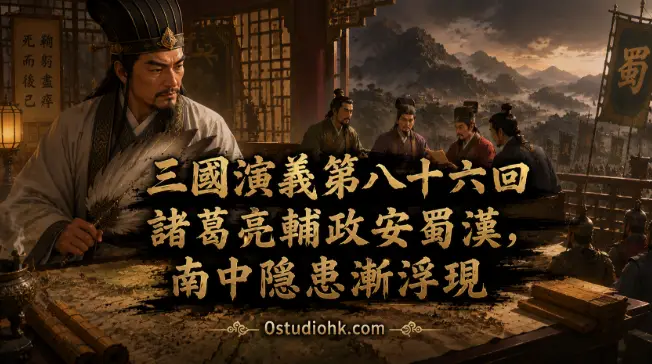
三國演義 第八十六回:諸葛亮輔政安蜀漢,南中隱患漸浮現 | Romance of the Three Kingdoms Chapter 86: Zhuge Liang Stabilizes Shu Han as Trouble Rises in the Southern Territories
劉備病逝後,劉禪繼位,諸葛亮依照白帝城託孤之命,全面主持蜀漢政務。他整頓朝政、安撫百姓、重用賢才,使戰後殘破的蜀漢逐漸恢復元氣。然而,遙遠的南中地區卻暗流洶湧,一場新的叛亂正悄然醞釀。
After Liu Bei’s death, the young Liu Shan inherited the throne while Zhuge Liang assumed responsibility for governing Shu Han. Through careful administration and political reform, he gradually restored stability to the kingdom. Yet beyond the peaceful court, unrest was growing in the southern frontier, where rebellion threatened the fragile future of Shu Han.
中文
白帝城的喪鐘早已停歇。
然而,劉備留下的重擔,才剛剛落在諸葛亮肩上。
成都皇宮內,年僅十餘歲的劉禪正式即位。
百官朝賀,新帝登基。
只是,朝廷上下都明白,真正肩負蜀漢命運的人,是那位身穿鶴氅、手執羽扇的丞相諸葛亮。
登朝第一日,諸葛亮率領百官拜見新君。
劉禪恭敬起身。
「一切國事,皆仰賴相父。」
一句「相父」,不僅代表信任,也代表先帝最後的囑託。
諸葛亮俯身行禮。
「臣必竭盡所能,不負先帝所托。」
從此,蜀漢正式進入輔政時代。
諸葛亮沒有急於興兵。
他深知,夷陵之敗讓國力大傷。
若不能先恢復民生,再大的理想也只是空談。
於是,他首先整頓朝政。
貪污官員依法查辦。
忠誠能幹者破格擢用。
各地倉庫重新清點,糧食統一調配。
百姓因戰亂荒廢的農田,也重新開始耕作。
他命各郡修築水利,鼓勵開墾。
又減輕部分賦稅,使流離失所的百姓逐漸返回家園。
成都城內,再次恢復往日繁榮。
商旅來往。
市集熱鬧。
百姓都說:
「丞相治國,如春風化雨。」
朝廷之中,諸葛亮也十分重視人才。
蔣琬、費禕、董允等青年官員逐漸受到重用。
他希望建立一個即使自己不在,也能穩定運作的朝廷。
每逢夜晚,丞相府燈火總是最後熄滅。
案上堆滿奏章。
羽扇放在一旁。
諸葛亮常常工作到深夜。
有人勸他多加休息。
他只是微微一笑。
「國事未定,何敢自安。」
然而,就在蜀漢逐漸恢復元氣之際,南方卻傳來令人不安的消息。
南中地區地勢遼闊,民族眾多。
多年來一直由地方豪族共同治理。
夷陵之敗後,不少地方首領認為蜀漢國力衰弱。
其中,雍闓率先舉兵反叛。
不久,高定、朱褒等人也相繼響應。
南中各郡局勢迅速惡化。
朝廷收到急報。
群臣議論紛紛。
有人主張立即出兵平亂。
也有人認為應集中兵力防備曹魏。
諸葛亮沒有立刻作出決定。
他先仔細閱讀各地軍報,又命人收集南中民情。
數日後,他召集眾臣。
「南中之亂,不止兵亂。」
眾人面面相覷。
諸葛亮繼續說:
「若只誅叛軍,不得民心,亂事終將再起。」
一句話,道出問題根源。
他決定先安定國內,待時機成熟,再親率大軍南征。
此時,一名年輕將領站了出來。
正是馬謖。
他侃侃而談南中地理與民族風俗。
諸葛亮靜靜聽完,微微點頭。
他知道,未來平定南中的道路,不只是靠兵力。
更需要智慧。
夜色降臨。
諸葛亮獨自走上成都城樓。
遠方群山連綿。
那片山嶺之後,就是動盪不安的南中。
他輕輕搖動羽扇。
目光平靜而堅定。
因為他明白,真正屬於自己的時代,如今才剛剛開始。
English Version
The mourning bells of White Emperor City had long since faded.
Yet the responsibility entrusted by Liu Bei had only just begun.
In Chengdu, the young Liu Shan formally ascended the throne.
Officials gathered to celebrate the new emperor, but everyone understood that the true burden of governing Shu Han rested upon Chancellor Zhuge Liang.
During the first court assembly, Liu Shan respectfully addressed his guardian.
“All affairs of the kingdom depend upon you, Imperial Father.”
The title reflected not only personal respect but also Liu Bei’s final wish.
Zhuge Liang bowed deeply.
“I shall devote every strength to fulfilling His Majesty’s trust.”
Rather than preparing another military campaign, Zhuge Liang focused on rebuilding a kingdom exhausted by years of warfare.
He reorganized the administration, removed corrupt officials, and promoted capable young administrators regardless of family background.
Storehouses were inspected.
Agricultural lands abandoned during the wars were reclaimed.
Taxes were adjusted to ease the burden on struggling families.
Irrigation systems were repaired, encouraging farmers to return to their fields.
Gradually, prosperity returned.
Markets became lively once again.
Trade resumed throughout Shu.
Ordinary citizens praised the Chancellor’s wise leadership, believing stability had finally returned.
At court, Zhuge Liang also began cultivating the next generation of officials.
Jiang Wan, Fei Yi, Dong Yun, and other talented administrators received increasing responsibility.
He hoped to build a government strong enough to endure long after his own lifetime.
Each evening, the lights inside the Chancellor’s office burned later than any other building in Chengdu.
Stacks of official documents covered his desk.
His feather fan rested quietly beside countless reports.
When advisers urged him to rest, Zhuge Liang always answered with the same calm determination.
“Until the kingdom is secure, how can I think of myself?”
Yet while Shu Han recovered, trouble quietly emerged beyond its southern frontier.
The vast region known as Nanzhong had always been difficult to govern.
Its rugged mountains and diverse tribal communities often challenged central authority.
Following Shu’s defeat at Yiling, several local leaders concluded that the kingdom had become too weak to control the region.
Yong Kai openly rebelled.
Soon Gao Ding and Zhu Bao joined the uprising.
Within weeks, much of southern Shu fell into disorder.
The imperial court debated its response.
Some ministers demanded immediate military action.
Others argued that every available soldier should remain ready against Wei.
Zhuge Liang refused to rush into either decision.
After carefully studying reports from the frontier, he addressed the court.
“This is not merely a military rebellion.”
The ministers listened carefully.
“If we defeat the armies but fail to win the hearts of the people, another rebellion will certainly follow.”
His words revealed a strategy far beyond simple conquest.
The Chancellor decided that lasting peace required wisdom as much as military strength.
That evening, standing upon Chengdu’s city walls, Zhuge Liang gazed toward the distant southern mountains.
Beyond those peaks waited the greatest challenge of his career.
The age of Liu Bei had ended.
Now the future of Shu Han rested in the hands of its legendary Chancellor, whose greatest achievements were still to come.