
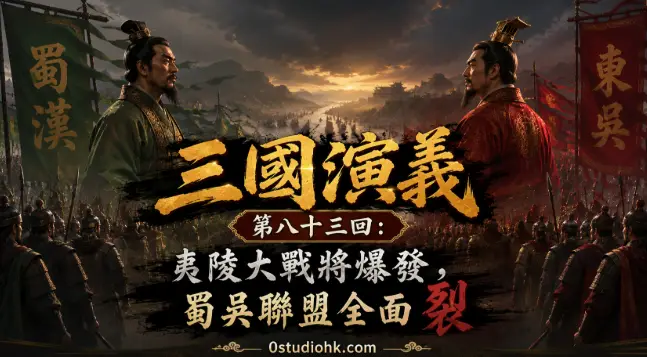
三國演義 第八十三回:夷陵大戰將爆發,蜀吳聯盟全面決裂 |Romance of the Three Kingdoms Chapter 83: The Battle of Yiling Approaches as the Shu–Wu Alliance Collapses
劉備為替關羽、張飛報仇,不顧群臣勸阻,親率蜀漢大軍東征孫吳。面對蜀軍步步逼近,孫權一方面積極備戰,一方面派使求和,卻遭劉備拒絕。曾經共同抗曹的蜀吳聯盟,終於走向全面決裂,夷陵大戰一觸即發。
Driven by grief and vengeance, Liu Bei led Shu Han’s armies eastward despite repeated warnings from his advisers. As the Shu forces advanced, Sun Quan strengthened Wu’s defenses while making one final attempt at diplomacy. The alliance that had once defeated Cao Cao at Red Cliffs finally collapsed, setting the stage for the decisive Battle of Yiling.
中文小說寫法
成都城外,數十萬蜀軍旌旗蔽日。
戰鼓聲震撼山河,刀槍映照著初升的晨光。
劉備親自披上戰甲,站在點將臺上,望向東方。
那裡,是東吳,也是關羽與張飛未竟的遺憾。
自從兩位結義兄弟相繼離世後,他心中的怒火從未熄滅。
如今,他要親自率軍討伐孫權。
出征之前,群臣再次進諫。
趙雲率先出列。
「陛下,魏國勢力仍然強盛。若此時與東吳交戰,只會讓曹魏坐收漁人之利。」
秦宓也上前勸諫,希望皇帝以國家為重,暫緩出兵。
諸葛亮雖然留守成都治理國政,也派人送來書信,希望劉備慎重考慮。
然而,劉備只是緩緩收起書信。
「國仇可忍,兄弟之仇不可忘。」
一句話,表明了他的決心。
大軍浩浩蕩蕩,自成都一路東進。
沿途州郡紛紛供應糧草,軍容鼎盛。
蜀軍將士人人士氣高昂,都希望替關羽與張飛雪恨。
另一方面,建業城內卻瀰漫著另一種氣氛。
孫權收到探報後,知道劉備親征,心中也十分沉重。
他明白,這一戰若敗,江東百年基業將危在旦夕。
不少大臣主張再次向蜀漢求和。
孫權思索再三,決定派遣使者攜帶厚禮前往蜀營。
使者抵達軍前,恭敬呈上國書。
孫權願意修復兩國盟約,共同抗魏,希望劉備以天下大局為重。
然而,劉備連書信都沒有看完。
他當場說道:
「若非東吳襲取荊州,雲長何至於此?」
使者無言以對,只得返回建業。
求和失敗。
孫權知道,再沒有退路。
他立即任命年輕將領陸遜為大都督,統率全軍迎戰。
這項決定,引起不少老將不滿。
陸遜年紀尚輕,又缺乏獨立統率大軍的資歷。
有人懷疑,他如何能抵擋身經百戰的劉備?
然而,孫權十分信任陸遜。
「此戰,非伯言不可。」
陸遜接下兵符後,沒有急於出戰。
他仔細研究蜀軍部署,命令全軍固守營寨,不得擅自迎戰。
即使蜀軍連番挑戰,他依然按兵不動。
不少東吳將領焦急萬分。
「若再退讓,士氣必衰!」
陸遜卻神情平靜。
「敵軍遠來,銳氣正盛。待其深入,再圖破敵。」
另一邊,劉備見東吳始終閉營不出,不禁認為對方畏戰。
蜀軍一路推進,占領大片土地。
連續數月,數十座營寨沿山谷排列,綿延數百里。
將士們開始相信,勝利只是時間問題。
然而,黃權望著漫山遍野的營寨,神情卻愈發凝重。
「營寨相連太長,一旦有變,首尾難以相救。」
他的提醒,沒有得到足夠重視。
夜幕降臨。
蜀營燈火連綿,猶如一條火龍蜿蜒山谷。
遠方高地上,陸遜默默凝視著這一切。
他沒有露出任何神情。
因為他知道,真正決定勝負的時機,尚未到來。
而當炎夏來臨之時,一場足以改變三國命運的大火,即將燃遍夷陵山谷。
English Version
The plains outside Chengdu echoed with the sound of marching armies.
Thousands of banners fluttered beneath the morning sky as Liu Bei personally prepared to lead Shu Han’s greatest military campaign.
This was no ordinary expedition.
It was a march driven by grief.
The deaths of Guan Yu and Zhang Fei had transformed the emperor’s desire for justice into an unshakable determination for revenge.
Before the army departed, several senior officials pleaded with him to reconsider.
Zhao Yun warned that Wei remained the strongest kingdom and would benefit if Shu and Wu exhausted each other.
Other advisers echoed the same concern.
Even Zhuge Liang, who remained behind to govern Chengdu, sent letters urging caution.
Liu Bei listened in silence.
Finally, he folded the letter and answered quietly.
“A kingdom may forgive many things, but I cannot forget the deaths of my brothers.”
The decision had been made.
Shu’s army advanced eastward with tremendous momentum.
Cities welcomed the imperial forces, while soldiers marched with confidence, believing justice was on their side.
Across the Yangtze, Sun Quan watched the situation grow increasingly dangerous.
He understood that Liu Bei’s invasion threatened not only Eastern Wu but the entire balance of power.
Hoping to avoid war, Sun Quan dispatched envoys carrying generous gifts and proposals for peace.
The message appealed to their former alliance against Wei.
Liu Bei rejected the offer immediately.
“If Wu had not seized Jing Province,” he declared, “Guan Yu would still live.”
Diplomacy had failed.
Recognizing that war was now unavoidable, Sun Quan appointed Lu Xun as Commander-in-Chief of Wu’s armies.
The decision surprised many experienced officers.
Lu Xun was young and had never commanded such a massive campaign.
Some openly questioned whether he could withstand Liu Bei’s legendary battlefield experience.
Sun Quan never hesitated.
“No one is better suited for this command.”
Assuming leadership, Lu Xun chose patience over aggression.
He ordered every fortress to remain on the defensive.
Regardless of Shu’s repeated challenges, Wu’s soldiers were forbidden from launching major attacks.
Many generals became frustrated.
Retreating without battle appeared to weaken morale.
Lu Xun remained completely calm.
“Our enemy has traveled far. Their confidence is strongest now. Time itself will become our ally.”
Meanwhile, Liu Bei interpreted Wu’s silence as weakness.
His army steadily occupied more territory, constructing an enormous chain of camps stretching across the valleys for hundreds of miles.
Victory seemed inevitable.
Yet not everyone shared that optimism.
Huang Quan carefully examined the growing network of encampments.
He quietly warned that such an extended line would become impossible to defend if disaster struck.
His advice received little attention.
Night fell across the mountains.
Countless campfires illuminated the valleys like rivers of light.
From a distant ridge, Lu Xun observed every movement without revealing his thoughts.
He was waiting.
Waiting for summer.
Waiting for the perfect opportunity.
Soon, the valleys of Yiling would become the stage for one of the most decisive battles in the Romance of the Three Kingdoms.