三國演義第六十二回:龐統巧獻連環策,劉備正式進逼益州 | Romance of the Three Kingdoms Chapter 62 Pang Tong’s Strategy for Yi Province
入蜀只是開始,真正的挑戰才剛展開。當人心與權勢交錯,益州的平靜,也終於被徹底打破。
Entering Shu is only the beginning. As ambition and loyalty collide, the fragile peace of Yi Province begins to collapse.
中文
蜀道陰雨連綿,山風低鳴。
劉備入蜀之後,表面上仍以援軍身份自居。
他禮待劉璋,軍紀嚴整,不輕舉妄動。
然而,益州上下的氣氛,已逐漸改變。
百姓開始議論。
將領開始比較。
同樣是漢室宗親,劉備身上卻多了一種令人願意追隨的力量。
這種變化,最先察覺的人,是龐統。
鳳雛之名,早已傳遍天下。
他與諸葛亮齊名,卻行事更加直接。
當他進入益州後,很快便看透局勢。
劉璋雖守一方,卻缺乏掌控人心的能力。
而劉備,正逐漸成為益州真正的中心。
夜色之中,軍帳燈火微亮。
龐統攤開地圖,低聲開口。
「若再拖延,局勢只會更加複雜。」
他的語氣平靜,卻帶著鋒利。
因為他知道,機會稍縱即逝。
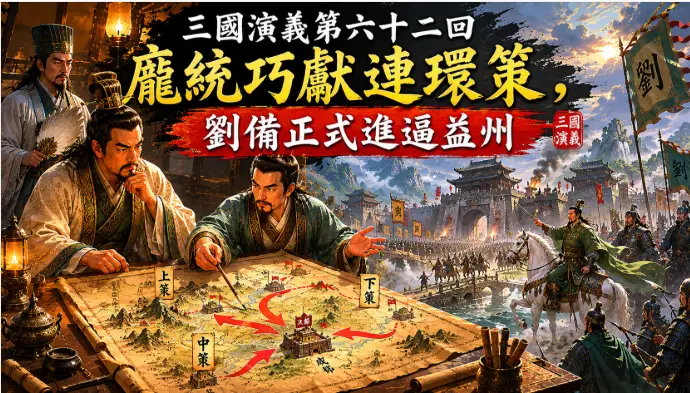
於是,他提出上、中、下三策。
上策,奇襲成都,一舉定局;
中策,逐步奪取要地,穩定推進;
下策,退回荊州,再圖後勢。
帳中一時沉默。
每一條路,都代表不同命運。
劉備久久未語。
他並非優柔寡斷。
只是他太清楚,一旦真正動兵,便意味著與劉璋徹底決裂。
名義上的援助,也將變成奪取。
而這一步,將影響天下對他的看法。
然而,龐統卻直言不諱。
「亂世之中,猶疑才最危險。」
這句話,如同利刃。
因為局勢已經無法回頭。
益州內部,早有不少人對劉璋失望。
有人暗中支持劉備,有人則觀望局勢。
而劉備越是克制,人心反而越向他傾斜。
最終,劉備選擇進兵。
不是奇襲,也不是退卻。
而是穩步推進。
大軍開始向益州腹地前行。
沿途城池,有人開門迎接,有人緊閉城門。
蜀地原本平靜的秩序,開始全面動搖。
而劉璋,也終於意識到。
自己請進來的,不只是援軍。
更是一股足以改變益州命運的力量。
山雨仍落。
遠方戰鼓聲逐漸傳來。
蜀地的真正戰爭,此刻才正式開始。
English Version
Liu Bei’s entrance into Shu had been careful and restrained.
Officially, he remained an invited ally—someone brought into Yi Province to help defend against external threats.
His conduct reflected that role perfectly.
Discipline was maintained.
Respect toward Liu Zhang remained public and deliberate.
At first glance, everything appeared stable.
But beneath the surface, Yi Province was already changing.
People observed quietly.
Officials compared leadership styles.
And slowly, Liu Bei’s presence began to reshape expectations.
What Liu Zhang offered was security.
What Liu Bei inspired was loyalty.
Among those who recognized the significance of this shift was Pang Tong.
Known as the “Young Phoenix,” Pang Tong possessed a strategic mind equal in reputation to Zhuge Liang’s, though his methods were often more aggressive and direct.
After entering Shu, he quickly understood the fragile political balance surrounding Liu Zhang’s rule.
Yi Province was wealthy and defensible, but its leadership lacked decisiveness.
And in uncertain times, indecision creates opportunity.
One evening, inside a dimly lit military tent, Pang Tong laid out his assessment before Liu Bei.
He proposed three possible paths.
The first: strike Chengdu quickly and seize control before resistance could organize.
The second: advance steadily, securing key territories while allowing support to build gradually.
The third: withdraw entirely and abandon the opportunity.
Each option carried enormous consequences.
Liu Bei hesitated—not from weakness, but from awareness.
Crossing the line from ally to conqueror would permanently change how others viewed him.
Once military action began, there would be no returning to neutrality.
Pang Tong understood the hesitation, but he also understood timing.
In his view, delay itself was dangerous.
Every day without action increased uncertainty.
Meanwhile, support inside Yi Province continued shifting.
Some officials secretly favored Liu Bei.
Others simply no longer trusted Liu Zhang’s ability to lead through crisis.
The more restrained Liu Bei appeared, the more support he quietly gained.
Eventually, the decision was made.
Not for reckless conquest, but for controlled advancement.
Liu Bei’s forces began moving deeper into Yi Province, securing territory step by step.
Some cities welcomed them willingly.
Others prepared for resistance.
The fragile calm of Shu finally broke apart.
And Liu Zhang realized too late that the man he had invited for protection now represented the greatest threat to his rule.
Across the mountains, war drums echoed through the rain.
The struggle for Shu had truly begun.