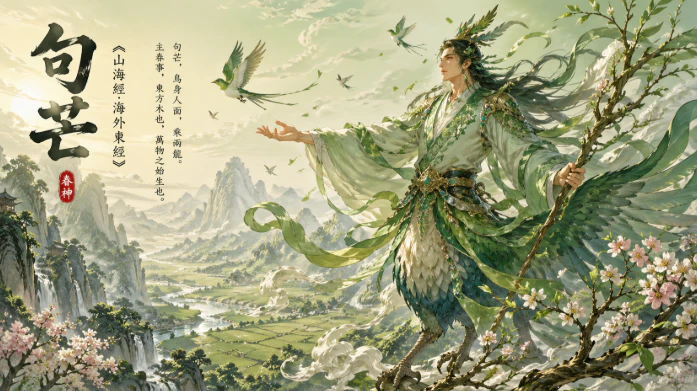
句芒是《山海經》中象徵春天與生命復甦的神祇,掌管萬物生長與天地循環。他不只是自然之神,更承載古人對季節更替與生命重生的理解與想像。
Ju Mang, a deity in the Shan Hai Jing, represents spring and the renewal of life. As a guardian of growth and seasonal cycles, he reflects ancient beliefs about nature, rebirth, and the rhythm of the living world.
中文小說寫法
當寒意尚未完全退去,大地仍覆著一層薄霜之時,東方的天空已隱隱透出青色的光,那是句芒甦醒的時刻。他並非如烈火般降臨,而是如風一般輕柔地走入人間,帶著未曾被察覺的氣息,讓沉睡的萬物開始顫動。樹木最先感知他的存在,枝幹深處流動起微弱卻堅定的生命之力,細小的嫩芽在寒冷中掙扎而出,彷彿回應一種遠古的召喚。句芒的身影模糊而悠長,有時被形容為人首鳥身,有時則只是青光一縷,他不需要固定的形體,因為他的存在本身就是變化與生長。他走過山川,山便披上新綠;他越過河流,水便解凍奔流;他掠過田野,種子便在土壤深處悄然甦醒。人們無法看見他,但總能在第一縷春風中感受到他的氣息,那種溫暖而柔和的力量,像是一種無聲的允諾,告訴世界:生命將再次開始。傳說中,句芒居於東方,與青木相連,是四時循環中最溫和卻最不可或缺的一環。他不似雷霆般震撼,也不如烈日般耀眼,但正因如此,他的力量滲透萬物,無聲無息地改變世界。古人敬畏他,因為他掌握著生長的權柄;農人依賴他,因為他決定收成的命運;詩人讚頌他,因為他讓枯寂變為生機。在漫長的冬季之後,句芒的到來總是帶著希望,那是一種不需要言語的訊息,只需看見嫩芽破土,聽見流水回聲,便知道他已經來過。他不會停留太久,當春意漸濃,萬物各自生長,他便悄然退去,把世界交還給時間與生命自身的力量,但他的影子仍留在每一片新葉之中,提醒人們每一次重生都曾經歷沉睡與等待。
English Version
Before winter fully loosens its grip, when frost still clings quietly to the earth, a subtle glow emerges in the eastern sky—a sign that Ju Mang has awakened. His arrival is never sudden or overwhelming; instead, it unfolds gently, like a whisper carried by the wind. Wherever he passes, life begins to stir. Trees are the first to respond, their inner currents shifting as dormant energy rises toward the surface. Tiny buds push through bark and branch, fragile yet determined, answering a call older than memory. Ju Mang is not bound to a single form. Sometimes envisioned with a human face and a bird’s body, sometimes as nothing more than a trace of green light, he embodies transformation itself. His presence is defined not by shape, but by change. Mountains soften under his touch, cloaked in fresh green; frozen rivers loosen and begin to flow; seeds buried deep within the soil awaken, sensing the return of warmth. Though unseen, his influence is unmistakable. It lingers in the first mild breeze of spring, in the quiet shift of the air, in the promise that life is beginning again. Said to dwell in the East and aligned with the element of wood, Ju Mang represents renewal within the eternal cycle of seasons. Unlike thunder or blazing sun, his power is subtle, yet it reaches everything. Ancient people revered him not for spectacle, but for necessity. Farmers depended on him, knowing their harvests were tied to his unseen rhythm. Poets found inspiration in his quiet transformation, as barren landscapes turned vibrant once more. After the long stillness of winter, his return always carries hope—not loudly declared, but deeply felt. One does not need to see him to know he has come; it is enough to witness the breaking of soil, the flowing of water, the greening of the world. And yet, Ju Mang never lingers. As spring matures and life takes root on its own, he recedes silently, leaving behind a world in motion. Still, traces of him remain in every leaf and every bloom, a reminder that renewal is born from patience, and that every beginning follows a time of rest.