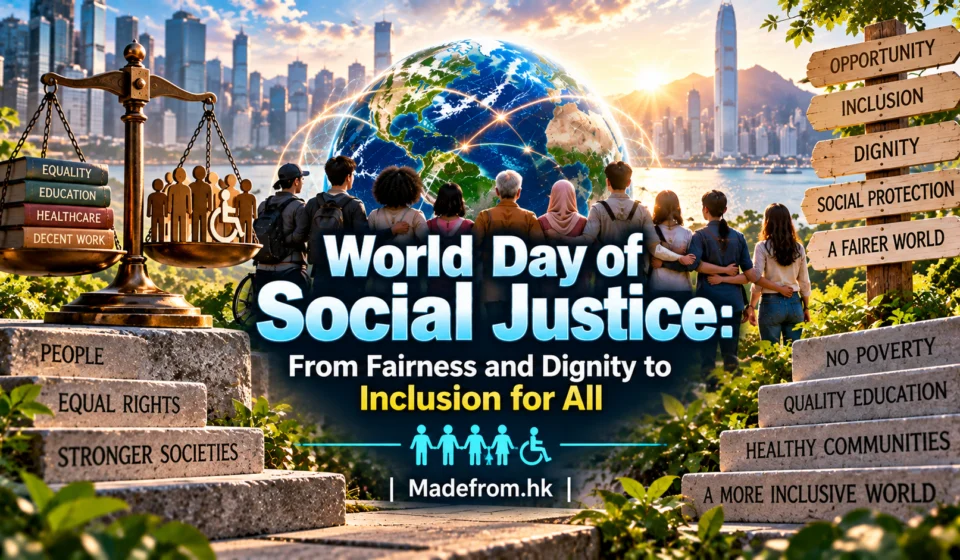
World Day of Social Justice: From Fairness and Dignity to Inclusion for All
Every February 20, World Day of Social Justice draws attention to poverty, inequality, decent work, social protection and inclusion, encouraging action toward a fairer society.
World Day of Social Justice is observed every February 20. The United Nations General Assembly proclaimed the day in November 2007, with the observance beginning during the sixty-third session of the General Assembly. Its purpose is to draw attention to social justice and to encourage greater awareness of poverty, inequality, discrimination, social exclusion, employment and participation in society. In 2026, the observance is held under the theme “Renewed Commitment to Social Development and Social Justice”, following the Second World Summit for Social Development and the adoption of the Doha Political Declaration. Social justice is broader than the idea of equal treatment under the law. It also concerns whether people have meaningful opportunities to receive an education, find employment, enjoy decent working conditions, access social protection and participate in economic and public life. Economic growth can improve national wealth, but growth alone does not guarantee that its benefits will reach everyone. For this reason, the United Nations identifies poverty eradication, full and productive employment, decent work and social inclusion as interconnected pillars of social development. Work is particularly important because employment is not simply a source of income. For many people, it provides stability, independence, social participation and a foundation for family life. The quality of employment therefore matters. Safe working conditions, fair treatment, labour rights and adequate opportunities all influence a person’s ability to live with dignity. Sustainable Development Goal 8 specifically calls for sustained, inclusive and sustainable economic growth, full and productive employment and decent work for all. Yet the world of work is changing rapidly. Digitalization, artificial intelligence, automation, the green transition and new forms of employment are reshaping labour markets. These changes can create new industries and opportunities, but they can also disrupt established occupations and create new forms of insecurity. The challenge for society is not simply to stop technological change, but to make sure that people have opportunities to adapt to it. The United Nations’ 2026 World Day of Social Justice materials highlight the importance of gender equality, opportunities for young people, transitions from informal to formal employment, and fair and inclusive transformations in the digital and green economies. Social protection is another essential part of social justice. No person’s life remains completely stable. Unemployment, old age, illness, family responsibilities and unexpected economic shocks can all affect household income. Without an adequate safety net, a temporary setback can become a long-term crisis. Social protection helps people manage these risks and maintain a basic level of security during difficult periods. Recent United Nations reporting shows that global social protection coverage has expanded, but large numbers of people remain without adequate protection, demonstrating that social justice remains unfinished work. Education is closely connected to these issues. Access to quality education can influence employment opportunities, economic mobility and participation in society. It can also help people understand their rights and respond to social and technological change. When educational opportunities are heavily concentrated among particular groups, disadvantage can persist across generations. Expanding access to education is therefore an important part of reducing long-term inequality. Social justice also concerns barriers linked to gender, age, disability, social background and other circumstances. When people face difficulties accessing employment, education, healthcare, housing or public services because of their circumstances, the issue may extend beyond individual choices and raise questions about whether institutions provide fair opportunities to participate. The United Nations’ 2026 observance notes that structural inequalities, labour-market informality, gender disparities and declining trust in institutions continue to hinder inclusive and sustainable development. Social justice is also connected with public trust. When people believe that institutions serve only a small part of society, or that effort does not lead to reasonable opportunities, confidence in institutions can weaken. When people have greater confidence that systems provide basic protection and meaningful opportunities to participate, cooperation can become easier. This is why social justice cannot be treated as the responsibility of a single government department. Economic policy, employment, education, social protection, housing, healthcare, digital policy and environmental policy all influence the distribution of opportunities and risks. The 2026 observance emphasizes greater policy coherence across economic, social and environmental dimensions, linking these areas rather than treating them as separate challenges. The Second World Summit for Social Development, held in 2025, adopted the Doha Political Declaration, reaffirming commitments to poverty eradication, decent work, combating discrimination, expanding social protection and protecting human rights. The United Nations describes social development and social justice as important foundations for peace, stability and sustainable development. Social justice should therefore not be understood as a goal that can simply be declared complete. Societies continue to change, and new technologies, economic structures, employment models and global crises can create new forms of inequality. Social justice is consequently an ongoing process that requires participation from governments, employers, workers, communities, civil society and international organizations. Artificial intelligence makes this especially relevant today. AI may increase productivity and create new forms of employment, while also transforming or replacing some existing tasks. This creates questions about who benefits from technological progress and whether people affected by economic transformation have access to training and new opportunities. These questions do not have a single answer, but they form an important part of the future discussion about social justice. The significance of World Day of Social Justice may therefore lie less in providing one universal solution and more in encouraging societies to examine how opportunities, resources and protection are distributed. Fairness does not necessarily mean that everyone’s circumstances must become identical. It means creating conditions in which people, despite different starting points and different risks, have meaningful opportunities to participate and live with dignity. When societies address poverty, improve working conditions, expand social protection, reduce discrimination, provide educational opportunities and allow different groups to participate in public life, social justice moves beyond an abstract principle and becomes part of everyday institutions and practices. The 2026 theme, “Renewed Commitment to Social Development and Social Justice”, emphasizes the need to turn international commitments into practical and measurable outcomes. For individuals, social justice is not necessarily a distant international issue. It can be found in whether a worker has reasonable protection, whether a child has access to education, whether an unemployed person has a path back into employment, whether an older person can receive basic support, or whether someone can live and work without discrimination. Taken together, these everyday conditions form part of the foundation of an inclusive society. World Day of Social Justice therefore encourages a broader understanding of progress. Economic growth matters, but so do the distribution of opportunity, access to protection, human dignity and the ability to participate in social development. As the world enters an era shaped by artificial intelligence, green transformation and the digital economy, the specific questions surrounding social justice will continue to evolve. The central concern, however, remains familiar: how can more people participate, work, live and develop their potential while retaining dignity and opportunity during periods of rapid change? That is why February 20 remains an important date for reflecting on the relationship between social development and justice.
World Day of Social Justice reminds us that progress is more than economic growth. Decent work, social protection, education, equal participation and human dignity are essential to building inclusive and sustainable societies.