Today in History: September 19 Civil Rights Milestones, Telecommunications, and Digital Culture
September 19 connects women’s rights, communication technology, popular culture and everyday life in the making of the modern world.
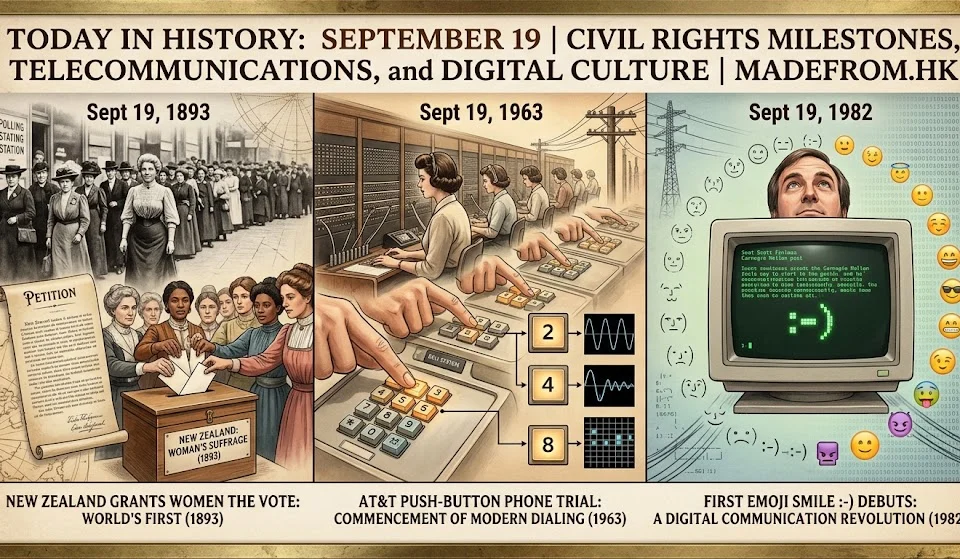
September 19 offers a fascinating mixture of social progress, communication technology, literature, popular culture and new ways of working together. One of the most important events associated with the date occurred in New Zealand in 1893, when the country became the first self-governing nation in the world to give women the right to vote in parliamentary elections. Governor Lord Glasgow signed the Electoral Act, allowing adult women to participate in national elections. The change was the result of years of campaigning rather than a sudden political decision. Kate Sheppard became one of the leading figures in the movement, using petitions, public speeches and organised campaigns to argue that women should have the same political voice as men. New Zealand’s achievement became an important symbol for women’s suffrage movements elsewhere. Today, voting rights are often regarded as a basic part of democratic society, but in the nineteenth century women in many countries were excluded from formal political participation. The reform of 1893 did not solve every question of equality, but it represented a major change in the understanding of who should be allowed to participate in public life. The history of women’s suffrage also demonstrates that social progress often depends on persistent campaigning by people who challenge assumptions that once seemed completely normal. September 19 can also be viewed through the development of communication systems. The growth of telephone networks during the twentieth century required increasingly sophisticated numbering systems as more households and businesses became connected. Telephone numbers may seem like one of the most ordinary things in modern life, yet they are part of a much larger technological history. Early telephone networks depended heavily on human operators and local exchanges. As cities grew and telephone use expanded, systems needed increasingly efficient ways to identify subscribers and connect calls across larger regions. Today, entering a sequence of numbers can connect two people almost instantly, but that convenience is the result of decades of engineering and organisational development.September 19 is also closely connected with literature and popular culture. William Golding was born on September 19, 1911. He later became one of Britain’s most respected novelists, best known for “Lord of the Flies,” published in 1954. The novel follows a group of boys stranded on an island and uses their situation to explore questions about civilisation, leadership, fear, power and human behaviour. Golding was awarded the Nobel Prize in Literature in 1983 for his novels, which illuminate the human condition. The lasting power of “Lord of the Flies” comes from its simple but unsettling question: what happens to a society when the institutions and rules that normally structure everyday life disappear? The novel has remained widely studied because its themes are not limited to one historical period. Questions about leadership, group behaviour, fear and responsibility remain relevant in schools, workplaces and communities around the world. September 19 can also be connected with the continuing cultural influence of “Star Wars.” George Lucas’s science-fiction universe developed into much more than a successful film series. Its characters, worlds, Jedi, the Force and distinctive visual language became part of global popular culture. What made “Star Wars” particularly influential was its ability to extend beyond cinema into television, novels, comics, games, toys and collectibles. The development of this kind of interconnected fictional universe later became an important model for modern entertainment franchises. A successful story could become an entire cultural ecosystem rather than remaining a single film or book. September 19 also has a place in television history. In 1988, the sitcom “Roseanne” premiered in the United States, focusing on a working-class family and the everyday challenges of employment, money, marriage and raising children. The series differed from more idealised family comedies by presenting characters dealing with ordinary economic and domestic pressures. Its success demonstrated that mainstream television audiences could respond strongly to stories that reflected the realities of everyday family life. (history.com) Sport provides another September 19 story. In 1988, during the Seoul Olympic Games, German tennis player Steffi Graf completed one of the most remarkable achievements in the history of the sport. She won all four major tennis tournaments and the Olympic women’s singles gold medal in the same calendar year, creating what became known as the “Golden Slam.” The achievement demonstrated the extraordinary level of consistency required to succeed across different competitions and conditions. Graf’s career also reflected the growing relationship between elite sport, international broadcasting, sponsorship and global audiences. September 19 can also be associated with the development of online collaboration and cloud-based work. During the early development of web-based document services, technologies that allowed people to create and edit documents through Internet browsers began changing the traditional idea that a document had to exist only on one computer. Google later developed its online document platform after acquiring Writely, helping popularise cloud-based document collaboration. The concept was transformative because several people could work on the same document from different locations without constantly exchanging separate files. Today, shared online documents are a normal part of education, business and personal projects, but the underlying idea represents a major change in how people think about information and collaboration. Looking across these stories, a common theme becomes visible: connection and participation. In 1893, women gained a new opportunity to participate in national political life. Telephone networks connected people across growing cities and countries. Literature allowed ideas to travel across generations and borders. Films and television created shared cultural experiences for international audiences. Online documents allowed people in different places to work together in real time. These developments belong to different fields, but all of them expanded the ways people could participate in something larger than themselves. September 19 also shows that major social and technological changes are rarely created by one person working alone. Kate Sheppard’s campaign depended on thousands of supporters. Telephone systems required engineers, companies and public institutions. Literature depends on the relationship between writers and readers. Film franchises depend on creators, performers, audiences and entire industries. Cloud collaboration depends on the Internet infrastructure that connects people across the world. Modern society is therefore built through networks of cooperation. Today, it is normal to express political opinions, communicate instantly with someone far away, enjoy stories created in another country or edit a document with colleagues living on another continent. These experiences feel ordinary precisely because earlier generations built the systems that made them possible. September 19 reminds us to look behind those ordinary experiences. Social movements can change who is allowed to participate. Communication technologies can reduce the distance between people. Literature can preserve ideas across generations. Popular culture can cross national borders. Digital tools can turn physical distance into a minor inconvenience rather than a barrier. These changes are not always dramatic when they first appear, but their long-term effects can be enormous. The history of September 19 is therefore not simply a list of anniversaries. It is a story about expanding possibilities: more people participating in society, more people communicating with one another, more stories crossing borders and more opportunities for people to work together. From women’s suffrage in New Zealand to the development of modern communication, from William Golding’s exploration of human behaviour to the cultural universe of “Star Wars,” and from television’s changing portrayal of ordinary families to cloud-based collaboration, September 19 offers a snapshot of a world becoming increasingly connected. The modern life we know today did not appear overnight. It was built through social movements, technological innovation and cultural creativity, one development at a time.
September 19 shows how social change, communication, literature and digital collaboration have steadily expanded the ways people participate, connect and create.