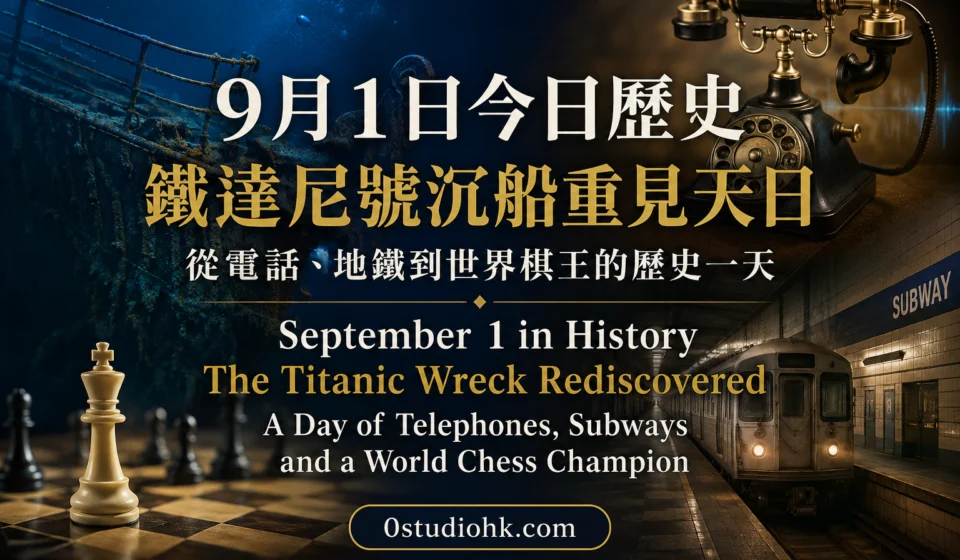
9月1日今日歷史|鐵達尼號沉船重見天日|從電話、地鐵到世界棋王的歷史一天|September 1 in History|The Titanic Wreck Rediscovered|A Day of Telephones, Subways and a World Chess Champion
9月1日不只有重大歷史事件,也見證科技、文化與人類探索一步步改變世界。
English:September 1 brings together stories of discovery, technology, culture and remarkable human achievement that continue to shape our world.
中文版本
每年的9月1日,在歷史長河中留下了不少值得回望的足跡,而其中最令人難忘的之一,是1985年鐵達尼號沉船終於在北大西洋海底被發現。1912年4月,鐵達尼號從英國南安普敦啟程前往紐約,首航途中撞上冰山沉沒,成為20世紀最廣為人知的海難之一。沉船在海底沉睡超過70年後,1985年9月1日,美國海洋學家羅伯特・巴拉德(Robert Ballard)與法國探險隊合作,在紐芬蘭附近海域找到鐵達尼號的殘骸,讓這艘傳奇客輪再次進入世人的視線。這次發現不只是尋找一艘沉船,更代表海洋探索、深海攝影與現代科技的一次重要突破。研究人員透過深海設備取得影像,讓人類第一次能夠直接看到這艘沉睡於數千米海底的著名船隻,也為後來的海洋考古與沉船研究提供珍貴資料。9月1日同樣見證科技如何逐步融入日常生活。1897年,美國波士頓地鐵正式啟用,成為北美第一個地下快速交通系統,城市交通由此進入新的時代。地鐵的出現不只是增加一種交通工具,也改變了城市規劃與人口流動方式,讓愈來愈多城市開始思考如何在有限的土地上容納不斷增加的人口。另一個與科技及職業發展有關的故事發生於1878年,Emma M. Nutt 在美國波士頓成為世界上第一位正式受聘的女性電話接線員。當時電話剛開始進入社會,電話交換工作原本主要由年輕男性擔任,但女性接線員逐漸成為這個新興行業的重要力量。這件事看似平凡,實際上反映了科技發展如何創造新的工作機會,也讓女性開始在通訊產業中扮演更加重要的角色。1914年的9月1日則留下了一個令人惋惜的自然歷史記錄。名叫Martha的旅鴿在美國辛辛那提動物園死亡,成為已知最後一隻旅鴿。旅鴿曾經是北美數量極其龐大的鳥類,甚至曾形成遮天蔽日的大型鳥群,但由於過度捕獵、棲息地破壞等因素,數量在短短幾十年間急劇下降,最終走向滅絕。Martha的死亡提醒人類,物種數量龐大並不代表永遠安全,當環境和人類活動發生巨大變化,即使曾經遍布大地的物種也可能迅速消失。文化方面,1952年9月1日,美國作家海明威的《老人與海》正式出版。小說以一名年老漁夫與大海搏鬥的故事,描寫孤獨、尊嚴、堅持與人面對命運時的精神力量。作品文字簡潔,卻留下深刻的人性思考,後來成為海明威最具代表性的作品之一,也進一步鞏固了他在20世紀世界文學中的地位。體育與智力競技方面,1972年9月1日,美國棋手鮑比・菲舍爾(Bobby Fischer)在雷克雅未克與蘇聯棋手鮑里斯・斯帕斯基(Boris Spassky)的世界象棋錦標賽中取得決定性勝利,成為首位出生於美國的世界國際象棋冠軍。這場比賽受到全世界關注,不只是因為棋局本身精彩,也因為當時國際象棋長期被蘇聯棋手主導,菲舍爾的勝利具有象徵意義。從深海沉船被重新發現,到地下鐵路改變城市生活;從第一位女性電話接線員,到一種鳥類的消失;再到文學作品與棋壇成就,9月1日提醒我們,歷史並不只是由政治與重大事件組成。科技、文化、自然、職業與個人的努力,同樣可以留下深遠的痕跡。回望這一天,我們看到的是一個不斷探索、不斷進步,也需要學習珍惜的世界。歷史真正有價值的地方,不只是記住發生過甚麼,更是從過去理解今天,並思考我們希望把怎樣的世界留給下一代。
English Version
September 1 has witnessed many moments that reveal how human society changes through discovery, technology, culture and individual achievement. One of the most remarkable stories associated with this date took place in 1985, when the wreck of the Titanic was finally located on the floor of the North Atlantic. The Titanic had left Southampton, England, for New York on her maiden voyage in April 1912, but struck an iceberg and sank during the journey. The disaster became one of the most famous maritime tragedies of the twentieth century. For more than seven decades, the wreck remained hidden beneath the ocean. On September 1, 1985, an American-French expedition led by oceanographer Robert Ballard and French explorer Jean-Louis Michel located the wreck in the North Atlantic, near Newfoundland. The discovery brought the Titanic back into public attention and represented an important achievement in deep-sea exploration. Instead of relying only on historical records and survivors’ accounts, researchers could now see the remains directly through advanced underwater technology. The images and scientific observations collected from the site later became valuable resources for maritime archaeology and the study of historic shipwrecks. September 1 also reminds us that technological progress often changes ordinary life in ways that eventually seem natural. In 1897, Boston opened a subway system that became the first underground rapid transit system in North America. The development of underground transportation offered cities a new way to move growing populations without relying entirely on crowded streets and surface railways. It also influenced urban planning, commuting patterns and the future development of major metropolitan areas. Another important technological milestone connected with the date occurred in 1878, when Emma M. Nutt of Boston became the first woman telephone operator. The telephone was still a relatively new technology, and telephone exchanges were initially staffed mainly by young men. As the industry developed, women increasingly entered telephone work and became an important part of the growing communications sector. Nutt’s achievement may appear modest compared with the invention of a major machine, but it represents something equally important: new technology can create new professions and open opportunities for people who previously had limited access to emerging industries. September 1 also carries a powerful lesson from the natural world. In 1914, Martha, the last known passenger pigeon, died at the Cincinnati Zoo. Passenger pigeons had once existed in enormous numbers across North America. Their flocks were so large that they were once described as capable of darkening the sky. Yet their population collapsed rapidly because of large-scale hunting and the destruction of their habitat. Martha’s death marked the extinction of a species that had once appeared almost impossible to eliminate. Her story remains an important reminder that abundance does not guarantee survival. Human activity can transform an ecosystem so dramatically that even a species once numbering in the billions can disappear. Literature also gives September 1 a place in cultural history. In 1952, Ernest Hemingway’s The Old Man and the Sea was published. The short novel tells the story of an elderly Cuban fisherman struggling against the forces of the sea and reflects on endurance, dignity, solitude and the human desire to continue despite overwhelming difficulties. Hemingway’s simple and restrained style gives the story a universal quality, allowing readers from different cultures to connect with its central ideas. The work became one of his best-known literary achievements and strengthened his lasting influence on twentieth-century literature. The date also belongs to the history of intellectual competition. On September 1, 1972, American chess player Bobby Fischer defeated Boris Spassky in the World Chess Championship in Reykjavík, Iceland, becoming the first American-born world chess champion. Fischer’s achievement attracted enormous international attention. Chess had long been dominated by Soviet players, so his victory represented a major change in the competitive landscape of the game. It also demonstrated how an individual could challenge an established tradition through preparation, determination and extraordinary skill. Taken together, these stories show why September 1 is more than a date on a calendar. It connects the rediscovery of a legendary ship with the development of urban transportation, the growth of modern communications, the disappearance of a once-abundant species, the power of literature and a landmark achievement in chess. History is not made only by political decisions or dramatic events. It is also shaped by engineers, explorers, writers, athletes, workers, scientists and ordinary people whose actions gradually change the world around them. Looking back at September 1 allows us to see both human creativity and human responsibility. We celebrate the ability to explore places once considered unreachable, to develop technologies that improve daily life and to achieve excellence through dedication. At the same time, the story of the passenger pigeon reminds us that progress must be accompanied by care for the natural world. Perhaps the greatest value of history is not simply knowing what happened, but understanding how those moments continue to influence the world we live in today.
總評
中文版本:9月1日串連深海探索、城市交通、通訊科技、自然保育、文學與棋藝,讓我們看見歷史不只屬於大事件,也屬於每一次改變世界的發現與努力。
English Version:September 1 brings together exploration, transportation, communication, nature, literature and chess, showing that history is shaped not only by dramatic events, but also by discoveries and achievements that quietly transform everyday life.