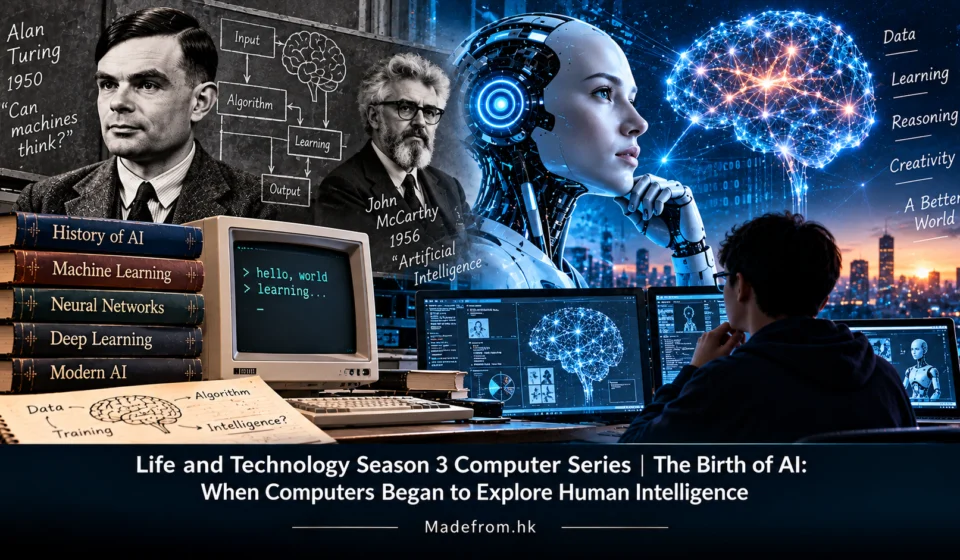
Life and Technology Season 3 Computer Series | The Birth of AI: When Computers Began to Explore Human Intelligence
Early computers were built primarily to calculate numbers faster and more accurately. Yet researchers soon began asking a much more ambitious question: could a computer learn, reason, solve problems and perhaps imitate aspects of human intelligence? That question eventually gave rise to artificial intelligence and opened a completely new chapter in computing history.
The birth of artificial intelligence did not happen suddenly in the modern era. Long before today’s generative AI systems could write articles, create images or generate computer code, scientists were already asking whether machines could reproduce some aspects of human intelligence. After the Second World War, electronic computers became increasingly powerful, and researchers began to see them as more than calculating machines. They could potentially become experimental platforms for studying reasoning, learning and problem-solving. One of the important early intellectual foundations came in 1943, when Warren McCulloch and Walter Pitts published influential work describing how neural activity could be represented through mathematical logic. Their ideas later became part of the intellectual history behind artificial neural networks. By 1950, British mathematician Alan Turing had taken the discussion much further. In his paper “Computing Machinery and Intelligence”, he asked the famous question: “Can machines think?” Rather than spending the entire discussion trying to define what thinking actually meant, Turing proposed the “imitation game”, which later became widely associated with the Turing Test. The basic idea was to consider whether a human could distinguish a machine from a person through communication. This was an important change in perspective. Instead of treating machine intelligence purely as a philosophical question, Turing turned it into something that could be discussed in terms of observable behaviour and computation. If a machine could produce intelligent-looking behaviour, how should scientists understand and measure it? During the early 1950s, researchers began building experimental programmes that attempted to reproduce specific forms of human problem-solving. Marvin Minsky and Dean Edmunds developed SNARC in 1951, an early neural-network machine designed to explore learning-like behaviour. In 1952, researchers including Allen Newell and Herbert A. Simon developed programmes such as Logic Theorist, which attempted to reproduce aspects of human reasoning through computation. These systems were extremely limited compared with modern AI, but they introduced an important new possibility: computers did not necessarily have to be limited to numerical calculation. They could also be designed to work with logic, rules, patterns and problems that appeared to require reasoning. The decisive milestone came in 1955, when John McCarthy, Marvin Minsky, Nathaniel Rochester and Claude Shannon proposed a research project called “A Proposal for the Dartmouth Summer Research Project on Artificial Intelligence”. It was in this proposal that the term “artificial intelligence” was introduced. The following summer, in 1956, a group of researchers gathered at Dartmouth College for the Dartmouth Summer Research Project on Artificial Intelligence. The workshop is widely regarded as the birth of artificial intelligence as a formal field of research. The researchers proposed that learning and other aspects of intelligence might be described precisely enough for a machine to simulate them. The ambition was remarkable considering the technology available at the time. Computers were enormous, expensive and extremely limited by modern standards. Memory was tiny, processing power was scarce, and programming was difficult. Yet researchers were already imagining machines that could reason, solve problems, understand language and perhaps learn. Following the Dartmouth workshop, artificial intelligence research expanded across universities and laboratories. Researchers explored symbolic reasoning, games such as chess, natural language, problem-solving and neural networks. Much of early AI relied on rules written by humans. Researchers attempted to represent knowledge and logic in a form that a computer could process. For certain well-defined problems, this approach could be surprisingly effective. But it also exposed a major limitation. The real world contains enormous amounts of knowledge and uncertainty, while human language is full of ambiguity and context. It is extremely difficult for people to write down every rule that another machine would need in order to behave intelligently. This helped encourage another approach: instead of telling a computer every rule explicitly, perhaps the computer could learn patterns from data and experience. In 1957, psychologist and computer scientist Frank Rosenblatt developed the Perceptron, an early artificial neural network capable of learning weights for pattern recognition. Although the Perceptron was limited and could not solve every kind of problem, it became an important milestone in the longer history of neural networks and machine learning. The development of AI was not a straight path towards today’s technology. Early researchers were often extremely optimistic about how quickly machines might achieve human-like abilities, but practical limitations in computing power, data and algorithms repeatedly slowed progress. AI research went through periods of reduced funding and enthusiasm before later technological advances changed the situation. Faster processors, enormous digital datasets, specialised hardware such as GPUs, improved algorithms and advances in machine learning and deep learning eventually transformed what computers could do. The AI systems of today may appear radically different from the machines imagined in the 1950s, but the underlying question remains surprisingly similar. Can aspects of human intelligence be represented, learned or simulated by machines? Modern generative AI can produce text, images, audio, video and computer code, capabilities that would have seemed extraordinary to the researchers at Dartmouth. In 2026, Dartmouth is marking the seventieth anniversary of the 1956 workshop, looking back at how the field developed from its original question about whether machines could simulate intelligence into today’s systems capable of generating content and making complex predictions. The birth of AI, therefore, was not the moment when one particular computer suddenly became intelligent. It was the result of a gradual change in how scientists imagined computers. First, computers were built primarily as calculating machines. Then they became programmable systems capable of handling increasingly complex tasks. Eventually, researchers began treating them as experimental platforms for exploring learning, reasoning, language and intelligence itself. From Turing’s question in 1950, through the Dartmouth workshop of 1956, to today’s generative AI, the history of artificial intelligence can be understood as one long attempt to answer a remarkably simple but profound question: if humans can use computers to simulate aspects of intelligence, how far can machines ultimately go?
The birth of AI marked a major change in the history of computing. From Turing’s question about whether machines could think to the Dartmouth workshop of 1956, computers became more than calculating machines. They became experimental platforms for exploring learning, reasoning and intelligence, eventually leading to today’s generative AI.