
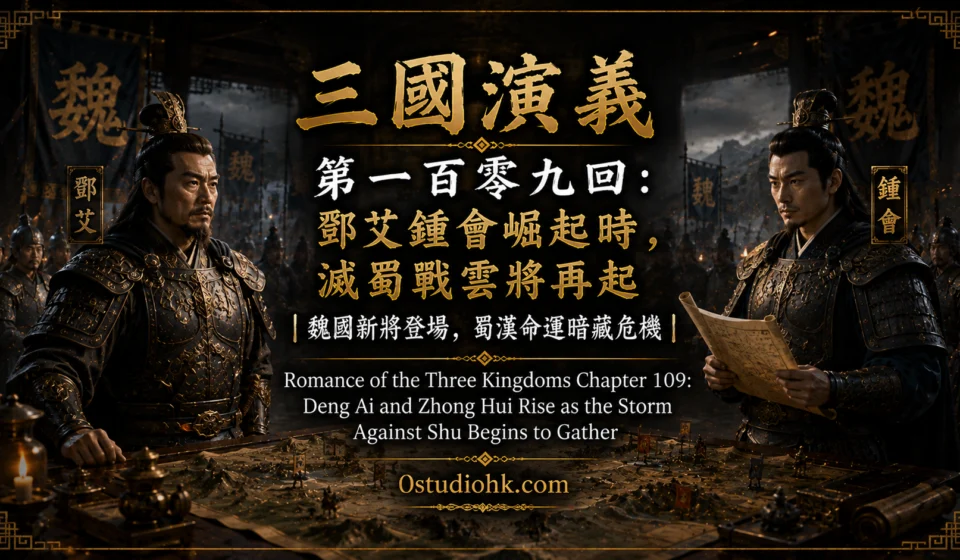
三國演義第一百零九回:鄧艾鍾會崛起時,滅蜀戰雲將再起|魏國新將登場,蜀漢命運暗藏危機 | Romance of the Three Kingdoms Chapter 109: Deng Ai and Zhong Hui Rise as the Storm Against Shu Begins to Gather
諸葛亮逝世後,姜維仍苦苦支撐北伐,但蜀漢國力已逐漸衰弱。與此同時,魏國新一代將領鄧艾與鍾會開始崭露頭角,一人善於奇兵與地形,一人長於謀略與統軍。魏蜀之間的戰爭,正悄悄走向最後也是最危險的階段。
While Jiang Wei continued Zhuge Liang’s unfinished Northern Expeditions, Shu Han was slowly losing the strength needed to sustain them. Within Wei, two ambitious commanders were rising: Deng Ai, known for daring maneuver and terrain-based strategy, and Zhong Hui, a gifted planner and army commander. Their emergence would soon reshape the final struggle between Wei and Shu.
中文版本
諸葛亮離開人世之後,蜀漢的北伐並沒有立即停止。姜維承接恩師遺志,多次率軍出祁山、進隴右,希望延續孔明未完成的復興漢室大業。可是多年戰爭留下的消耗,已經開始從各個方面影響蜀漢。前線需要糧草,後方需要休養;軍隊需要補充,百姓也需要安定生活。姜維雖然仍然相信北伐不能停止,卻越來越清楚地感受到,自己所能調動的力量正在減少。每一次出兵,都必須更加仔細計算糧草與兵力;每一次撤軍,都代表新的損耗。相比之下,魏國的國力仍然雄厚。只要守住關中與重要城池,便能利用地利與後勤優勢等待蜀軍疲弱。姜維的北伐因此逐漸陷入困局。就在蜀漢努力維持北伐之際,魏國內部卻開始出現新的軍事力量。鄧艾逐漸受到重視。他雖然不是出身最顯赫的名門,卻有極強的軍事才能,尤其擅長觀察地形與安排軍隊行進。他知道戰爭並不只是兩軍正面交鋒,山川、道路、糧道與天時,都可能成為決定勝負的因素。鄧艾經常研究魏蜀邊境的山勢與道路,思考如何從敵人意想不到的地方尋找突破口。這種不拘泥於傳統道路的作戰思維,讓他逐漸在魏國軍中嶄露頭角。與鄧艾不同,鍾會更擅長從全局思考戰爭。他年輕而有才華,熟悉兵法,也懂得分析政治與軍事之間的關係。他並不滿足於只取得一場戰役的勝利,而是思考如何透過連續的軍事行動改變整個戰局。當鄧艾研究山地與奇襲的可能性時,鍾會則開始思考如何調動大軍、分割敵軍以及逐步壓縮蜀漢的防線。兩人的風格不同,卻形成了非常特殊的互補。魏國原本只需要防守蜀軍北伐,如今卻開始出現一個更大的問題:如果蜀漢已經逐漸衰弱,是否可以不再只是防守,而是主動尋找消滅蜀漢的機會?這個念頭一旦出現,魏國的戰略方向便開始發生變化。過去幾十年,魏蜀之間的戰爭往往是蜀軍主動北上,魏軍依靠防守與消耗等待機會。可是到了這個時代,情況已經不同。蜀漢的軍力逐漸減少,朝廷內部也出現更多矛盾。姜維雖然在前線努力整軍,但後方未必能夠提供足夠的支持。成都與漢中之間的距離,使前線將領很難完全掌握朝廷的真正想法。姜維越是希望透過北伐保持主動,便越需要消耗有限的資源。魏國則可以利用更大的國力逐步等待。這種差距,開始成為蜀漢最危險的問題。姜維也察覺到,魏國的軍事人才正在更新。過去他熟悉的對手,已經逐漸退出歷史舞台;如今站在魏軍陣營中的,是一群更加年輕、更加積極的將領。鄧艾開始研究蜀漢西線的山川道路,鍾會則開始累積統率大軍所需要的經驗。兩個名字在魏國軍報之中越來越常見。姜維知道,這意味著新的時代正在來臨。一天夜裡,姜維獨自坐在軍帳之中,看著桌上的地圖。他從漢中看到祁山,再看到隴右與關中。這些道路,他已經走過很多次。當年孔明也曾在同樣的山河之間策劃北伐。可是如今的蜀漢,已經不是當年的蜀漢。劉備時代的將領逐漸凋零,諸葛亮也早已離世,而國家的力量正在一步一步減少。姜維明白,自己仍然可以率軍作戰,仍然可以取得局部勝利,但要靠這些勝利重新改變天下大勢,已經越來越困難。他最大的敵人,除了魏軍之外,還有時間。時間讓魏國更加強大,也讓蜀漢更加疲弱。就在這時,鄧艾與鍾會的崛起更令局勢發生變化。鄧艾善於利用地形,敢於選擇常人不願走的道路;鍾會則能夠從全局部署軍隊,尋找敵軍防線上的缺口。這兩種能力如果有一天真正結合起來,將可能形成一支極具威脅的魏軍。蜀漢的危機因此不再只是北方防線上的一次失利,而可能是整個國家安全的問題。姜維沒有因此放棄。他知道,只要蜀漢仍然存在,自己就不能停止準備。他繼續訓練士兵,整頓軍隊,研究魏軍動向,也繼續尋找新的北伐機會。然而,他心中比任何人都明白,蜀漢正在打一場越來越不對等的戰爭。魏國擁有更大的土地、更充足的人口、更完整的後勤體系;蜀漢所能依靠的,則是將士的忠誠、軍隊的意志,以及姜維本人對北伐理想的堅持。戰爭的天平正在慢慢傾斜。祁山的風再次吹過蜀軍軍旗,姜維站在山道之上,遠望魏國方向。他不知道未來會出現怎樣的戰局,但他知道一件事:魏國的新一代將領正在崛起,而蜀漢真正危險的時刻,也正在一步一步逼近。鄧艾與鍾會的名字,從此不再只是魏國軍中的新星,而將逐漸成為蜀漢命運最重要的威脅之一。北伐的戰鼓仍然會響起,但下一場大戰的方向,或許已經開始悄悄改變。
English Version
Years had passed since Zhuge Liang’s death, yet the Northern Expeditions continued. Jiang Wei had inherited his teacher’s unfinished mission and repeatedly led Shu forces toward Mount Qi and the western regions, hoping to preserve the dream of restoring the Han dynasty. But the cost of those campaigns was becoming increasingly difficult for Shu Han to bear. Soldiers needed food and weapons, farmers needed time to recover, and the government had to maintain a military system that was constantly under pressure. Jiang Wei remained determined, but he could no longer ignore the shrinking resources behind every campaign. Each advance required more supplies, while every retreat left the kingdom weaker. Wei, by contrast, still possessed enormous advantages. Its larger territory, population, and logistical network allowed its commanders to defend important positions and wait for Shu forces to become exhausted. This imbalance gradually turned the Northern Expeditions into a struggle that Shu could no longer easily win. At the same time, a new generation of commanders was emerging within Wei. Among them was Deng Ai. His rise did not come simply from family background or political connections. He gained recognition through practical military ability, especially his understanding of terrain and movement. Deng Ai studied mountains, roads, supply routes, and the weaknesses of defensive positions. He understood that a battlefield was not limited to the open ground where armies met. A narrow mountain path could become more important than a heavily defended gate, and a well-planned march through difficult terrain could achieve what a large frontal assault could not. This way of thinking gradually made him one of Wei’s most promising commanders. Another rising figure was Zhong Hui. His strengths were different. Zhong Hui was highly intelligent, ambitious, and deeply interested in large-scale strategy. Rather than concentrating only on individual battles, he studied how armies, political decisions, logistics, and multiple fronts could be combined into a single campaign. Deng Ai focused heavily on practical movement and unexpected routes, while Zhong Hui looked toward the broader structure of war. Their abilities were different, but that difference could eventually become an advantage. Wei had spent decades defending itself against Shu’s Northern Expeditions. But as Shu weakened, a new question began to emerge within the Wei leadership. Why continue defending indefinitely if Shu could eventually be destroyed? The idea represented a major change in strategic thinking. For generations, Shu had been the side attempting to advance north while Wei waited behind strong defensive positions. Now the balance was gradually changing. Shu Han was losing strength, while Wei was becoming increasingly confident. Jiang Wei continued to prepare his forces, but political support and resources from the rear were no longer as dependable as before. The distance between the battlefield and Chengdu made coordination difficult, and every new campaign required resources that Shu could barely spare. Wei did not face the same problem. Its larger economy allowed it to replace troops, replenish supplies, and maintain defensive positions for much longer. Jiang Wei therefore found himself fighting two battles at once: one against Wei soldiers in the mountains, and another against the gradual exhaustion of his own kingdom. He also began to recognize that the opponents facing him were changing. The commanders of an earlier generation were disappearing from the stage, while younger men were beginning to shape Wei’s military future. Deng Ai was studying the western approaches to Shu, paying particular attention to difficult mountain routes. Zhong Hui was developing the ability to command larger forces and think beyond individual engagements. Their names appeared more frequently in military reports, and Jiang Wei understood the significance. A new era was approaching. One night, Jiang Wei sat alone inside his command tent and studied a map stretching from Hanzhong through Mount Qi and toward Longyou and Guanzhong. He had traveled many of these roads before. Zhuge Liang had once studied the same mountains while planning his Northern Expeditions. But the Shu Han of the present was not the Shu Han of Zhuge Liang’s time. Liu Bei’s generation had largely disappeared. Zhuge Liang was gone. The kingdom’s resources were shrinking. Jiang Wei could still win individual battles, but he was beginning to understand that individual victories were no longer enough to change the overall balance of power. His greatest enemy was not simply the Wei army. It was time itself. Time was allowing Wei to become stronger while Shu became weaker. The rise of Deng Ai and Zhong Hui made that situation even more dangerous. Deng Ai was willing to exploit terrain that others considered impassable, while Zhong Hui possessed the strategic ability to organize large-scale operations and search for weaknesses across an entire defensive system. If their talents were ever combined in a major campaign, Shu Han could face a threat unlike anything it had experienced before. The danger was no longer simply another failed Northern Expedition. It could become a direct threat to the survival of the kingdom. Jiang Wei nevertheless refused to surrender. As long as Shu Han existed, he believed he had a duty to prepare for the next campaign. He continued training troops, organizing supplies, studying Wei movements, and searching for opportunities. But deep inside, he understood how unequal the struggle had become. Wei possessed greater territory, more people, stronger logistics, and greater reserves. Shu relied upon loyalty, military discipline, determination, and Jiang Wei’s refusal to abandon the dream he had inherited from Zhuge Liang. The balance of power was slowly shifting. Once again, the winds swept across the banners near Mount Qi. Jiang Wei stood upon the mountain road and looked toward the northern horizon. He could not know exactly what the future would bring, but one fact was becoming clear. Wei’s new generation of commanders was rising, and the most dangerous phase of the struggle was approaching. Deng Ai and Zhong Hui were no longer merely promising young officers. They were becoming figures who would eventually play a decisive role in Shu Han’s fate. The drums of the Northern Expeditions had not yet fallen silent. But the direction of the coming war was already beginning to change.