
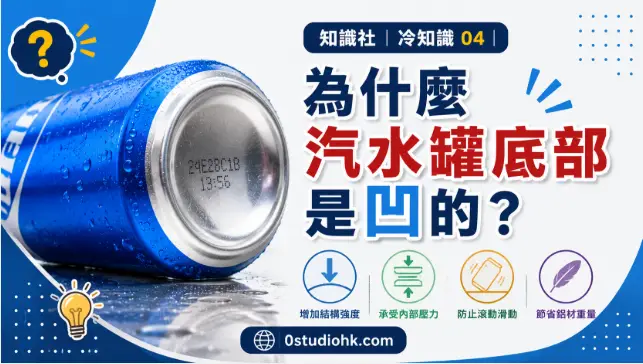
知識社|冷知識 04|為什麼汽水罐底部是凹的? Why Is the Bottom of a Soda Can Concave?
喝汽水時,你是否曾留意過鋁罐底部都是向內凹陷,而不是完全平坦?這個設計並不是為了美觀,而是經過多年工程研究後,兼顧安全、耐用與節省材料的重要成果。
Have you ever noticed that the bottom of a soda can curves inward instead of being completely flat? This seemingly simple design is actually a clever engineering solution that improves strength, safety, and manufacturing efficiency.
中文版本
汽水鋁罐幾乎每天都出現在我們的生活中,但很少人會仔細觀察它的底部。與一般杯子或罐子不同,鋁罐的底部並不是平的,而是向內凹陷,形成一個圓弧狀結構。許多人以為這只是方便堆疊或美觀的設計,其實真正原因與物理學及材料工程有密切關係。汽水、啤酒及各種碳酸飲料在密封後,罐內會維持一定壓力,尤其在溫度升高時,二氧化碳會令內部壓力增加。如果罐底採用完全平面設計,受到壓力時容易向外鼓起甚至變形,長期儲存亦可能影響穩定性。相反,圓弧形的凹底能夠把壓力平均分散到整個底部與罐身,大幅提升整體結構強度,就像拱橋能承受巨大重量一樣,把力量均勻傳遞到四周,而不是集中在某一個位置,因此更能抵抗擠壓與撞擊。除了提升強度外,凹底設計還能節省鋁材。若要製造同樣強度的平底鋁罐,就必須使用更厚的金屬,增加成本與重量。利用弧形結構,即使鋁片較薄,也能保持足夠的承壓能力,這對全球每年生產數千億個飲料罐而言,可以節省大量原料、能源及運輸成本,同時減少碳排放。製造商亦會精密控制凹陷深度,使每一個鋁罐都能承受相近壓力,不容易因碰撞而變形。另一方面,凹底亦能提升放置時的穩定性。當鋁罐受到輕微撞擊時,底部的彈性結構可以吸收部分衝擊力,減少整個罐身直接變形。當飲料完成裝填與封口後,內部壓力會令底部保持在設計狀態,使整個鋁罐更加堅固。這也是為什麼打開一罐汽水前,若罐身出現嚴重鼓起或變形,通常代表內部壓力異常,不宜飲用。今天,不只是汽水罐,許多食品罐、噴霧罐及壓力容器都採用了相似的弧形底部設計。這個看似不起眼的小細節,其實凝聚了工程學、材料科學及工業設計的智慧,也說明許多日常用品背後,都隱藏著精密的科學原理。
English Version
A soda can may seem like one of the simplest everyday objects, yet every curve has been carefully engineered. One of its most distinctive features is the inward-curved base. Rather than being flat, the bottom forms a shallow dome that plays a crucial role in keeping the can strong and reliable. Carbonated drinks contain dissolved carbon dioxide, creating pressure inside the sealed container. As temperatures change, that pressure can increase, placing continuous stress on the can’s walls and base. If the bottom were completely flat, it would be much more likely to bulge outward or deform under pressure. Engineers solved this problem by giving the base a curved shape that distributes force evenly across the entire structure. This principle is similar to the way arches support bridges and domes strengthen large buildings. By spreading the load instead of concentrating it at one point, the can becomes far more resistant to internal pressure and external impacts. Another major advantage is material efficiency. A flat-bottomed can would require thicker aluminum to achieve the same strength, making every can heavier and more expensive to manufacture. Because billions of beverage cans are produced every year, even saving a fraction of a gram of aluminum per can results in enormous reductions in raw materials, transportation costs, and environmental impact. Modern manufacturing processes precisely control the depth and curvature of the base so that every can performs consistently during filling, shipping, storage, and refrigeration. The concave bottom also contributes to stability. Its flexible structure can absorb small impacts and helps the can maintain its shape during handling. After the beverage is filled and sealed, the internal pressure works together with the engineered base to create a surprisingly rigid container despite the thin aluminum walls. This is one reason consumers should avoid drinking from cans that appear badly swollen or distorted, as abnormal pressure may indicate damage or spoilage. Similar engineering principles are now used in food cans, aerosol containers, and many other pressurized products. What appears to be a simple curve is actually the result of decades of research in structural engineering, materials science, and industrial manufacturing, proving that some of the smartest innovations are hidden inside the most ordinary objects.
總評
汽水罐底部的凹陷設計,不只是節省材料,更能提高承壓能力與安全性,是工程學利用簡單形狀解決複雜問題的經典例子。
Summary
The concave base of a soda can is far more than a stylistic choice. It is an elegant engineering solution that improves strength, saves materials, and keeps billions of beverages safe every year.

-150x150.webp "知識社|冷知識 04|為什麼汽水罐底部是凹的? Why Is the Bottom of a Soda Can Concave?")