三國演義 第七十七回:關羽敗走麥城,父子忠義壯烈殉國||Romance of the Three Kingdoms Chapter 77: Guan Yu’s Last Stand at Maicheng and the Heroic Sacrifice of Father and Son
荊州失守後,關羽率殘軍一路撤退,遭曹魏與東吳兩面夾擊,最終退守麥城。援軍遲遲未至,糧草早已耗盡,關羽與長子關平仍誓死不降。這位威震華夏的名將,最終以忠義寫下生命最後一頁,也成為《三國演義》中最令人動容的篇章之一。
After the loss of Jing Province, Guan Yu retreated with his remaining soldiers while pursued by both Wei and Wu forces. Surrounded in Maicheng with no hope of reinforcement, he and his son Guan Ping refused every opportunity to surrender. Their final stand became one of the most enduring symbols of loyalty and honor in the Romance of the Three Kingdoms.
中文
夜色籠罩大地。
敗退中的蜀軍拖著疲憊的腳步,一路向西南撤退。昔日旌旗蔽野、威震天下的大軍,如今只剩下寥寥數千人。
關羽騎著赤兔馬,沉默地走在隊伍前方。
沿途所見,盡是殘破村落與戰火留下的痕跡。
荊州已失。
北伐功業盡成泡影。
不久,大軍退入麥城。
這座孤城城牆低矮,糧草不足,四周皆被東吳軍隊層層包圍。
呂蒙早已完成部署,朱然、潘璋、馬忠等將領分守各處要道,斷絕關羽所有退路。
城內眾將望著敵軍營火,人人神色凝重。
關平率先開口。
「父親,不如趁夜突圍,或可與西川援軍會合。」
關羽點頭。
他知道,死守麥城只有坐以待斃。
當夜,關羽率領數百精騎悄然衝出城門。
赤兔馬奔馳如飛,青龍偃月刀寒光閃耀,東吳士兵紛紛避讓。
然而,吳軍早已布下重重伏兵。
喊殺聲四起。
箭雨如潮。
關羽父子一路奮戰,身邊將士卻不斷倒下。
突破第一道防線,又遇第二道伏兵。
剛衝出山谷,又遭第三路兵馬截擊。
整整一夜,血染征袍。
黎明時分,身邊只剩下十餘名隨從。
關羽回首望去。
麥城早已遠在身後,而前方道路卻依舊被敵軍封鎖。
就在一處山谷之中,馬忠率兵突然殺出。
四面伏兵同時現身。
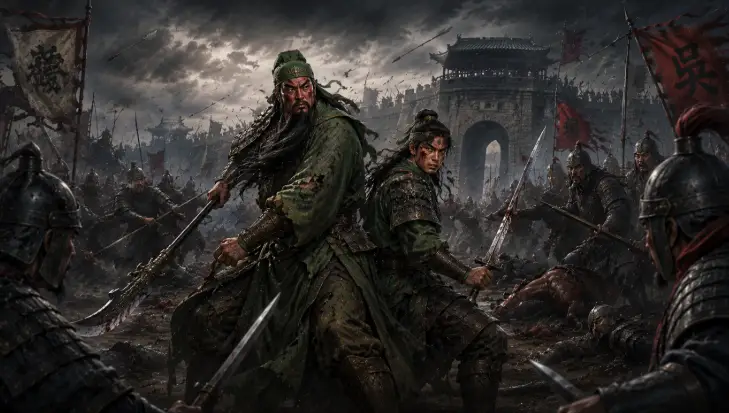
關羽與關平背靠背迎戰。
青龍偃月刀依舊威勢驚人,然而長途奔襲與連番激戰,早已耗盡父子二人的體力。
赤兔馬亦因連日奔馳而力竭。
終於,在重重包圍之下,關羽父子被東吳軍生擒。
孫權得知消息後,立即命人押送關羽。
他仍希望勸降這位天下聞名的英雄。
大帳之中,孫權親自相迎。
「將軍若願歸吳,孤必以上賓之禮相待。」
關羽神情平靜。
「吾受漢中王厚恩,生為漢臣,死為漢鬼。」
一句話,斬斷所有勸降之言。
孫權沉默許久。
他知道,眼前這位英雄絕不可能改變心志。
最終,下令將關羽與關平處斬。
刑場之上,父子二人神色從容。
關平望向父親。
「孩兒能與父親同死,此生無憾。」
關羽微微點頭。
「忠臣不事二主,今日無愧天地。」
刀光落下。
一代名將,就此長眠。
消息傳入成都。
劉備聞訊,悲痛欲絕,久久不能言語。
張飛更怒髮衝冠,拍案大吼。
「不報此仇,誓不為人!」
蜀漢上下無不痛哭。
百姓自發設祭,追悼這位守護荊州多年的英雄。
而在北方,曹操得知關羽死訊,也不禁感慨。
昔日並肩論英雄,如今竟成永別。
他命人厚葬關羽首級,以示敬重。
關羽雖敗於戰場,卻未敗於氣節。
他的忠義、勇武與信念,並未隨生命終結而消失,反而流傳千古。
後世百姓尊其為「關聖帝君」,歷代文人歌頌其忠義,無數廟宇香火不絕。
麥城失守,結束了一位名將的生命。
卻也開始了一段跨越千年的傳奇。
English Version
The retreat had become a desperate journey.
After losing Jing Province, Guan Yu led only a fraction of the once-mighty Shu army toward the small fortress of Maicheng. The soldiers who had once marched confidently across battlefields now struggled with exhaustion, hunger, and constant pursuit.
Maicheng offered little hope.
Its walls were weak, supplies were scarce, and Wu forces had already surrounded every possible escape route.
Lü Meng’s careful planning had left Guan Yu completely isolated.
Inside the fortress, Guan Ping urged his father to break through before it was too late.
Guan Yu agreed.
Remaining inside the city meant certain defeat.
Under the cover of darkness, several hundred cavalry charged through the gates.
Mounted on the legendary Red Hare and wielding the Green Dragon Crescent Blade, Guan Yu once again fought with astonishing courage.
But the enemy had anticipated every move.
Hidden ambushes waited beyond each mountain pass.
Every successful breakthrough led only to another line of soldiers blocking the road.
Through the long night, Shu’s remaining warriors fell one after another.
By dawn, only a handful remained beside Guan Yu and Guan Ping.
Then came the final trap.
General Ma Zhong and Wu’s troops emerged from concealed positions, surrounding the exhausted father and son from every direction.
Despite fierce resistance, neither Guan Yu nor his horse could continue fighting.
Both were captured alive.
Sun Quan still hoped to persuade Guan Yu to join Eastern Wu.
Receiving the legendary general with respect, he promised honor, rank, and safety in exchange for surrender.
Guan Yu answered calmly.
“I have served the King of Hanzhong with unwavering loyalty. I will never serve another master.”
The reply ended all negotiation.
Knowing that Guan Yu would never abandon his principles, Sun Quan reluctantly ordered the execution of both Guan Yu and Guan Ping.
Before the execution, Guan Ping looked toward his father.
“To die beside you is my greatest honor.”
Guan Yu nodded quietly.
“A loyal man never serves two masters.”
Moments later, father and son met death together.
News quickly reached Chengdu.
Liu Bei was overcome with grief.
Zhang Fei swore vengeance.
Throughout Shu, soldiers and civilians mourned the loss of the kingdom’s greatest warrior.
Even Cao Cao, Guan Yu’s longtime rival, expressed deep respect for the fallen hero.
Though defeated in battle, Guan Yu’s honor remained untouched.
His unwavering loyalty, courage, and integrity elevated him beyond the role of a military commander.
In later generations, he would be worshipped as Guan Di, the God of War and a symbol of righteousness throughout the Chinese world.
The fall of Maicheng marked not merely the death of a general, but the birth of an immortal legend whose influence would endure for centuries.