尼古拉斯·奧托與德意志帝國:改變世界交通的內燃機革命先驅 | Nikolaus Otto and the German Empire: The Inventor Who Revolutionized Transportation with the Internal Combustion Engine | 世界名人錄
尼古拉斯·奧托以四行程內燃機改變世界工業與交通發展,他的發明成為現代汽車與機械動力的重要基礎,也讓德意志帝國成為工業革命後期的重要科技強國。
Nikolaus Otto transformed modern transportation and industry through the invention of the four-stroke internal combustion engine, a breakthrough that became the foundation of automobiles, aviation, and modern mechanical power systems.
中文版本
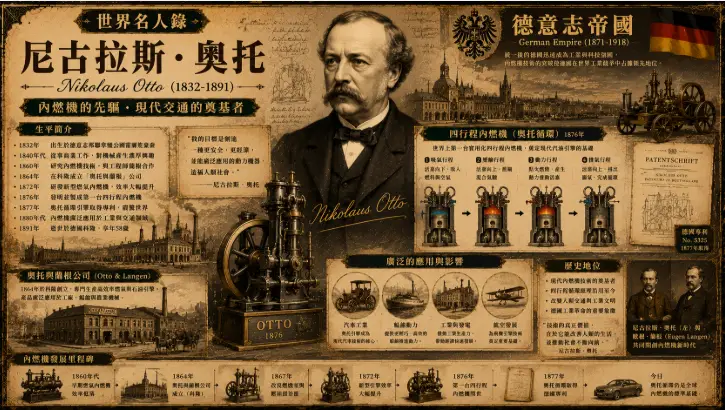
尼古拉斯·奧托出生於1832年的德意志邦聯拿騷公國霍爾茨豪森。當時的德意志地區尚未統一,由眾多邦國組成,但工業化與技術革新已開始快速發展。奧托出身於普通家庭,父親早逝,使他年輕時必須提早面對現實生活壓力。他並未接受完整大學教育,而是進入商業領域工作,曾擔任業務員與商人。然而,十九世紀中葉的歐洲正處於工業革命重要階段,蒸汽機雖已廣泛應用,但體積龐大、效率有限且運作成本高昂。奧托對機械與動力技術產生濃厚興趣,開始思考是否存在比蒸汽機更有效率的新型引擎。1860年代,法國工程師勒努瓦已發明早期燃氣內燃機,但效率低落且耗能極高。奧托在研究相關技術後,相信仍有巨大改進空間。他與工程師歐根·蘭根合作,共同投入內燃機研究。1864年,兩人於科隆成立公司,後來逐漸發展成德國重要引擎製造企業之一。奧托最大的突破,來自他對燃燒與動力循環方式的重新設計。1876年,奧托成功研發出世界上第一具實用化四行程內燃機,也就是後來著名的「奧托循環引擎」。這種引擎利用進氣、壓縮、燃燒與排氣四個步驟循環運作,大幅提升能源效率與動力輸出。相比先前內燃機,奧托引擎更穩定、更節能,也更適合實際工業與交通用途。這項發明被視為現代汽油引擎的真正起點。四行程循環原理後來成為全球汽車工業的核心技術,直到今日仍廣泛應用於汽車、機車、船舶與部分飛機引擎。奧托的發明不僅改變工程技術,也深刻影響人類社會結構。內燃機比蒸汽機更加輕巧靈活,使個人交通工具成為可能。後來卡爾·本茨與戈特利布·戴姆勒等德國工程師,正是在奧托技術基礎上進一步發展現代汽車。德意志帝國於1871年統一後,工業實力快速崛起,而內燃機技術更成為德國工業革命後期的重要象徵之一。隨著汽車產業發展,全球交通、城市結構與經濟活動模式也逐漸被徹底改變。除了交通用途之外,內燃機也推動農業、工廠與軍事技術發展。從拖拉機、發電設備到後來飛機引擎,其核心概念皆源自奧托建立的動力循環原理。雖然後世許多工程師持續改良引擎設計,包括柴油引擎與高性能汽油引擎誕生,但奧托的四行程循環始終是現代引擎工程的重要基礎。奧托本人雖非典型學院派科學家,但他具備極強實作能力與技術直覺。他重視實驗與機械改良,能從失敗中持續修正設計。這種結合工業實務與創新思維的精神,也正反映十九世紀德國工程文化快速崛起的時代特色。隨著內燃機逐漸普及,奧托獲得國際聲譽與財富,但他也面臨專利競爭與技術爭議。部分工程師指出四行程原理早有概念存在,因此奧托專利後來曾受到挑戰。不過,歷史學家普遍認為,真正讓四行程內燃機成功實用化的人,仍是尼古拉斯·奧托。1891年,奧托於德國科隆逝世,享年58歲。雖然他並未親眼見證汽車全面普及與航空時代來臨,但他的發明已為現代交通文明奠定基礎。今日全球數十億輛內燃機交通工具,其技術根源都能追溯至奧托循環。歷史學家普遍將尼古拉斯·奧托視為工業革命後期最重要的發明家之一。他不只是改良引擎,更改變了人類移動方式與現代世界發展方向。從高速公路、汽車工業到全球物流與航空科技,現代機械文明的巨大擴張,都與這位來自德意志帝國時代的工程先驅密切相關。
English Version
Nikolaus Otto was born in 1832 in Holzhausen, within the Duchy of Nassau, at a time when the German lands remained politically fragmented but were rapidly entering the industrial age. Long before the unification of the German Empire, technological innovation and industrial growth were transforming Europe. Otto came from a modest family background, and after the early death of his father, he faced economic pressures at a young age. Unlike many later engineers and scientists, Otto did not receive a formal university education in engineering. Instead, he worked in commercial and sales positions while developing a growing fascination with machinery and mechanical power. During the mid-nineteenth century, steam engines dominated transportation and industry, yet they remained large, heavy, inefficient, and expensive to operate. Otto became convinced that a smaller and more efficient source of power could eventually replace steam technology. In the 1860s, early experiments with internal combustion engines had already begun in Europe. French inventor Étienne Lenoir created one of the first gas-powered engines, but its performance remained inefficient and impractical for widespread use. Otto carefully studied these early designs and believed significant improvements were possible. He partnered with engineer Eugen Langen, and together they established an engine manufacturing company in Cologne in 1864. Their collaboration combined Otto’s mechanical insight with practical industrial experience, allowing them to continue refining internal combustion technology. Otto’s greatest achievement came through his redesign of the combustion cycle itself. In 1876, he successfully developed the first practical four-stroke internal combustion engine, later known worldwide as the Otto cycle engine. This revolutionary system operated through four stages: intake, compression, combustion, and exhaust. By compressing the fuel-air mixture before ignition, Otto dramatically increased efficiency, power output, and reliability compared with previous engines. The invention represented a major breakthrough in engineering and became the foundation of the modern gasoline engine. The four-stroke cycle remains one of the most important mechanical principles in transportation history and continues to power millions of automobiles, motorcycles, boats, and aircraft around the world today. Otto’s engine fundamentally transformed industry and society. Unlike steam engines, internal combustion engines were compact and flexible enough to power personal transportation. Later inventors such as Karl Benz and Gottlieb Daimler built upon Otto’s work to develop the first modern automobiles. Following the unification of Germany in 1871, the German Empire rapidly emerged as one of the world’s leading industrial powers, and internal combustion technology became one of its defining achievements. The spread of automobiles eventually reshaped cities, commerce, transportation networks, and daily life across the globe. Beyond transportation, Otto’s invention also revolutionized agriculture, manufacturing, and military technology. Tractors, generators, industrial machinery, and eventually aircraft engines all relied upon principles connected to the four-stroke combustion cycle. Although later inventors developed diesel engines and more advanced propulsion systems, Otto’s design remained the essential foundation of modern engine engineering. What made Otto especially remarkable was that he succeeded not through academic theory alone but through experimentation, persistence, and mechanical intuition. He repeatedly refined his engines through trial and error, improving efficiency and durability after each setback. His career reflected the broader rise of German engineering culture during the nineteenth century, when industrial innovation increasingly depended on practical inventors capable of turning scientific ideas into usable machines. As the importance of internal combustion technology grew, Otto gained international recognition and financial success. However, he also faced patent disputes and legal challenges. Some engineers argued that elements of the four-stroke principle had been conceived earlier by other inventors. Despite these controversies, historians generally agree that Otto was the individual who successfully transformed the concept into a practical and commercially viable engine capable of changing the modern world. Nikolaus Otto died in Cologne in 1891 at the age of fifty-eight. Although he did not live long enough to witness the global rise of automobiles or the dawn of aviation, his invention had already set these revolutions into motion. Today, billions of internal combustion engines operating across the world still rely on the fundamental principles established by the Otto cycle. Historians regard Nikolaus Otto as one of the most influential inventors of the late Industrial Revolution because his work reshaped human mobility and accelerated the expansion of modern industrial civilization. From highways and automotive industries to aviation and global logistics, the technological transformation of the modern age owes an enormous debt to the pioneering engine developed by this German inventor.