
歐內斯特·盧瑟福與新西蘭:揭開原子結構的核物理之父 | Ernest Rutherford and New Zealand: The Father of Nuclear Physics Who Unlocked the Atom | 世界名人錄
歐內斯特·盧瑟福被譽為「核物理之父」,他透過革命性實驗揭開原子內部結構,改變人類對物質世界的理解,也讓來自新西蘭的他成為近代科學史最偉大的物理學家之一。
Ernest Rutherford transformed modern science by uncovering the internal structure of the atom. His groundbreaking discoveries in radioactivity and nuclear physics reshaped humanity’s understanding of matter and laid the foundation for the atomic age.
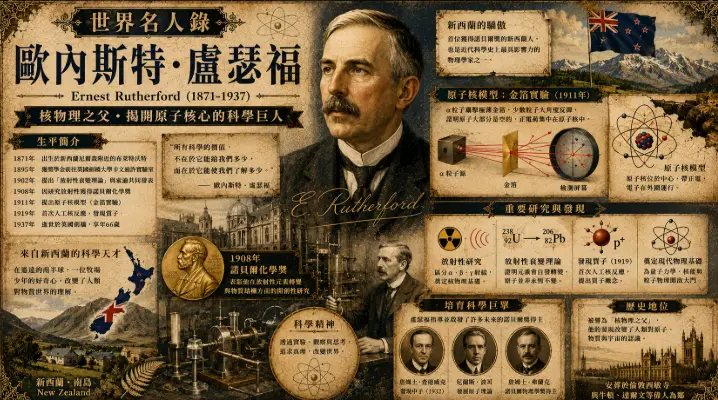
歐內斯特·盧瑟福出生於1871年的新西蘭南島尼爾森附近一個農村家庭。當時的新西蘭仍屬於大英帝國殖民地,地理位置偏遠,教育與科研資源遠不如歐洲。然而,盧瑟福從小便展現驚人的學習能力與對科學的濃厚興趣。他的父母雖然務農,但十分重視教育,希望孩子能透過知識改變命運。年輕時的盧瑟福在學校成績優異,尤其擅長數學與物理。憑藉優秀表現,他進入坎特伯雷學院深造,開始接觸當時快速發展的電磁學與實驗物理學。十九世紀末,科學界正處於巨大變革時代。X射線、電子與放射性等新發現接連出現,人類對物質世界的理解開始被徹底改寫。1895年,盧瑟福獲得獎學金前往英國劍橋大學卡文迪許實驗室研究,師從著名物理學家J.J.湯姆森,也就是電子發現者。進入歐洲頂尖科研中心後,盧瑟福很快展現卓越實驗才能。他早期研究無線電波與電離現象,之後開始專注於放射性研究。當時法國科學家貝克勒爾與居里夫婦剛發現放射性現象,但其本質仍不清楚。盧瑟福透過實驗首次將放射線區分為α射線與β射線,後來又進一步發現γ射線存在。這些研究成為核物理學的重要基礎。1902年,盧瑟福與化學家弗雷德里克·索迪共同提出「元素衰變理論」,指出放射性元素會自發轉變為其他元素。這項理論震撼整個科學界,因為它首次證明原子並非不可分割的永恆存在,而是會發生內部變化。這種觀念徹底改變人類對原子的理解,也為後來核能與粒子物理研究奠定基礎。1908年,盧瑟福因研究放射性而獲得諾貝爾化學獎,成為首位獲得諾貝爾獎的新西蘭人。然而,他最著名的成就還在後面。1911年,盧瑟福根據著名的「金箔實驗」提出原子核模型。在實驗中,他的研究團隊以α粒子轟擊極薄金箔,原本依照當時流行的「葡萄乾布丁模型」,粒子應該幾乎直接穿過原子。但實驗結果顯示,少數粒子竟被強烈反彈。盧瑟福因此推論,原子大部分空間其實是空的,而正電荷與絕大部分質量集中於極小的核心,也就是「原子核」。這項發現被視為近代物理學史最重要突破之一。後來,丹麥物理學家波耳進一步發展原子模型,而量子力學與核物理學也因此快速誕生。1919年,盧瑟福又完成另一項重大突破。他首次成功以人工方式改變原子結構,透過α粒子撞擊氮原子,產生氧原子與質子。這被視為人類首次人工核反應,也讓他被稱為「核物理之父」。此外,他也首次提出「質子」概念,為後來中子與基本粒子研究開啟道路。除了個人研究成就外,盧瑟福也是極具影響力的科學導師。他在英國培養大量年輕科學家,包括後來發現中子的詹姆士·查德威克,以及發展原子物理的重要學者。許多二十世紀最重要的核物理突破,都能追溯至盧瑟福建立的研究體系。雖然他的研究後來間接促成核能與原子彈發展,但盧瑟福本人其實較重視純科學探索。他曾半開玩笑地表示,利用原子能發電「幾乎不可能」。然而數十年後,核能時代卻迅速來臨。1937年,盧瑟福於英國劍橋逝世,享年66歲。由於其巨大貢獻,他被安葬於西敏寺,與牛頓、達爾文等偉大科學家長眠同地。今日,盧瑟福被廣泛視為近代核物理與原子科學最重要奠基者之一。從醫療放射技術、核能發電到粒子加速器研究,人類對原子世界的理解幾乎都建立於他的發現之上。對新西蘭而言,盧瑟福更象徵著來自偏遠小國的人才,也能改變整個世界科學歷史。
English Version
Ernest Rutherford was born in 1871 near Nelson on New Zealand’s South Island, at a time when the country was still a distant colony of the British Empire. Growing up in a rural farming family, Rutherford experienced a childhood far removed from the great scientific centers of Europe. Despite limited resources, he displayed exceptional intelligence and curiosity from an early age. His parents strongly valued education and encouraged him to pursue academic excellence. Rutherford excelled particularly in mathematics and science, eventually earning admission to Canterbury College, where he began serious studies in physics and experimental science. During the late nineteenth century, the scientific world was undergoing revolutionary change. Discoveries involving electricity, magnetism, X-rays, electrons, and radioactivity were transforming humanity’s understanding of nature. In 1895, Rutherford won a scholarship to study at the Cavendish Laboratory at Cambridge University in England, one of the most advanced scientific institutions in the world. There he worked under J. J. Thomson, the physicist who discovered the electron. Rutherford quickly distinguished himself through his remarkable skill in designing experiments and interpreting results. His early work focused on electromagnetic waves and ionization, but he soon became fascinated by radioactivity, an entirely new field of research. At the time, scientists such as Henri Becquerel and Marie Curie had only recently discovered radioactive phenomena, and little was understood about their nature. Rutherford’s experiments led him to identify and classify alpha and beta radiation, while later work contributed to the discovery of gamma radiation. These findings became essential foundations for nuclear physics. In 1902, Rutherford collaborated with chemist Frederick Soddy to develop the theory of radioactive decay. Together, they demonstrated that radioactive elements spontaneously transformed into different elements over time. This discovery shocked the scientific community because it challenged the long-held belief that atoms were indivisible and eternal. Rutherford’s work revealed that atoms possessed internal structures capable of change, opening the door to entirely new understandings of matter and energy. In recognition of his achievements, Rutherford received the Nobel Prize in Chemistry in 1908, becoming the first New Zealander to win a Nobel Prize. Yet his most famous contribution was still to come. In 1911, Rutherford proposed the nuclear model of the atom following the famous gold foil experiment conducted with his students Hans Geiger and Ernest Marsden. According to the prevailing “plum pudding” model, atoms were thought to contain evenly distributed positive charge. However, Rutherford’s experiments showed that while most alpha particles passed through thin gold foil, a small number were deflected sharply backward. Rutherford concluded that atoms were mostly empty space, with nearly all positive charge and mass concentrated within a tiny central nucleus. This discovery fundamentally transformed atomic theory and became one of the defining breakthroughs in modern physics. Later scientists, including Niels Bohr, expanded upon Rutherford’s ideas, leading to the development of quantum mechanics and modern atomic science. Rutherford continued pushing scientific boundaries. In 1919, he achieved the first artificial nuclear reaction by bombarding nitrogen atoms with alpha particles, transforming them into oxygen and releasing hydrogen nuclei. This experiment effectively marked the beginning of nuclear physics as an experimental science. Rutherford also introduced the concept of the proton, helping establish the foundation for future discoveries involving subatomic particles, including the neutron. Beyond his own discoveries, Rutherford became one of the most influential scientific mentors of the twentieth century. Working mainly in Britain, he trained and inspired a generation of physicists who would go on to transform modern science. Among his students and associates were James Chadwick, who discovered the neutron, and numerous other pioneers of atomic and nuclear research. Many of the greatest scientific advances of the twentieth century emerged from laboratories shaped by Rutherford’s leadership and experimental philosophy. Although Rutherford’s discoveries eventually contributed to nuclear energy and atomic weapons, he himself remained focused primarily on pure scientific exploration. He once joked that generating useful power from atomic energy seemed unlikely, unaware that future generations would unlock the enormous energy hidden within the nucleus. Rutherford died in Cambridge in 1937 at the age of sixty-six. Due to his immense contributions to science, he was buried in Westminster Abbey near figures such as Isaac Newton and Charles Darwin. Today, Ernest Rutherford is remembered as the father of nuclear physics and one of the architects of modern scientific understanding. His discoveries transformed humanity’s view of matter, energy, and the structure of the universe itself. From nuclear medicine and particle accelerators to atomic theory and energy research, countless scientific fields continue to build upon Rutherford’s groundbreaking work. For New Zealand, he also remains a symbol of how extraordinary talent from a small and distant nation can change the course of world history.