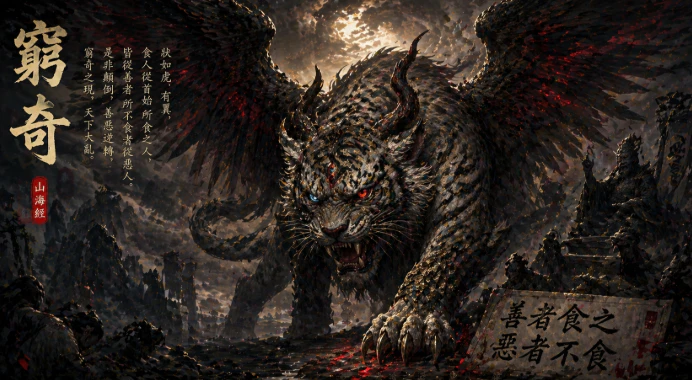
窮奇是《山海經》中極具爭議的神獸,傳說牠吞食善人、庇護惡者,顛覆善惡秩序,象徵人性與價值判斷的混亂與矛盾。
Qiong Qi, a notorious creature in the Shan Hai Jing, is said to favor the wicked and harm the virtuous, embodying the unsettling inversion of morality and the ambiguity of human judgment.
中文
在遙遠而荒涼的山野深處,有一片被遺忘的土地,那裡風聲如泣,石影如獸,無人敢輕易踏足,因為傳說中,窮奇便棲息於此。牠的身形似虎,卻生有雙翼,能在山谷與天空之間自由來去,目光陰冷而深沉,彷彿能洞察人心最隱秘的角落。不同於其他神獸的威嚴與秩序,窮奇的存在本身就是對規則的挑戰。人們說,牠不食惡人,反而專門吞噬那些被稱為善良的人;而對於奸詐與暴戾之徒,牠卻表現出奇異的寬容,甚至予以庇護。這樣的傳說讓窮奇成為恐懼與困惑的象徵,因為在牠面前,善與惡的界線變得模糊不清。曾有旅人誤入其領地,他原以為只要心存正直便可安然無恙,然而當窮奇從山影中現身時,那雙冷冽的眼睛卻緊緊鎖定他,彷彿在審視他內心深處未曾察覺的矛盾與虛偽。風忽然停止,天地變得沉寂,下一瞬間,傳說中的結局便悄然降臨。也有人說,窮奇並非單純的邪惡,而是一種對人類自以為是的道德的反諷,牠看見的不只是表面的善,而是更深層的動機與欲望。在牠的世界裡,沒有絕對的正義,也沒有純粹的邪惡,一切都在不斷流動與變化。古老的記錄中提到,窮奇常出現在動盪與混亂之時,彷彿是對秩序崩解的回應。牠的雙翼掠過天空時,留下的不只是風聲,更是一種難以言喻的不安,提醒人們,人心本就複雜,任何簡單的判斷都可能是錯誤的。隨著時間流逝,關於窮奇的故事被一再傳述,也被一再質疑,但牠的形象卻始終未曾消失,因為人類始終無法擺脫對善惡的思考與困惑。也許窮奇並不只是存在於山海之間的異獸,而是存在於每個人心中的陰影,當我們自以為理解正義時,它便悄然出現,提醒我們一切並不如表面那般簡單。
English Version
In a remote and desolate wilderness, where the wind carries a mournful tone and shadows twist into unnatural forms, there lies a forgotten land feared by all who know its name. It is said that Qiong Qi dwells there—a creature both majestic and unsettling, with the body of a tiger and wings that allow it to roam between earth and sky. Its gaze is cold, piercing beyond appearances and into the hidden depths of the human heart. Unlike other mythical beings that uphold order or divine law, Qiong Qi exists in defiance of them. Legends claim that it does not prey upon the wicked; instead, it seeks out those deemed virtuous, while offering a strange tolerance—even protection—to those who act with cruelty or deceit. This reversal has made it a symbol of unease, for in its presence, the line between good and evil dissolves. Travelers who wander into its domain often believe that righteousness will shield them, yet when the creature emerges from the shadows, its attention falls upon them with unsettling precision, as though measuring something far deeper than outward behavior. Silence descends, the air thickens, and what follows becomes another tale whispered among those who survive to speak of it—or imagined by those who do not. Some interpretations suggest that Qiong Qi is not purely malevolent, but rather a reflection of humanity’s flawed sense of morality. It perceives not just actions, but intentions, contradictions, and hidden desires. In its world, there is no absolute virtue, no pure corruption—only shifting shades of meaning. Ancient accounts often place its appearances in times of chaos, as if it is drawn to the unraveling of order itself. When its wings sweep across the sky, they carry more than wind; they bring a quiet disturbance, a reminder that human nature is far more complex than simple labels allow. Over time, its legend has been retold, debated, and reimagined, yet it persists, perhaps because the questions it embodies have never been resolved. Qiong Qi may not merely be a beast of myth, but a manifestation of the shadow within every individual—a presence that emerges whenever certainty about right and wrong begins to falter, revealing that truth is rarely as clear as it seems.