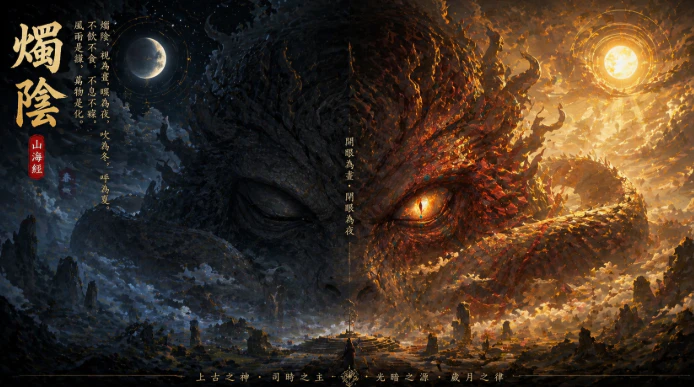
燭陰是《山海經》中掌管光明與黑暗的神祇,其開眼為晝、閉眼為夜,象徵時間流轉與宇宙秩序,是古人對天地運行最深刻的想像之一。
Zhu Yin, a mythical being in the Shan Hai Jing, governs light and darkness—its eyes opening to create day and closing to bring night—symbolizing time, balance, and the rhythm of the cosmos.
中文
在極北之地,有一處永遠籠罩在幽暗與微光之間的世界,那裡沒有四季更替,也沒有日月升落,因為所有光與暗的變化,皆源自燭陰的一呼一吸。牠的身軀如山般綿延,盤踞於無盡的荒原之上,赤色的鱗片在微光中閃爍,彷彿蘊含著尚未被釋放的火焰。牠的頭顱巨大而沉靜,雙目緊閉時,大地便陷入深沉的黑夜,寒意蔓延,萬物靜止,時間仿佛也隨之凝固;而當牠緩緩睜開雙眼,光芒便自其中流瀉而出,驅散黑暗,天地甦醒,風開始流動,生命重新運轉。燭陰不需要言語,也不需行動,祂的存在本身就是時間的刻度,是晝夜更替的源頭。傳說中,牠既非純粹的神,也非單一的獸,而是一種介於存在與法則之間的古老力量,掌握著宇宙最原始的節奏。沒有人知道牠何時誕生,也沒有人能預測牠何時沉睡,因為時間對牠而言並不存在,牠本身就是時間。偶有遠古的旅人誤入其領域,他們會發現自己的影子忽長忽短,呼吸變得緩慢甚至停滯,彷彿被拉入一種不屬於人間的節奏之中。有些人聲稱看見燭陰的眼睛在黑暗中微微開啟,那一瞬間,天地仿佛重生;也有人說牠永遠沉睡,世界不過是在其夢境之中輪轉。無論真相為何,燭陰始終存在於傳說的深處,象徵著人類無法掌控的時間與秩序。當風穿越荒原,帶起細微的聲響,那聲音如同低語,提醒世人,晝與夜的更替並非理所當然,而是一種來自遠古的恩賜。燭陰不偏不倚,不喜不怒,祂只是維持著世界的平衡,讓光與暗交替,讓生命得以延續。在無盡的時間長河中,祂靜靜地存在,既是開始,也是終結,既是光明,也是黑暗,將一切包容於自身之中,成為宇宙最沉默卻最偉大的守護者。
English Version
In the farthest reaches of the north, beyond the reach of ordinary seasons and celestial cycles, lies a realm suspended between dim light and endless shadow. There, no sun rises and no moon falls, for all transitions between brightness and darkness are governed by Zhu Yin. Its immense body stretches across the land like a living horizon, covered in crimson scales that shimmer faintly, as if holding embers of an ancient fire. When its eyes remain closed, the world sinks into profound darkness. Cold spreads silently, motion ceases, and time itself seems to hesitate. Yet when those eyes slowly open, light pours forth, dissolving the night and awakening the world. Winds begin to stir, life resumes its quiet rhythm, and existence moves forward once more. Zhu Yin does not act in ways mortals understand; it does not speak, nor does it intervene. Its very being defines the passage of time, marking the endless alternation between day and night. Neither fully god nor beast, it exists as something more fundamental—a force intertwined with the structure of the universe itself. No one knows when it first came into being, nor can anyone foresee its end, because time does not contain it; rather, it contains time. Travelers who wander too close to its domain report strange distortions—their shadows stretching unnaturally, their breathing slowing as if caught in a different current of existence. Some claim to have witnessed its eyes flicker open within the darkness, an instant in which the world seemed newly created. Others believe it never awakens at all, and that reality unfolds within its eternal dream. Whatever the truth may be, Zhu Yin endures in myth as a symbol of forces beyond human control—the quiet authority of time and the balance it imposes. When the wind crosses that silent land, it carries a faint murmur, like a reminder that the cycle of light and darkness is not guaranteed, but granted. Zhu Yin neither favors nor judges; it simply sustains equilibrium, allowing life to persist through the constant exchange of shadow and illumination. In the vast flow of existence, it remains—at once origin and ending, brightness and void—holding all things within its silent, immeasurable presence.