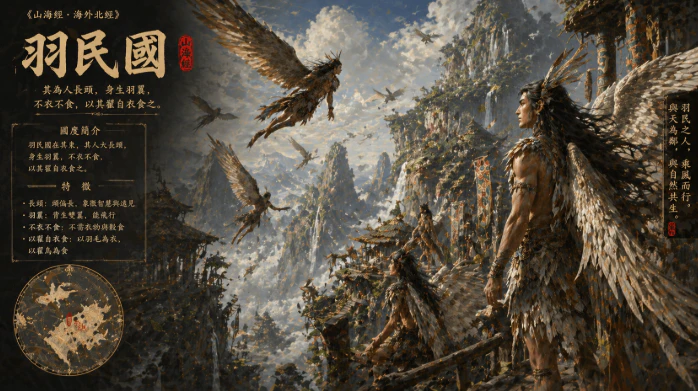
《山海經 008 (異國與民族)》羽民國:長著翅膀的人類傳說|《山海經》中的飛行族群與想像世界The Feathered People: A Mythical Winged Tribe in Classic Chinese Legends
羽民國是《山海經》中記載的奇異國度,當地居民生有翅膀,能在天地之間飛翔。這個傳說展現古人對自由與天空的想像,也象徵人類突破限制的渴望。
The Feathered People appear in ancient Chinese texts as a tribe of winged humans who can fly freely. Their legend reflects humanity’s fascination with the sky and the timeless desire to transcend earthly limits.
中文
在遠離人間疆域的極東之地,有一片被雲霧與風環繞的國度,人們稱之為羽民國。此地不屬凡世疆界,四周高山聳立,如屏障般阻隔外來者,而山巔之上常年雲海翻騰,宛如另一個世界的入口。傳說中,羽民國的居民與世人不同,他們背生雙翼,羽毛如雲般潔白或如夜般深黑,能振翅高飛,自由往來於天空與大地之間。這些人並非神祇,也非禽獸,而是一種介於人與自然之間的存在。他們的城市並不建立於地面,而是在高聳的山崖與巨木之間,以藤蔓與木橋相連,宛如漂浮於空中的國度。當晨曦初現,第一道光穿透雲層,羽民便振翼而起,成群飛翔於天際,羽影交錯,與風共舞。他們不以步行為主,而以飛行為日常,從一處山巔到另一處林海,只需片刻。孩子在學會言語之前,便先學會展翅,老人即使年邁,也仍能在低空滑翔。對他們而言,天空不是遙不可及的領域,而是生活的一部分。外界之人若偶然闖入此地,往往會被眼前景象震撼,以為誤入仙境。有人曾試圖模仿羽民,製作翅膀以求飛行,卻終究無法理解那份與生俱來的力量。羽民並不輕易接納外來者,他們相信飛行不只是能力,更是一種與天地共鳴的象徵。當風起之時,他們能感知氣流的變化,如同聆聽大地的語言;當暴雨將至,他們會提前歸巢,靜待天地的怒息過去。他們的生活與自然緊密相連,不爭、不奪,順應天地而存。然而,關於羽民國的傳說並非只有寧靜與自由,也有隱約的距離與神祕。有人說,他們是遠古人類的一支分化,因與天空親近而逐漸脫離凡世;也有人認為,他們是天地之氣所孕育的存在,不屬於任何一界。無論真相如何,羽民國始終存在於傳說與現實的邊界。當夕陽西沉,天空染上金紅之色,羽民們會在高空盤旋,最後歸於山巔之巢,羽翼收攏,如同融入夜色。對於地面上的人而言,他們或許只是神話中的幻影,但在那片被雲霧包圍的國度裡,他們是真實存在的族群,以翅膀書寫自己的歷史。羽民國不只是奇異的想像,更是一種象徵,象徵人類對自由的嚮往,對天空的渴望,以及對自身限制的超越。
English Version
Far beyond the familiar boundaries of the human world, hidden among towering mountains and drifting clouds, lies a place spoken of only in legend—a realm known as the Land of the Feathered People. It is said to exist where the earth rises high enough to meet the sky, where mist never fully lifts and the horizon seems suspended between two worlds. The inhabitants of this land are unlike ordinary humans. From their backs extend wings, broad and feathered, allowing them to move through the air with effortless grace. They are not birds, nor are they gods, but something in between—a living bridge between earth and sky. Their settlements are not built on flat ground but woven into cliffs, treetops, and natural formations that rise above the clouds. Bridges of wood and vine connect one height to another, forming a network of pathways that exist as much in the air as on the land. To them, flight is not extraordinary—it is simply life. From an early age, children learn to spread their wings, to trust the currents of air, and to navigate the invisible pathways that wind through the sky. Walking is secondary; flying is instinct. At dawn, as the first light touches the clouds, they rise together, their silhouettes cutting across the sky in fluid motion. To an outsider, the sight would seem impossible—a community not bound by gravity, moving as freely as the wind itself. Yet their ability is not merely physical. The Feathered People are deeply attuned to their environment. They read the air as others read written words, sensing subtle changes that signal storms or calm. Their lives follow the rhythms of nature with quiet precision. They do not seek to dominate the world around them but to move within it, guided by forces larger than themselves. Because of this, they remain distant from outsiders. Legends tell of travelers who stumbled upon their realm, only to find themselves unable to stay. Some tried to imitate them, crafting wings in hopes of sharing their freedom, but imitation could not replace what the Feathered People possessed naturally—a harmony between body and sky. Over time, theories emerged. Some believed they were descendants of ancient humans who adapted to the heights, evolving beyond the limitations of the ground. Others claimed they were born from the breath of the heavens themselves, never meant to belong to the earth at all. Whatever the truth, their existence remains uncertain, balanced between myth and possibility. As the sun sets and the sky burns with color, the Feathered People return to their high dwellings, folding their wings as darkness settles. To those who live below, they are little more than a story—an image of freedom imagined but never reached. Yet within their hidden world, they are real, living lives defined not by what they cannot do, but by what they have already become. Their legend endures not because it can be proven, but because it speaks to something universal—the desire to rise, to escape limitation, and to experience a freedom that lies just beyond reach.
其他集數《山海經》Other episodes of “Classic of Mountains and Seas”