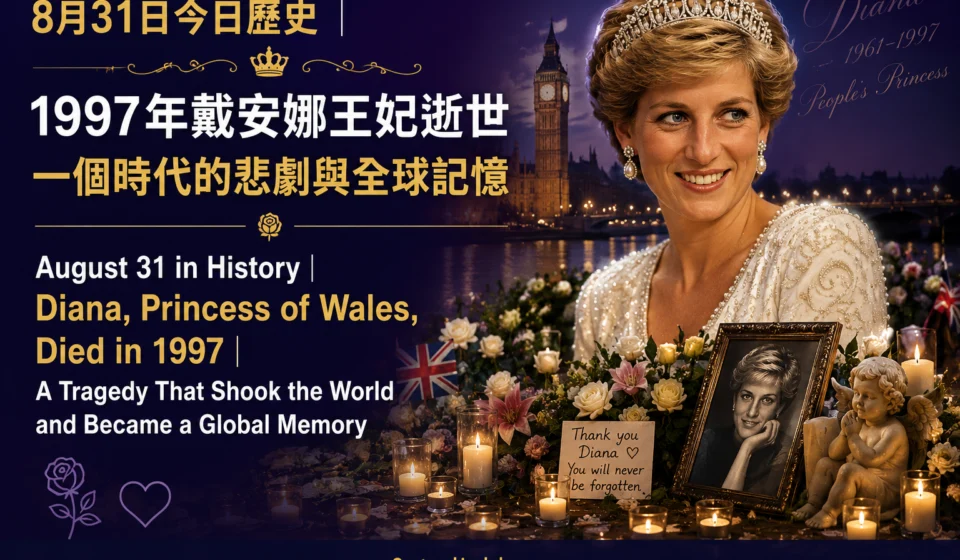
8月31日今日歷史|1997年戴安娜王妃逝世|一個時代的悲劇與全球記憶 | Diana, Princess of Wales, Died in 1997|A Tragedy That Shook the World and Became a Global Memory
1997年8月31日,戴安娜王妃在巴黎車禍中離世,36歲的生命突然終結,震撼英國,也令全球無數人陷入悲痛。
On August 31, 1997, Diana, Princess of Wales, died after a car crash in Paris. Her sudden death shocked Britain and touched millions around the world.
中文版本
1997年8月31日,世界突然失去了一位極具影響力的公眾人物——戴安娜王妃(Diana, Princess of Wales)。這一天,原本只是20世紀末一個普通的夏日週末,卻因一場發生在巴黎的嚴重車禍,成為英國王室及全球現代歷史中難以忘記的一頁。戴安娜出生於1961年7月1日,原名戴安娜・弗朗西斯・斯賓塞(Diana Frances Spencer),來自英國斯賓塞家族。她在1977年認識當時的威爾斯親王查爾斯,兩人於1981年7月29日在倫敦聖保羅大教堂舉行婚禮,這場盛大的皇室婚禮成為全球矚目的事件。婚後,她正式成為威爾斯王妃,並迅速成為世界上最受關注的皇室人物之一。她的衣著、公開活動、家庭生活以及與民眾互動的一舉一動,都經常成為新聞焦點。然而,如果只把戴安娜理解為一位備受媒體追逐的王妃,便無法真正理解她留下的歷史影響。戴安娜最重要的公共角色之一,是她對慈善工作的投入。英國王室官方資料指出,她在婚姻期間曾擔任超過100個慈善機構的主席或贊助人,關注無家可歸者、殘疾人士、兒童以及愛滋病患者等不同群體。她亦逐漸改變了部分傳統皇室活動的形象,以較親近、直接的方式與需要幫助的人接觸。她的公共形象因此不再只是華麗的皇室成員,而逐漸成為一位能夠把社會關注帶到弱勢群體身上的人物。到了1990年代,戴安娜與查爾斯王子的婚姻已經出現嚴重問題。兩人於1992年宣布分居,並在1996年8月正式離婚。離婚後,她仍然以「戴安娜,威爾斯王妃」的身份生活,並繼續參與部分慈善工作。她尤其積極推動禁止製造及使用地雷的國際行動。1997年,她曾前往安哥拉,親自探訪地雷問題嚴重的地區;同年6月,她在倫敦參與相關會議,並前往美國華盛頓推動反地雷工作。8月,她又前往波斯尼亞,探訪與地雷受害者及相關項目有關的工作。她在生命最後一年所投入的公共活動,使她的形象進一步超越皇室與時尚,成為國際慈善與人道關懷的重要象徵。1997年8月30日晚,戴安娜身處法國巴黎。接近午夜時,她乘坐的汽車在巴黎阿爾瑪廣場地下通道發生嚴重車禍。根據英國王室官方資料,車禍發生後,她被送往巴黎皮提耶・薩爾佩特里耶爾醫院接受緊急手術,但最終於8月31日凌晨3時被宣告死亡,終年36歲。同行的多迪・法耶茲(Dodi Fayed)及車輛司機亦在事故中死亡,一名保鑣則重傷。消息傳出後,震動迅速從巴黎傳遍英國及世界各地。 對許多人而言,戴安娜並不只是報紙和電視上的王妃,而是一位陪伴了他們十多年公共生活的熟悉人物。她的突然離世帶來巨大的震驚與悲傷。英國各地出現大量鮮花及悼念訊息,世界各地的人亦透過不同方式表達哀悼。英國王室後來回顧當時的情況時,也形容那段日子充滿震驚、悲傷以及強烈的公眾哀悼。 9月6日,戴安娜的葬禮在西敏寺舉行,成為全球關注的重大事件。她的兩名兒子威廉王子與哈里王子當時分別只有15歲和12歲,他們與父親查爾斯王子及其他家人一起走在靈柩隊伍後方。葬禮結束後,她的靈柩被運往斯賓塞家族位於奧爾索普的家族莊園,最後安葬在湖中央的小島上。 戴安娜的死亡也改變了人們對她一生的重新理解。她曾經是全球最受攝影記者追逐的人物之一,但在她離世之後,人們開始更加關注她在慈善、人道工作及與普通人接觸方面留下的影響。她對無家可歸人士、兒童、殘疾人士、愛滋病患者及地雷問題的關注,逐漸成為她公共遺產的重要部分。英國王室在其官方回顧中亦指出,她的慈善工作在她去世後仍透過不同紀念慈善機構及項目延續。 2004年,英國王室為戴安娜紀念噴泉揭幕時,伊麗莎白二世再次談到她對社會的影響,指出戴安娜對處於困難、困苦或痛苦中的人具有強烈同理心,也願意投入新的公益議題。這種影響力正是她最重要的遺產之一。 回望1997年8月31日,戴安娜的離世不只是一場個人悲劇,也成為一個時代的集體記憶。她的一生充滿皇室、媒體、家庭、慈善與公眾生活之間的交織,而她的死亡則讓全世界重新思考名人生活背後的壓力,以及一個公眾人物如何利用自己的知名度去關注社會問題。多年過去,戴安娜仍然被世界各地的人記得。她的照片、故事、慈善工作以及她與普通人接觸的形象,仍然出現在不同的紀念活動與公共文化之中。她留下的真正遺產,也許並不只是「人民的王妃」這個廣為人知的稱號,而是她曾經讓許多人注意到那些通常不容易被看見的人。1997年8月31日,36歲的戴安娜生命突然停止;但她所關心的許多議題,以及她在人與人之間所建立的親近感,並沒有隨她離去。這一天因此不只是歷史上的一個日期,也是全球許多人共同記住的一個瞬間。
English Version
On August 31, 1997, the world lost one of the most recognisable public figures of the late twentieth century: Diana, Princess of Wales. What began as an ordinary summer weekend ended in tragedy when a car carrying Diana crashed in Paris, bringing her life to an abrupt end at the age of 36. The event sent shock waves through Britain and around the world, creating an extraordinary period of public mourning that remains one of the most memorable moments of modern royal history. Diana was born Diana Frances Spencer on July 1, 1961, into the Spencer family, an established British aristocratic family. She became widely known after her relationship with Charles, then Prince of Wales, developed in the late 1970s. The couple married at St Paul’s Cathedral in London on July 29, 1981, in a ceremony watched by a huge international audience. As Princess of Wales, Diana quickly became one of the most photographed and discussed women in the world. Her clothing, public appearances, family life and interactions with ordinary people regularly attracted enormous media attention. Yet her historical importance cannot be explained simply by her celebrity or royal status. One of the defining aspects of Diana’s public life was her commitment to charitable work. According to the official Royal Family biography, she became president or patron of more than 100 charities during her marriage, supporting causes involving homelessness, disability, children and people living with HIV/AIDS. She gradually became known for approaching charity work in a highly personal way, meeting people directly and helping bring public attention to groups that were often marginalised or misunderstood. This helped reshape her image from a glamorous royal figure into a public advocate associated with compassion and social causes. Diana’s personal life became increasingly difficult during the 1990s. She and Charles separated in 1992, and their divorce was finalised in August 1996. After the divorce, she continued to be known as Diana, Princess of Wales, and remained active in selected charitable causes. One of her most prominent campaigns during the final year of her life involved the international effort to oppose landmines. In January 1997, she travelled to Angola and visited areas affected by landmines. Later that year, she supported anti-landmine efforts in London and Washington, and in August she travelled to Bosnia to visit projects connected with landmine victims. These activities strengthened her reputation as a humanitarian figure whose public platform could draw international attention to difficult social and humanitarian issues. Her final weeks were still filled with public activity. On August 30, 1997, Diana was in Paris. Shortly before midnight, the car in which she was travelling crashed in the Place de l’Alma underpass in central Paris. The official Royal Family account records that Diana was taken to the Pitié-Salpêtrière Hospital, where she underwent emergency surgery. She was pronounced dead at 3:00 a.m. on August 31. Dodi Fayed and the driver of the vehicle also died in the crash, while a bodyguard survived with serious injuries. The news immediately travelled across Britain and the rest of the world. For millions of people, Diana was more than a distant member of the royal family. She had been a familiar presence on television, in newspapers and in public life for more than a decade. Her sudden death therefore produced an unusually personal sense of loss among people who had never met her. Flowers and messages of condolence appeared across Britain, while people around the world expressed their grief. The Royal Family later described the period as one of extraordinary shock, sadness and mourning. Diana’s funeral took place at Westminster Abbey on September 6, 1997. Her two sons, Prince William and Prince Harry, were only 15 and 12 years old respectively, and they walked behind their mother’s coffin alongside their father and other members of the family. The funeral attracted enormous international attention and became one of the defining public ceremonies of the decade. After the service, Diana’s coffin was taken to the Spencer family estate at Althorp, where she was buried on an island in the centre of an ornamental lake. In the years that followed, Diana’s legacy increasingly became associated with her humanitarian work. Her death initially dominated global attention, but her charitable activities continued to shape the way she was remembered. Her work involving homelessness, children, disability, HIV/AIDS and landmine awareness helped give lasting visibility to issues that were often overlooked. The Royal Family has noted that her charitable legacy continued through organisations and projects established in her memory. In 2004, when a memorial fountain dedicated to Diana was opened in London, Queen Elizabeth II reflected on the impact Diana had made on people experiencing hardship and distress. She highlighted Diana’s ability to empathise with people in difficult circumstances and her willingness to embrace new causes. That capacity to connect with people became one of the most enduring parts of her public legacy. Looking back at August 31, 1997, Diana’s death represents more than the loss of a famous individual. It became a shared moment of grief and a defining memory of the end of the twentieth century. Her life had brought together the worlds of royalty, media, family, fashion, charity and international public attention. Her death forced many people to reflect on the pressures surrounding public figures and on the responsibilities that can accompany extraordinary fame. Nearly three decades later, Diana remains a familiar figure around the world. Her photographs, charitable work and personal approach to people continue to form part of public memory. Her legacy is not simply the image of a glamorous princess or the title often associated with her. It is also the attention she helped bring to people who were vulnerable, overlooked or struggling. On August 31, 1997, a 36-year-old woman died suddenly in Paris, but the causes she supported and the emotional connection she created with millions of people did not disappear with her. That is why the date remains more than a historical anniversary. For many people, it is a reminder of a life that ended too soon and of the lasting influence one public figure could have on the way the world saw compassion, charity and humanitarian responsibility.
總評
中文版本
戴安娜王妃的一生交織皇室、媒體與慈善,她的突然離世震撼全球。多年後,人們記住的不只是悲劇,更是她對弱勢群體的關懷與人道工作。
English
Diana’s life brought royalty, media attention and humanitarian work together in an extraordinary way. Her sudden death shocked the world, but her lasting legacy lies in the compassion and causes she championed.