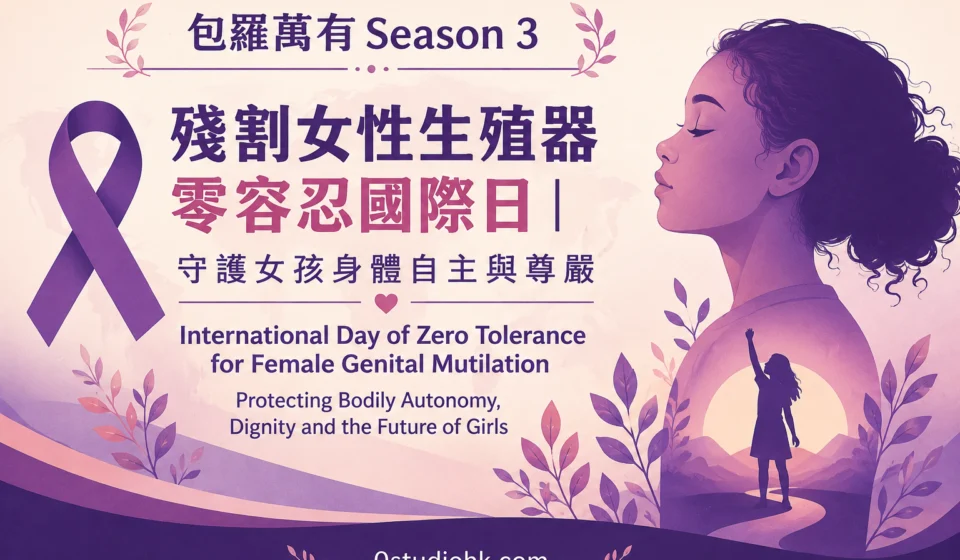
包羅萬有 Season 3 | 殘割女性生殖器零容忍國際日|守護女孩身體自主與尊嚴 | International Day of Zero Tolerance for Female Genital Mutilation|Protecting Bodily Autonomy, Dignity and the Future of Girls
每年2月6日,世界關注殘割女性生殖器問題,呼籲終止傷害女孩與婦女身體、健康、尊嚴及基本人權的有害習俗。
English:Observed every 6 February, this international day calls for an end to female genital mutilation and for every girl to grow up with dignity, safety and bodily autonomy.
中文版本
殘割女性生殖器零容忍國際日於每年2月6日舉行,是聯合國推動終止殘割女性生殖器這項有害習俗的重要日子。聯合國大會在2012年指定2月6日為這個國際日,目的在於提高全球對問題的認識,並加強消除這項做法的國際行動。到了2026年,聯合國把關注焦點放在「邁向2030年:沒有持續的承諾與投資,就沒有終結女性生殖器殘割」這一方向,強調要達到2030年終止殘割女性生殖器的目標,不能只依靠短期宣傳,而需要政府、社區、醫療工作者、民間組織、宗教及傳統領袖,以及整個國際社會長期投入。 殘割女性生殖器(Female Genital Mutilation,FGM)是指因非醫療原因而部分或全部切除女性外生殖器,或者以其他方式傷害女性生殖器官的行為。世界衛生組織指出,這種做法沒有任何健康益處,卻可能造成嚴重出血、感染、排尿困難、傷口癒合問題,以及日後的月經問題、慢性疼痛、性健康問題、分娩併發症和心理健康問題。 根據世界衛生組織2025年的資料,在目前有相關人口數據的國家中,全球已有超過2.3億名女孩及婦女曾經歷殘割女性生殖器,而這項習俗主要發生在非洲西部、東部及東北部,以及中東和亞洲部分地區。這並不是一個只屬於某一個地區的問題,隨着人口流動和移民增加,歐洲、北美及澳洲等地亦可能有曾經接受殘割女性生殖器的婦女,或者有女孩面臨相關風險,因此國際社會將它視為全球性的人權與公共健康問題。 其中最令人關注的是,這項做法大多在女孩仍然年幼時發生,通常介乎嬰兒期至15歲之間。女孩往往沒有能力作出真正知情和自由的選擇,因此問題不只是健康風險,更涉及兒童權利、身體完整性和自主權。世界衛生組織明確指出,殘割女性生殖器侵犯女孩及婦女的人權,亦涉及健康權、安全權、人身完整權,以及免受酷刑、殘忍、不人道或有辱人格待遇的權利。 從醫療角度來看,這項做法不存在「安全版本」。有些地方可能出現醫療化現象,即由醫療工作者進行相關程序,部分家庭可能認為由醫護人員操作會比較安全,但世界衛生組織明確反對醫療化,並呼籲醫療工作者不要進行殘割女性生殖器。把一項本身沒有醫療必要、而且可能造成長期傷害的行為交由醫療人員執行,並不能改變它對女孩身體自主和人權造成的根本問題。 殘割女性生殖器之所以難以消除,其中一個重要原因,是它往往與社會規範和群體壓力有關。在一些社區,家庭可能擔心女兒如果沒有接受這項習俗,便會被社會排斥、難以獲得婚姻機會,或者被認為沒有完成成長過程中的某項傳統要求。世界衛生組織指出,社會接受程度、害怕被社區拒絕,以及對女性性行為的控制等因素,都可能令這項習俗代代延續。 因此,終止殘割女性生殖器並不是簡單地告訴一個家庭「不要做」便可以解決。真正有效的改變,需要社區一起參與,讓人們知道女孩不需要透過傷害身體來證明自己的價值,也不需要透過這種方式才能成為一個被社會接受的女性。教育尤其重要。當女孩能夠獲得教育、健康資訊和表達自己意見的機會,她們便更有能力了解自己的權利,也更有機會拒絕對自己身體造成傷害的做法。同時,男孩和男性亦需要參與,因為性別規範並不是女性單方面可以改變的問題。家庭、學校、社區、醫療系統以及地方領袖,都可以在改變社會觀念方面發揮作用。宗教因素亦需要以準確和負責任的方式處理。世界衛生組織指出,雖然有些人相信殘割女性生殖器獲得宗教支持,但並沒有宗教經文規定必須實施這項做法;不同宗教領袖對此亦持有不同立場,而部分宗教領袖更積極推動終止這項習俗。 這說明問題不能簡單歸咎於某一種宗教或文化。真正需要處理的是長期存在的性別不平等、社會壓力、資訊不足,以及把女性身體和婚姻價值連結起來的觀念。尊重文化並不代表必須接受所有傳統。文化可以保存語言、藝術、飲食、故事和社區記憶,但當某項習俗對兒童造成嚴重傷害並侵犯基本人權時,社會同樣有責任重新檢視它。人類文明一直都在改變,很多過去被視為理所當然的做法,經過教育、法律和社會對話後,都可以逐漸改變。這正是「零容忍」的重要意義:不是針對某個民族或某個家庭,而是清楚表達一個基本原則——女孩的身體不應該成為社會壓力的犧牲品。殘割女性生殖器所造成的傷害亦可能持續一生。世界衛生組織指出,部分女性可能面對慢性疼痛、泌尿系統問題、月經困難、疤痕組織、性生活疼痛,以及懷孕和分娩期間較高的醫療風險;部分人亦可能出現焦慮、抑鬱或創傷後壓力等心理健康問題。 這些影響提醒我們,問題並不是在程序完成後便結束。女孩當時可能只有幾歲,但後果可以陪伴她進入青春期、成年、婚姻、生育,甚至影響下一代。因此,消除殘割女性生殖器除了預防新個案,也必須照顧已經受到傷害的倖存者。她們需要的不只是醫療服務,也包括心理支援、尊重、保密、安全,以及不被指責的環境。聯合國2026年的訊息亦強調,全球仍有超過2.3億名婦女和女孩受到這項習俗造成的長期影響,而到2030年前仍有數以千萬計的女孩面臨風險。要真正實現終止殘割女性生殖器的目標,需要持續的政治承諾和資源投入,並讓政府、民間社會、醫療工作者及社區領袖共同參與。 這項工作其實也與聯合國可持續發展目標有關。終止殘割女性生殖器不只是婦女健康問題,更涉及性別平等、教育、消除貧困、減少不平等以及建立安全和公正社會。當一個女孩可以不因性別而被迫接受傷害,可以自由接受教育,可以對自己的身體作出選擇,可以安全地成長,這不只是她個人的進步,也是整個社會的進步。聯合國目前的全球行動亦強調,要把預防工作融入教育、健康及經濟發展等不同領域,同時加強數據、社區參與和資源投入。 殘割女性生殖器零容忍國際日最重要的訊息,並不是要求世界上的文化變得一樣,而是希望每個女孩都能擁有一項不應被剝奪的基本權利:完整、安全和有尊嚴地成長。當我們談論「零容忍」時,也不應只停留在口號,而應該理解背後的現實——有些女孩需要有人保護她們,有些倖存者需要有人聆聽她們,有些家庭需要更多教育和社區支持,而一些地方則需要更完善的法律、醫療和社會服務。真正的改變,往往不是一夜之間發生,而是由很多人長期共同努力形成。從家庭開始,讓女孩知道她的身體屬於自己;從學校開始,讓孩子認識平等與人權;從社區開始,讓傳統可以在不傷害人的前提下延續;從醫療系統開始,提供專業而有尊嚴的照顧;從政府開始,建立有效的法律、政策與資源;再由國際社會持續合作,才能一步一步減少這項習俗。2026年的主題提醒世界,距離2030年的目標已經沒有太多時間,因此現在需要的不是放棄,而是更加持續的投入。 一個女孩是否能完整地擁有自己的身體,不應該由出生地、家庭傳統或社區壓力決定。她應該有機會長大、學習、工作、建立關係、組織自己的生活,並在成年後作出屬於自己的選擇。這就是殘割女性生殖器零容忍國際日所要守護的核心價值:不是反對文化,而是反對傷害;不是否定傳統,而是保護人的尊嚴;不是要求所有人一樣,而是讓每一個女孩都有權安全地成為自己。
English Version
The International Day of Zero Tolerance for Female Genital Mutilation is observed every year on 6 February, providing a global moment to raise awareness of female genital mutilation and strengthen efforts to end the practice. The United Nations General Assembly designated 6 February as the International Day of Zero Tolerance for Female Genital Mutilation in 2012, with the aim of supporting international action towards its elimination. In 2026, the global campaign focuses on moving towards 2030 and emphasizes that ending female genital mutilation will require sustained commitment and investment rather than short-term attention. Governments, civil society organizations, health professionals, community leaders, religious and traditional leaders, and international partners all have an important role to play. Female genital mutilation, commonly abbreviated as FGM, refers to procedures that partially or totally remove the external female genitalia, or otherwise injure female genital organs, when there is no medical reason for doing so. The World Health Organization makes clear that FGM provides no health benefits. Instead, it can cause severe bleeding, infection, problems with urination and wound healing, menstrual difficulties, chronic pain, sexual health problems, complications during childbirth and psychological harm. According to WHO data published in 2025, more than 230 million girls and women alive today have undergone FGM in countries where population-level data are available. The practice is concentrated mainly in parts of western, eastern and north-eastern Africa, as well as some areas of the Middle East and Asia. Yet FGM is not only a regional issue. With increasing migration and movement between countries, women and girls affected by FGM or considered at risk may also be found in Europe, North America, Australia and elsewhere. For this reason, the issue is recognized as a global concern involving human rights, health, gender equality and social justice. One of the most serious aspects of FGM is the age at which it commonly occurs. WHO reports that it is mostly carried out on girls sometime between infancy and age 15. Children in this situation may not have the ability to make a free and informed decision about what happens to their bodies. The issue is therefore not simply about medical consequences. It is also about children’s rights, bodily integrity, dignity and autonomy. WHO recognizes FGM as a violation of the human rights of girls and women, including rights relating to health, security, physical integrity and freedom from cruel, inhuman or degrading treatment. There is also no medically safe form of FGM. In some communities, the practice has become medicalized, meaning that health workers may be asked to carry it out because families believe a medical setting will reduce the risks. However, the WHO strongly opposes the medicalization of FGM and urges health professionals not to perform it. Medical supervision does not change the fact that the procedure has no medical benefit and can cause lasting physical and psychological harm. Ending FGM is difficult partly because it can be deeply connected to social expectations. In communities where the practice is treated as a social norm, families may fear that refusing it will lead to rejection, stigma or reduced marriage opportunities for their daughters. Some may regard FGM as an expected part of becoming an adult woman, while others may associate it with ideas about sexuality, virginity or marital behaviour. WHO identifies social pressure, the desire for community acceptance and gender inequality among the factors that can help perpetuate the practice. This means that simply telling individual families to stop is rarely enough. Sustainable change requires communities themselves to become part of the solution. Families need reliable information about the health and human rights consequences. Girls need access to education and the confidence to understand and defend their rights. Boys and men also need to participate because gender norms affect the whole community, not women alone. Teachers, health professionals, local organizations and community leaders can help create an environment in which girls are valued for who they are rather than judged according to harmful expectations about their bodies. Religion also needs to be discussed carefully and accurately. WHO notes that although some people believe FGM has religious support, no religious scripture prescribes the practice, and religious leaders have different positions on the issue. Some religious leaders actively support efforts to abandon it. This is important because FGM should not be reduced to a simple accusation against one religion, culture or community. The deeper issues include gender inequality, social pressure, lack of information and beliefs that connect a girl’s worth or future marriage prospects to a harmful practice. Respect for cultural diversity does not require accepting every tradition without question. Cultures evolve. Communities preserve language, art, food, stories and traditions while also reconsidering practices that cause serious harm. A tradition can be meaningful to a community and still deserve critical examination when it violates the rights and safety of children. This is one of the central ideas behind zero tolerance: the goal is not to attack a particular culture or family, but to establish a basic principle that a girl’s body should never become the price she pays for social acceptance. The consequences of FGM can extend throughout a person’s life. WHO identifies a range of possible long-term effects, including urinary problems, menstrual difficulties, scar tissue, sexual health problems and complications associated with pregnancy and childbirth. Psychological consequences can also include anxiety, depression and post-traumatic stress disorder. The fact that the practice may happen during childhood makes its long-term consequences particularly serious. A girl may be only a few years old when the procedure takes place, but its effects can continue into adolescence, adulthood, relationships, pregnancy and childbirth. Ending FGM therefore requires two connected approaches: preventing new cases and ensuring that survivors receive appropriate care. Survivors may need medical treatment, psychological support and respectful services that protect their privacy and dignity. They should never be treated as responsible for what happened to them. The United Nations stated in its 2026 message that more than 230 million women and girls worldwide are living with the consequences of FGM, while millions of girls remain at risk before 2030. Reaching the goal of ending FGM will require sustained political commitment and investment, together with coordinated action by governments, civil society, health workers and community leaders. Ending FGM is also connected to broader global goals. It is not only a women’s health issue. It intersects with gender equality, education, poverty reduction, reduced inequality and the development of safe and just societies. When a girl can grow up without being subjected to harmful practices because of her gender, when she can attend school, understand her rights and make decisions about her own future, the benefit extends beyond her individual life. It strengthens families and communities as well. The United Nations campaign for 2026 emphasizes the importance of integrating prevention into education, health and economic programmes, improving data, supporting community-based action and maintaining investment. The phrase “zero tolerance” is therefore more than a slogan. It represents a commitment to protect girls before harm occurs, to support women who have already experienced FGM, and to challenge the social conditions that allow the practice to continue. In some places, girls need stronger protection. In others, families need better information and community support. Survivors may need accessible healthcare and psychological services. Governments may need stronger laws and better enforcement. Health professionals need training and clear ethical standards. Community, religious and traditional leaders can also help reshape social expectations by making it clear that a girl’s dignity does not depend on undergoing FGM. Change rarely happens overnight. It is built through education, dialogue, community engagement, legal protection, healthcare and sustained investment. The 2026 campaign’s focus on 2030 is particularly significant because the remaining years are limited. The international community cannot assume that progress will continue automatically. A girl’s right to bodily integrity should not depend on where she is born, the traditions of her family or the pressure of her community. She deserves the opportunity to grow up safely, receive an education, develop her own ambitions, form relationships freely and make decisions about her own life. That is the central message of the International Day of Zero Tolerance for Female Genital Mutilation. It is not a rejection of cultural identity; it is a rejection of harm. It is not an attack on tradition; it is a defence of human dignity. It does not demand that every community become identical. Instead, it asks the world to agree on something fundamental: every girl deserves the right to grow up with her body, dignity, health and future protected. When families, schools, communities, healthcare systems, governments and international organizations work together towards that principle, the possibility of ending FGM by 2030 becomes more than an international promise. It becomes a responsibility shared across generations.
總評
中文版本:殘割女性生殖器零容忍國際日提醒世界,女孩的身體完整、健康與自主權不應成為任何傳統或社會壓力的代價,終止傷害需要教育、保護與持續行動。
English:This international day reminds us that no tradition or social pressure should come at the cost of a girl’s bodily integrity, health and dignity. Ending FGM requires protection, education, care and sustained global action.