
香港超市真的很快嗎?|不同地區的購物節奏與服務差異 | Are Hong Kong Supermarkets Really Fast? How Different Districts Shape Shopping Behavior | 0感官
很多人說香港超市很快,但當你走進不同地區,感覺其實並不一樣。有些地方節奏急促,有些地方卻可以慢慢選擇,問題不只是城市,而是區域。
Hong Kong supermarkets are often described as fast-paced, but the experience changes depending on where you are. Different districts create different rhythms, shaping how people shop and interact.
中文
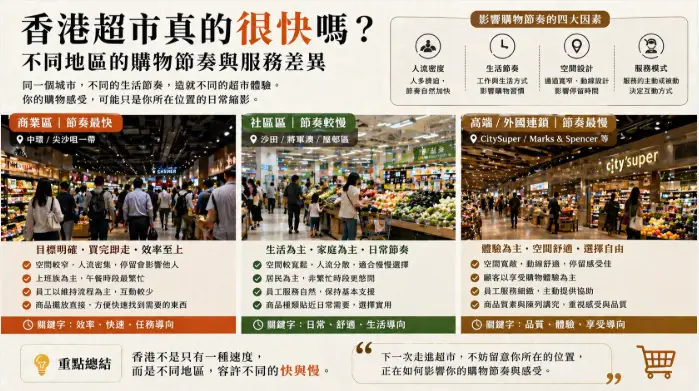
很多人會用一個簡單的印象去形容香港的超市,就是「快」,但如果你真的留意,就會發現這個描述並不完整。香港的超市,並不是只有一種節奏,而是同一個城市裡,同時存在著不同的購物方式。當你走進商業區的超市,例如中環或尖沙咀一帶,你會明顯感受到一種緊湊的節奏,人們通常帶著明確目的進來,拿到需要的東西就離開,很少停留,也很少比較,整個過程像是一個需要迅速完成的任務。在這種環境裡,空間較為有限,人流密集,當你停下來的時候,很容易影響其他人,因此你會自然地加快動作,避免阻礙他人,而這種無形的壓力,會讓選擇變得簡化。當節奏變快,服務也會跟著改變,員工的角色會偏向維持效率,而不是提供額外的互動,整個系統的重點,是讓流程順暢地進行。但當你離開這些區域,走進一些屋邨或社區型的超市,例如沙田或將軍澳一帶,你會發現另一種節奏正在運作。這裡的空間相對寬鬆,人流也較分散,顧客之間的距離較大,因此當你停下來選擇的時候,不會產生同樣的壓力。你會看到有人慢慢比較,有家庭一起購物,甚至會花時間思考要買什麼,這種購物方式,更接近日常生活的一部分,而不是一個需要完成的任務。在這種環境裡,服務也會顯得較為自然,不需要過度強調效率,而是維持一種基本的支援。而如果再進一步,你走進一些較高端或外國連鎖的超市,例如 CitySuper 或 Marks & Spencer,你會感受到另一種不同的氣氛。這些空間通常設計較為寬敞,商品陳列也更整齊,節奏明顯較慢,讓人可以花時間去看、去選擇,甚至會產生一種接近外國超市的感覺。在這裡,購物不再只是完成需求,而是一種可以被體驗的過程。當你把這三種場景放在一起,就會發現,香港並不是一個單一節奏的城市,而是一個由不同區域組成的系統,每一個地方都在回應不同的生活方式。商業區回應的是時間緊迫的工作節奏,社區區回應的是日常生活的需要,而高端空間則提供另一種較慢的選擇。問題從來不是香港太快,而是不同地方容許不同的快與慢。當我們只用一個標準去看,就會忽略這些細微但重要的差異。當你下一次走進超市,也許可以試著留意,你所在的位置,正在影響你的節奏,而你的購物方式,也正在被這個空間默默地改變。當你開始看到這些差異,你就會發現,香港不是沒有慢,只是慢,藏在不同的地方。
English Version
Hong Kong supermarkets are often described as fast-paced, but this description only captures part of the reality. The experience is not defined by a single rhythm; instead, multiple shopping behaviors coexist within the same city, shaped by different districts and environments. In commercial areas such as Central or Tsim Sha Tsui, the pace is noticeably intense. People enter with clear intentions, move quickly through the aisles, and leave as soon as their purchases are complete. There is little hesitation and minimal browsing, as the space itself encourages efficiency. Narrow layouts and dense foot traffic create a subtle pressure to keep moving, discouraging prolonged decision-making. In this setting, service naturally aligns with speed. Staff focus on maintaining flow rather than engaging in extended interaction, ensuring that the system functions smoothly under constant demand. However, when you move into residential neighborhoods like Sha Tin or Tseung Kwan O, the atmosphere changes. The space often feels more open, the crowd more dispersed, and the overall pace more relaxed. Shoppers are more likely to browse, compare products, and take their time. Families may shop together, and decisions are made with less urgency. Here, the supermarket becomes part of daily life rather than a task to be completed quickly. Service in this context remains present but unobtrusive, supporting rather than directing the experience. A different layer emerges in premium or international-style supermarkets, such as CitySuper or Marks & Spencer. These spaces are typically more spacious, with carefully arranged displays and a noticeably slower rhythm. The environment invites exploration, allowing customers to engage with products in a more deliberate way. Shopping here feels less like a necessity and more like an experience. When these three settings are considered together, it becomes clear that Hong Kong does not operate under a single pace. Instead, it functions as a system of overlapping environments, each responding to different needs. Commercial districts reflect the urgency of work-oriented routines, residential areas support everyday living, and premium spaces offer an alternative pace. The issue is not that Hong Kong is inherently fast, but that different areas accommodate different speeds. A single perspective cannot fully capture this complexity. The next time you enter a supermarket, it may be worth noticing how your surroundings shape your behavior. The pace you adopt is not entirely your own—it is influenced by the space you are in. Once this becomes visible, the city begins to reveal its layered nature, where slower experiences do exist, just not always in the places you expect.