
Skip to content
madefrom.hk madefrom.hk madefrom.hk

Rewriting culture, history and memories beyond language and borders.

madefrom.hk madefrom.hk madefrom.hk

Rewriting culture, history and memories beyond language and borders.

  • Comics
    • Strange Tales
    • Myths of the Constellations
  • 繁體中文漫畫
    • 碧廬冤孽
  • Column
    • Knowledge Hub
      • 生活篇
      • 食品篇
      • 科技篇
      • 超市篇
    • Life & Technology
    • Hong Kong Guide
    • Today in History
    • City Stories
    • Anime & Manga
    • Game Magazine
    • Toy Club
    • Language of Flowers
    • Street Notes
    • All Things
    • Music Memories
    • Chinese Idioms
    • Cantonese Sayings
    • Movie Magazine
  • Original Stories
    • 不可思議故事
    • 十三號的約定
    • 星座宮神話
    • 香港山怪談
    • 香港都市靈異傳說
  • Adapted Stories
    • romance of the three kingdoms
    • hong kong places
    • dream of the red chamber
    • strange tales
    • The house on the borderland
    • usherhouse
    • Theblackcat
  • History
    • History in 80 Seconds
    • 當年報章摘要
    • 香港歷史
    • 世界名作家
    • World Biographies
  • Movies
    • USA
    • japan
    • Korea
    • Taiwan
    • HONGKONG
    • India
    • china
    • france
    • Tunisia
    • Germany
    • Jordan
    • Switzerland
    • sweden
    • Spain
    • Palestine
    • Norway
    • Argentina
    • Brazil
  • ACG
    • Winter 2026 Anime
    • Summer 2026 Anime
    • ACGHK
      • 2016
      • 2018
      • 2019
      • 2023
      • 2024
    • 創天綜合同人祭
      • 同人表演
    • 音樂
    • 電玩
      • 玩具資訊
      • 遊戲資訊
    • 遊戲
      • SNK Neo Geo
      • PlayStation 2
      • Arcade
      • NEWS
  • 旅行
    • Hong Kong Travel
      • 土瓜灣
      • 舊建築
      • 街道
      • 單車
      • 文化
      • 交通
      • 香港書展
      • 表演
      • 廟宇
      • 教堂
      • 香港書展
      • 分享會
      • 紀念活動
      • 文化活動
      • 活動
      • 寵物
      • 巴士
      • 電車
      • 機場
      • 飲食
        • 上環
        • 中環
        • 筲箕灣
        • 西環
        • 天后
        • 旺角
        • 荔枝角
        • 佐敦道
        • 太子
        • 大角咀
        • 深水埗
        • 油麻地
        • 長沙灣
        • 黃大仙
        • 尖沙咀
        • 油塘
        • 葵芳
        • 屯門
        • 元朗
        • 上水
        • 粉嶺
        • 荃灣
        • 渡輪
      • 心理測驗
    • Macau Travel
    • International Travel
    • 日本旅遊
    • Taiwan Travel
    • Thailand Travel
  • Archive
    • 文化生活
    • 莎拉有約
  • Comics
    • Strange Tales
    • Myths of the Constellations
  • 繁體中文漫畫
    • 碧廬冤孽
  • Column
    • Knowledge Hub
      • 生活篇
      • 食品篇
      • 科技篇
      • 超市篇
    • Life & Technology
    • Hong Kong Guide
    • Today in History
    • City Stories
    • Anime & Manga
    • Game Magazine
    • Toy Club
    • Language of Flowers
    • Street Notes
    • All Things
    • Music Memories
    • Chinese Idioms
    • Cantonese Sayings
    • Movie Magazine
  • Original Stories
    • 不可思議故事
    • 十三號的約定
    • 星座宮神話
    • 香港山怪談
    • 香港都市靈異傳說
  • Adapted Stories
    • romance of the three kingdoms
    • hong kong places
    • dream of the red chamber
    • strange tales
    • The house on the borderland
    • usherhouse
    • Theblackcat
  • History
    • History in 80 Seconds
    • 當年報章摘要
    • 香港歷史
    • 世界名作家
    • World Biographies
  • Movies
    • USA
    • japan
    • Korea
    • Taiwan
    • HONGKONG
    • India
    • china
    • france
    • Tunisia
    • Germany
    • Jordan
    • Switzerland
    • sweden
    • Spain
    • Palestine
    • Norway
    • Argentina
    • Brazil
  • ACG
    • Winter 2026 Anime
    • Summer 2026 Anime
    • ACGHK
      • 2016
      • 2018
      • 2019
      • 2023
      • 2024
    • 創天綜合同人祭
      • 同人表演
    • 音樂
    • 電玩
      • 玩具資訊
      • 遊戲資訊
    • 遊戲
      • SNK Neo Geo
      • PlayStation 2
      • Arcade
      • NEWS
  • 旅行
    • Hong Kong Travel
      • 土瓜灣
      • 舊建築
      • 街道
      • 單車
      • 文化
      • 交通
      • 香港書展
      • 表演
      • 廟宇
      • 教堂
      • 香港書展
      • 分享會
      • 紀念活動
      • 文化活動
      • 活動
      • 寵物
      • 巴士
      • 電車
      • 機場
      • 飲食
        • 上環
        • 中環
        • 筲箕灣
        • 西環
        • 天后
        • 旺角
        • 荔枝角
        • 佐敦道
        • 太子
        • 大角咀
        • 深水埗
        • 油麻地
        • 長沙灣
        • 黃大仙
        • 尖沙咀
        • 油塘
        • 葵芳
        • 屯門
        • 元朗
        • 上水
        • 粉嶺
        • 荃灣
        • 渡輪
      • 心理測驗
    • Macau Travel
    • International Travel
    • 日本旅遊
    • Taiwan Travel
    • Thailand Travel
  • Archive
    • 文化生活
    • 莎拉有約
Close

Search

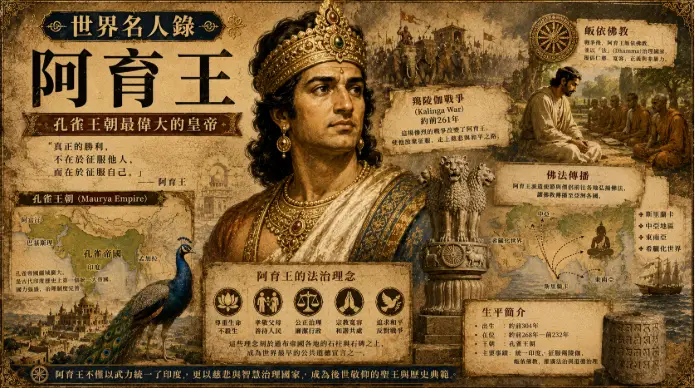
阿育王與孔雀王朝佛教歷史主題插畫
HistoryWorld Biographies

阿育王與孔雀王朝:從征服者到佛教護法的印度傳奇君主 | Ashoka and the Maurya Empire: The Emperor Who Transformed India Through Buddhism  | 世界名人錄

2026-05-17

阿育王是古代印度最具影響力的統治者之一,他從冷酷征服者轉變為推廣和平與佛法的君王,不僅改變孔雀王朝,也讓佛教傳播至亞洲各地,深刻影響世界文明。
Ashoka emerged as one of the greatest rulers in ancient history after transforming from a powerful conqueror into a champion of peace and Buddhism. His reign reshaped the Maurya Empire and helped spread Buddhist philosophy across Asia.

中文版本
阿育王約於西元前304年出生於古代印度的孔雀王朝,為孔雀帝國第二位皇帝賓頭娑羅之子,也是帝國建立者旃陀羅笈多·孔雀的孫子。孔雀王朝是古代印度歷史上最強盛的帝國之一,版圖涵蓋今日印度、巴基斯坦、阿富汗與孟加拉部分地區。阿育王自幼便接受王族教育,學習軍事、政治與行政管理。他年輕時以勇猛與果斷著稱,也因此被派往帝國重要地區擔任總督,負責鎮壓叛亂與維持秩序。根據後世傳說,阿育王性格強硬,甚至帶有殘酷的一面,因此早期有「暴君阿育」的形象。賓頭娑羅去世後,孔雀王朝內部爆發激烈王位鬥爭。阿育王最終成功擊敗其他競爭者,於西元前268年左右正式即位,成為孔雀帝國第三任皇帝。登基後的阿育王積極擴張帝國勢力,希望統一整個印度次大陸。他最著名的軍事行動,就是對羯陵伽國的征服戰爭。羯陵伽位於今日印度東部沿海地區,擁有強烈獨立意識,也是孔雀帝國少數尚未臣服的重要國家。這場戰爭極為慘烈,大量士兵與平民死亡。根據阿育王石柱詔令記載,超過十萬人喪生,更多人民流離失所。戰爭結束後,阿育王親眼見到屍橫遍野與人民痛苦,內心受到極大震撼。這場經歷成為他人生最重要的轉折點。阿育王開始反思暴力與征服的意義,最終皈依佛教,並決定以和平與道德治理國家。他放棄進一步的大規模軍事擴張,轉而提倡「法」的理念,也就是結合道德、仁慈、寬容與社會責任的統治方式。阿育王成為歷史上最早以宗教與道德理念推動國家治理的大帝之一。他下令在全國各地建立石柱與石碑,刻上自己的詔令,向人民宣揚和平、孝道、誠實、宗教寬容與尊重生命的重要性。這些「阿育王詔令」至今仍是研究古代印度歷史的重要資料。除了推廣道德治理外,阿育王也積極支持佛教發展。他資助寺院建設,保護僧團,並舉辦大型佛教會議整理佛教經典。更重要的是,他派遣使節與僧侶前往各地傳播佛法,包括斯里蘭卡、中亞、東南亞甚至希臘化世界。傳說中,他的兒子摩哂陀與女兒僧伽蜜多便將佛教正式傳入斯里蘭卡,使佛教在當地深深扎根。後來佛教能夠傳播至中國、日本、韓國與東南亞,阿育王時代的推廣具有極關鍵作用。阿育王統治期間,孔雀帝國達到鼎盛。帝國擁有完善行政制度、道路交通與商業網絡,也促進不同文化與宗教交流。他鼓勵人民尊重各種信仰,不強迫改宗,這種宗教寬容政策在古代世界極為罕見。儘管如此,阿育王晚年也面臨帝國財政壓力與地方統治問題。部分歷史學家認為,他過度投入宗教與公共建設,削弱了帝國軍事力量。阿育王去世後,孔雀王朝逐漸衰弱,最終於數十年後瓦解。然而,阿育王的歷史地位並未因此消失。相反地,他在後世被視為印度歷史最偉大的君主之一,也是佛教世界的重要護法王。十九世紀後,隨著阿育王石柱與詔令重新被發現,世界再次認識這位古代皇帝。今日印度國徽中的獅子柱與國旗中央的法輪,皆源自阿育王時代象徵。許多歷史學家認為,阿育王不只是征服者,更是少數真正將權力轉向道德與和平理念的古代統治者。他從戰爭走向慈悲的轉變,使他成為世界歷史上極具代表性的傳奇人物,而孔雀王朝也因他的統治成為古代印度文明最輝煌的時代之一。

English Version
Ashoka was born around 304 BCE into the powerful Maurya Empire, one of the largest and most influential empires in ancient Indian history. He was the grandson of Chandragupta Maurya, the founder of the Mauryan dynasty, and the son of Emperor Bindusara. The Maurya Empire already controlled vast territories across the Indian subcontinent, including regions of present-day India, Pakistan, Afghanistan, and Bangladesh. From a young age, Ashoka received extensive training in military strategy, administration, diplomacy, and governance. Historical traditions describe him as intelligent, fearless, and highly ambitious. Because of his abilities, he was appointed governor of important provinces during his youth, where he gained experience suppressing rebellions and managing imperial authority. Early accounts often portray Ashoka as a harsh and ruthless prince who believed strongly in conquest and centralized power. After the death of Bindusara, a fierce struggle for succession erupted within the Mauryan royal family. Ashoka eventually emerged victorious and became emperor around 268 BCE. Once on the throne, he continued expanding the empire through military campaigns, seeking to consolidate control over the Indian subcontinent. His most famous and transformative campaign was the conquest of Kalinga, a prosperous and independent kingdom located along the eastern coast of India. The Kalinga War proved devastating. Ancient inscriptions attributed to Ashoka state that more than one hundred thousand people were killed, while countless others were displaced or taken prisoner. Unlike earlier victories, the destruction caused by this war deeply disturbed Ashoka. According to his own edicts, witnessing the suffering of civilians and the horrors of battle filled him with remorse and changed the direction of his life forever. Following the Kalinga War, Ashoka embraced Buddhism and began redefining the purpose of kingship. Rather than pursuing endless conquest, he turned toward moral governance, compassion, and peace. He adopted the concept of “Dhamma,” a philosophy centered on ethical behavior, kindness, justice, tolerance, and respect for all living beings. Ashoka became one of the earliest rulers in world history to openly promote nonviolence and moral responsibility as principles of statecraft. To spread these values, he ordered inscriptions to be carved onto stone pillars and rock edicts throughout the empire. These inscriptions encouraged honesty, filial piety, religious harmony, humane treatment of people and animals, and ethical conduct among officials and citizens alike. The Edicts of Ashoka remain among the most important historical sources for understanding ancient India. Ashoka also became one of Buddhism’s greatest patrons. He funded monasteries, supported Buddhist monks, and organized major councils to preserve and clarify Buddhist teachings. Most significantly, he sponsored missions that carried Buddhism far beyond India. Buddhist emissaries traveled to Sri Lanka, Central Asia, Southeast Asia, and even regions connected to the Hellenistic world. According to tradition, Ashoka’s son Mahinda and daughter Sanghamitta introduced Buddhism to Sri Lanka, where it became deeply rooted and later spread across Asia. The eventual transmission of Buddhism to China, Korea, Japan, and Southeast Asia can be traced in large part to Ashoka’s support and missionary efforts. During his reign, the Maurya Empire reached its greatest territorial and administrative strength. Roads, trade routes, irrigation systems, and communication networks expanded across the empire, encouraging economic growth and cultural exchange. Ashoka’s policy of religious tolerance was especially remarkable for the ancient world. Although he personally followed Buddhism, he encouraged respect toward different religions and discouraged sectarian conflict. Nevertheless, some historians argue that Ashoka’s focus on morality and public welfare weakened military strength and strained imperial finances. After his death around 232 BCE, the Maurya Empire gradually declined and eventually fragmented. Despite the empire’s fall, Ashoka’s reputation endured across centuries. In modern India, he is remembered as one of the nation’s greatest rulers and a symbol of ethical leadership. The Lion Capital of Ashoka became the national emblem of India, while the Ashoka Chakra appears at the center of the Indian flag. Historians often view him as a rare example of a conqueror transformed by conscience. His journey from ruthless warrior to promoter of peace and compassion continues to inspire scholars, religious communities, and political thinkers around the world. Through his embrace of Buddhism and moral governance, Ashoka not only reshaped the Maurya Empire but also influenced the spiritual and cultural history of Asia for more than two thousand years.

Views: 18
延伸閱讀
威廉·哈維與英格蘭王國:發現血液循環的近代醫學先驅 | William Harvey and the Kingdom of England: The Physician Who Discovered Blood Circulation | 世界名人錄 
威廉·哈維是近代醫學史最重要的人物之一,他以實驗與觀察推翻古代醫學理論,首次完整提出人體血液循環概念,徹底改變人類對身體與醫學科學的理解…
5月6日歷史上的今天|權力與轉折的關鍵瞬間 On This Day: May 6 and the Moments of Power and Turning Points
5月6日承載多個歷史節點,從政治決策到制度轉變,展現人類社會在權力與變革之間不斷前行的軌跡。May 6 reflects pivotal…
🎵 8月9日今日歷史|長崎原子彈爆炸,核時代的悲劇與和平警示 Today in History, August 9 | The Atomic Bombing of Nagasaki Changed the Course of World History
1945年8月9日,美國向日本長崎投下原子彈「胖子」,造成大規模傷亡與城市毀滅。這是歷史上第二次、也是至今最後一次在戰爭中使用核武器,深…
Niccolò Machiavelli: The Political Thinker Who Changed the Way We Understand Power
Niccolò Machiavelli was an Italian political philosopher, diplomat, …

Tags:

AshokaMaurya Empire佛教歷史孔雀王朝阿育王
Other Articles
On This Day
Previous

5月17日歷史上的今天|自由與科技變革的轉折點 On This Day: May 17 and the Turning Points of Freedom and Technology

Next

虛擬情感是否真實?《ソードアート・オンライン》中的心靈與存在 Virtual Emotions, Real or Not? Consciousness and Being in Sword Art Online

No Comment! Be the first one.

Leave a Reply Cancel reply

You must be logged in to post a comment.

  • Patreon
  • Facebook
  • Instagram
  • YouTube
  • Bluesky
  • Tumblr
  • LinkedIn

Register|Lost your password?

  • Terms of Service
  • Privacy Policy
  • Contact
  • About Us
  • Register
  • Login
  • Password Reset
  • Advertising
  • Column Sponsorship
  • plus member

Content & Corrections

This website covers films, animation, games, cultural columns, and other related content and information. Our information is primarily based on publicly available sources, official announcements, and editorial research. Content may be revised or updated when new information becomes available.
If you notice any errors, believe that information needs to be corrected, or have updated official information that may be added, please contact us by email:
📧 [email protected]
We will review the information and make updates as soon as possible after verification.
Thank you for your help and understanding.

  • 《碧廬冤孽:旋緊之螺》第一集:布萊莊園的邀約
  • Myths of the Constellations | Episode 7 | The Cost of Fire |English Comic Edition 
  • Strange Tales | The Monster in the Buckwheat  | English Comic Edition 
  • Strange Tales|Hunting a Fox | English Comic Edition
  • Myths of the Constellations|Episode 6|After the Fracture|English Comic Edition

ACG HK anime Chinese Mythology Dream of the Red Chamber Hong Kong History On This Day Romance of the Three Kingdoms Silent film world history 三國演義 世界歷史 中國古典小說 中國神話 今日歷史 劉備 動畫 動畫電影 古典文學 台灣旅遊 專欄 小說連載 山海經 廣東話歇後語 影評 恐怖電影 推薦 日本動畫 日本電影 曹操 林黛玉 歷史上的今天 澳門 紅樓夢 經典電影 美國電影 聊齋志異 賈寶玉 電影 電影劇情介紹 飲食 香港文化 香港旅遊 香港歷史 香港都市傳說 香港電影

Copyright 2021 - 2026 — 0studiohk.com | madefrom.hk. All rights reserved.