
Skip to content
madefrom.hk madefrom.hk madefrom.hk

Rewriting culture, history and memories beyond language and borders.

madefrom.hk madefrom.hk madefrom.hk

Rewriting culture, history and memories beyond language and borders.

  • Comics
    • Strange Tales
    • Myths of the Constellations
  • 繁體中文漫畫
    • 碧廬冤孽
  • Column
    • Knowledge Hub
      • 生活篇
      • 食品篇
      • 科技篇
      • 超市篇
    • Life & Technology
    • Hong Kong Guide
    • Today in History
    • City Stories
    • Anime & Manga
    • Game Magazine
    • Toy Club
    • Language of Flowers
    • Street Notes
    • All Things
    • Music Memories
    • Chinese Idioms
    • Cantonese Sayings
    • Movie Magazine
  • Original Stories
    • 不可思議故事
    • 十三號的約定
    • 星座宮神話
    • 香港山怪談
    • 香港都市靈異傳說
  • Adapted Stories
    • romance of the three kingdoms
    • hong kong places
    • dream of the red chamber
    • strange tales
    • The house on the borderland
    • usherhouse
    • Theblackcat
  • History
    • History in 80 Seconds
    • 當年報章摘要
    • 香港歷史
    • 世界名作家
    • World Biographies
  • Movies
    • USA
    • japan
    • Korea
    • Taiwan
    • HONGKONG
    • India
    • china
    • france
    • Tunisia
    • Germany
    • Jordan
    • Switzerland
    • sweden
    • Spain
    • Palestine
    • Norway
    • Argentina
    • Brazil
  • ACG
    • Winter 2026 Anime
    • Summer 2026 Anime
    • ACGHK
      • 2016
      • 2018
      • 2019
      • 2023
      • 2024
    • 創天綜合同人祭
      • 同人表演
    • 音樂
    • 電玩
      • 玩具資訊
      • 遊戲資訊
    • 遊戲
      • SNK Neo Geo
      • PlayStation 2
      • Arcade
      • NEWS
  • 旅行
    • Hong Kong Travel
      • 土瓜灣
      • 舊建築
      • 街道
      • 單車
      • 文化
      • 交通
      • 香港書展
      • 表演
      • 廟宇
      • 教堂
      • 香港書展
      • 分享會
      • 紀念活動
      • 文化活動
      • 活動
      • 寵物
      • 巴士
      • 電車
      • 機場
      • 飲食
        • 上環
        • 中環
        • 筲箕灣
        • 西環
        • 天后
        • 旺角
        • 荔枝角
        • 佐敦道
        • 太子
        • 大角咀
        • 深水埗
        • 油麻地
        • 長沙灣
        • 黃大仙
        • 尖沙咀
        • 油塘
        • 葵芳
        • 屯門
        • 元朗
        • 上水
        • 粉嶺
        • 荃灣
        • 渡輪
      • 心理測驗
    • Macau Travel
    • International Travel
    • 日本旅遊
    • Taiwan Travel
    • Thailand Travel
  • Archive
    • 文化生活
    • 莎拉有約
  • Comics
    • Strange Tales
    • Myths of the Constellations
  • 繁體中文漫畫
    • 碧廬冤孽
  • Column
    • Knowledge Hub
      • 生活篇
      • 食品篇
      • 科技篇
      • 超市篇
    • Life & Technology
    • Hong Kong Guide
    • Today in History
    • City Stories
    • Anime & Manga
    • Game Magazine
    • Toy Club
    • Language of Flowers
    • Street Notes
    • All Things
    • Music Memories
    • Chinese Idioms
    • Cantonese Sayings
    • Movie Magazine
  • Original Stories
    • 不可思議故事
    • 十三號的約定
    • 星座宮神話
    • 香港山怪談
    • 香港都市靈異傳說
  • Adapted Stories
    • romance of the three kingdoms
    • hong kong places
    • dream of the red chamber
    • strange tales
    • The house on the borderland
    • usherhouse
    • Theblackcat
  • History
    • History in 80 Seconds
    • 當年報章摘要
    • 香港歷史
    • 世界名作家
    • World Biographies
  • Movies
    • USA
    • japan
    • Korea
    • Taiwan
    • HONGKONG
    • India
    • china
    • france
    • Tunisia
    • Germany
    • Jordan
    • Switzerland
    • sweden
    • Spain
    • Palestine
    • Norway
    • Argentina
    • Brazil
  • ACG
    • Winter 2026 Anime
    • Summer 2026 Anime
    • ACGHK
      • 2016
      • 2018
      • 2019
      • 2023
      • 2024
    • 創天綜合同人祭
      • 同人表演
    • 音樂
    • 電玩
      • 玩具資訊
      • 遊戲資訊
    • 遊戲
      • SNK Neo Geo
      • PlayStation 2
      • Arcade
      • NEWS
  • 旅行
    • Hong Kong Travel
      • 土瓜灣
      • 舊建築
      • 街道
      • 單車
      • 文化
      • 交通
      • 香港書展
      • 表演
      • 廟宇
      • 教堂
      • 香港書展
      • 分享會
      • 紀念活動
      • 文化活動
      • 活動
      • 寵物
      • 巴士
      • 電車
      • 機場
      • 飲食
        • 上環
        • 中環
        • 筲箕灣
        • 西環
        • 天后
        • 旺角
        • 荔枝角
        • 佐敦道
        • 太子
        • 大角咀
        • 深水埗
        • 油麻地
        • 長沙灣
        • 黃大仙
        • 尖沙咀
        • 油塘
        • 葵芳
        • 屯門
        • 元朗
        • 上水
        • 粉嶺
        • 荃灣
        • 渡輪
      • 心理測驗
    • Macau Travel
    • International Travel
    • 日本旅遊
    • Taiwan Travel
    • Thailand Travel
  • Archive
    • 文化生活
    • 莎拉有約
Close

Search

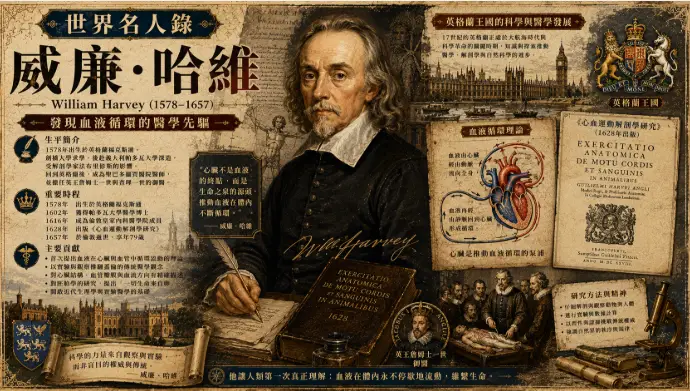
威廉·哈維與英格蘭王國醫學革命主題插畫
HistoryWorld Biographies

威廉·哈維與英格蘭王國:發現血液循環的近代醫學先驅 | William Harvey and the Kingdom of England: The Physician Who Discovered Blood Circulation | 世界名人錄 

2026-05-19

威廉·哈維是近代醫學史最重要的人物之一,他以實驗與觀察推翻古代醫學理論,首次完整提出人體血液循環概念,徹底改變人類對身體與醫學科學的理解。
William Harvey transformed medical science through his groundbreaking discovery of blood circulation. By combining anatomy, experimentation, and observation, he challenged centuries of traditional medicine and laid the foundation for modern physiology.

中文版本
威廉·哈維出生於1578年的英格蘭福克斯通,當時正值英格蘭王國逐漸崛起的時代。伊莉莎白一世統治下的英格蘭正進入海外擴張與文化發展的重要階段,而歐洲也逐漸從中世紀邁向科學革命。哈維出身於富裕商人家庭,自幼便接受良好教育。他後來進入劍橋大學岡維爾與凱斯學院學習,對自然哲學與醫學產生濃厚興趣。完成英格蘭學業後,他前往當時歐洲最著名的醫學中心之一——義大利帕多瓦大學深造。在帕多瓦期間,哈維受到著名解剖學家法布里修斯影響,學習人體結構與血管瓣膜功能,這些知識後來成為他研究血液循環的重要基礎。1602年,哈維取得醫學博士學位後返回英格蘭,開始行醫並逐漸建立名聲。他後來成為倫敦皇家內科醫學院成員,也擔任聖巴多羅買醫院醫師。由於醫術高明,他先後成為英王詹姆士一世與查理一世的御醫,深受王室信任。在十七世紀以前,歐洲醫學長期受到古希臘醫師蓋倫理論影響。蓋倫認為血液由肝臟產生,並在人體內被不斷消耗,而非循環流動。這套理論統治醫學界超過千年,幾乎無人質疑。然而,哈維透過大量解剖、觀察與動物實驗,開始懷疑傳統說法。他仔細研究心臟跳動、血管方向與瓣膜功能,發現靜脈瓣膜只能讓血液朝單一方向流動。哈維進一步計算心臟每次收縮所排出的血量,推論人體若不循環血液,短時間內便會產生超過身體總量的血液,這在生理上根本不可能。1628年,哈維出版《動物心血運動解剖學研究》,正式提出血液循環理論。他指出心臟是推動血液流動的中心器官,血液會經由動脈離開心臟,再透過靜脈返回心臟,形成持續循環系統。這項理論徹底顛覆傳統醫學觀念,也成為近代生理學的重要起點。雖然今日血液循環被視為基本常識,但在當時卻引發巨大爭議。許多醫師拒絕接受哈維的觀點,認為他違反古代權威。部分病人甚至因此不再信任他。然而,哈維堅持以觀察與實驗證據支持自己的理論,逐漸獲得更多學者認同。後來隨著顯微鏡發展,科學家發現毛細血管存在,更進一步證實哈維理論的正確性。除了血液循環研究外,哈維也對胚胎學產生重要影響。他研究動物繁殖與發育過程,提出「一切生命來自卵」的觀點,反對當時流行的自發生成論。他強調觀察自然現象的重要性,認為醫學不應只依靠古代文獻,而應建立於實驗與實證之上。這種研究態度正是科學革命時代的重要精神。哈維一生經歷英格蘭政治動盪,包括英國內戰與王權衝突。作為查理一世御醫,他曾陪同國王參與戰事,也因此在政治上受到影響。戰亂期間,他部分研究手稿與收藏遭到毀損,但他仍持續進行醫學研究與寫作。晚年的哈維逐漸退出公共生活,專注於學術與教育工作。1657年,威廉·哈維於倫敦逝世,享年79歲。雖然他生前並非所有人都接受其理論,但後世普遍認為他是現代醫學最重要的奠基者之一。他透過實驗與理性推翻流傳千年的錯誤觀念,開啟人體生理學的新時代。從心臟外科、血液學到現代循環系統研究,幾乎所有相關醫學領域都建立在哈維的發現之上。歷史學家認為,威廉·哈維不只是醫師,更是將實驗科學方法帶入醫學的重要革命者。他的研究象徵人類開始以科學方式真正理解自身身體,而英格蘭王國也因這場科學革命成為近代醫學發展的重要中心之一。

English Version
William Harvey was born in 1578 in Folkestone, England, during a transformative period in European history. The Kingdom of England under Queen Elizabeth I was expanding its political influence, maritime power, and intellectual ambitions, while Europe itself was entering the age later known as the Scientific Revolution. Harvey grew up in a prosperous merchant family and received an excellent education from an early age. He later attended Gonville and Caius College at the University of Cambridge, where he developed a deep interest in natural philosophy and medicine. Seeking advanced medical training, Harvey traveled to the University of Padua in Italy, one of the most prestigious medical institutions in Europe. There he studied under the renowned anatomist Hieronymus Fabricius, whose work on venous valves profoundly influenced Harvey’s future investigations into the human circulatory system. After earning his medical doctorate in 1602, Harvey returned to England and quickly established himself as a respected physician. He became a member of the Royal College of Physicians in London and later worked at St Bartholomew’s Hospital. Due to his skill and reputation, Harvey eventually served as personal physician to King James I and later King Charles I, placing him at the center of royal and intellectual life in seventeenth-century England. At that time, European medicine remained heavily dependent on the teachings of the ancient Greek physician Galen. According to Galenic theory, blood was continuously produced in the liver and consumed by the body rather than circulating through a closed system. These ideas had dominated medicine for over a thousand years and were rarely questioned. Harvey, however, approached medicine differently. Through careful observation, dissection, and experimentation, he began to doubt traditional explanations. He closely studied the movement of the heart, the direction of blood flow, and the function of venous valves. Harvey realized that the valves allowed blood to travel in only one direction. He also calculated the amount of blood pumped by the heart during each heartbeat and concluded that the liver could not possibly generate such enormous quantities of blood continuously. The only logical explanation was that blood moved in a circular system throughout the body. In 1628, Harvey published his revolutionary work “Exercitatio Anatomica de Motu Cordis et Sanguinis in Animalibus,” commonly known as “On the Motion of the Heart and Blood.” In this groundbreaking study, he argued that the heart functioned as a pump and that blood circulated continuously through arteries and veins. This theory completely transformed medical understanding of the human body and laid the foundation for modern physiology. Although today the concept of blood circulation appears obvious, Harvey’s ideas initially faced intense resistance. Many physicians rejected his findings because they contradicted centuries of accepted authority. Some patients even refused treatment from him. Nevertheless, Harvey remained committed to experimental evidence and logical reasoning. Over time, advances in microscopy and the later discovery of capillaries confirmed the accuracy of his work and secured his place in scientific history. Harvey’s contributions extended beyond circulation. He also conducted important research in embryology and reproduction. Rejecting older theories of spontaneous generation, he argued that all living creatures originated from eggs, emphasizing observation and developmental processes in nature. His scientific approach reflected the broader intellectual transformation of the Scientific Revolution, which encouraged scholars to rely on experimentation rather than unquestioned tradition. Harvey lived through a turbulent period in English history that included political conflicts, civil war, and struggles between monarchy and Parliament. As physician to King Charles I, he accompanied the king during parts of the English Civil War and witnessed the instability affecting the kingdom. Some of Harvey’s manuscripts and collections were destroyed during the conflict, yet he continued his studies and writings despite these setbacks. In his later years, Harvey gradually withdrew from public life and devoted himself to scholarship and education. He died in London in 1657 at the age of seventy-nine. Although not everyone accepted his discoveries during his lifetime, later generations recognized William Harvey as one of the founding figures of modern medicine. By challenging ancient medical doctrine through experimentation and evidence, he helped establish medicine as a scientific discipline grounded in observation and reason. Modern cardiology, physiology, hematology, and countless areas of medical science trace their origins back to Harvey’s work. Historians often describe him not merely as a physician but as a scientific revolutionary whose discoveries fundamentally changed humanity’s understanding of the body. His achievements also reflected the growing intellectual power of the Kingdom of England during the early modern era and its emerging role in the advancement of science and medicine.

Views: 8
延伸閱讀
約翰·洛克與英格蘭王國:自由主義與現代民主思想的奠基者|John Locke and the Kingdom of England: The Foundation of Liberalism and Modern Democracy | 世界名人錄
在17世紀的英格蘭王國,約翰·洛克提出自然權利與政府契約理念,為現代民主與自由制度奠定深遠基礎。In the 17th-century …
歷史一刻,80秒速覽|1月6日 On This Day in 80 Seconds | January 6
新年的第六天,歷史的層次逐漸展開,1月6日交織宗教象徵與政治震盪,在傳統與現代之間留下深刻印記。The sixth day of the…
7月8日今日歷史|世界重要歷史事件回顧 July 8 in History | Major Events That Shaped the World
1889年7月8日,《華爾街日報》正式創刊;1947年7月8日,美國軍方公布「羅斯威爾飛碟事件」消息,引發全球UFO熱潮;2011年7月…
約翰尼斯·開普勒|行星運動定律奠基者與近代天文學先驅 Johannes Kepler | Founder of the Laws of Planetary Motion and Pioneer of Modern Astronomy
約翰尼斯·開普勒以精確數學揭開行星運動的規律,提出三大行星運動定律,改變人類對宇宙的理解,並為後來的牛頓物理學奠定重要基礎。 Johan…

Tags:

Kingdom of EnglandWilliam Harvey威廉哈維英格蘭王國血液循環
Other Articles
On This Day
Previous

5月19日歷史上的今天|探索與變革交織的時刻 On This Day: May 19 and the Moments of Exploration and Change

Garou Mark of the Wolves Neo Geo battle scene
Next

Neo Geo 034 | Garou: Mark of the Wolves|NEOGEO格鬥藝術巔峰| The Peak of NEOGEO Fighting Games【Game Short Film 】 

No Comment! Be the first one.

Leave a Reply Cancel reply

You must be logged in to post a comment.

  • Patreon
  • Facebook
  • Instagram
  • YouTube
  • Bluesky
  • Tumblr
  • LinkedIn

Register|Lost your password?

  • Terms of Service
  • Privacy Policy
  • Contact
  • About Us
  • Register
  • Login
  • Password Reset
  • Advertising
  • Column Sponsorship
  • plus member

Content & Corrections

This website covers films, animation, games, cultural columns, and other related content and information. Our information is primarily based on publicly available sources, official announcements, and editorial research. Content may be revised or updated when new information becomes available.
If you notice any errors, believe that information needs to be corrected, or have updated official information that may be added, please contact us by email:
📧 [email protected]
We will review the information and make updates as soon as possible after verification.
Thank you for your help and understanding.

  • 《碧廬冤孽:旋緊之螺》第一集:布萊莊園的邀約
  • Myths of the Constellations | Episode 7 | The Cost of Fire |English Comic Edition 
  • Strange Tales | The Monster in the Buckwheat  | English Comic Edition 
  • Strange Tales|Hunting a Fox | English Comic Edition
  • Myths of the Constellations|Episode 6|After the Fracture|English Comic Edition

ACG HK anime Chinese Mythology Dream of the Red Chamber Hong Kong History On This Day Romance of the Three Kingdoms Silent film world history 三國演義 世界歷史 中國古典小說 中國神話 今日歷史 劉備 動畫 動畫電影 古典文學 台灣旅遊 專欄 小說連載 山海經 廣東話歇後語 影評 恐怖電影 推薦 日本動畫 日本電影 曹操 林黛玉 歷史上的今天 澳門 紅樓夢 經典電影 美國電影 聊齋志異 賈寶玉 電影 電影劇情介紹 飲食 香港文化 香港旅遊 香港歷史 香港都市傳說 香港電影

Copyright 2021 - 2026 — 0studiohk.com | madefrom.hk. All rights reserved.