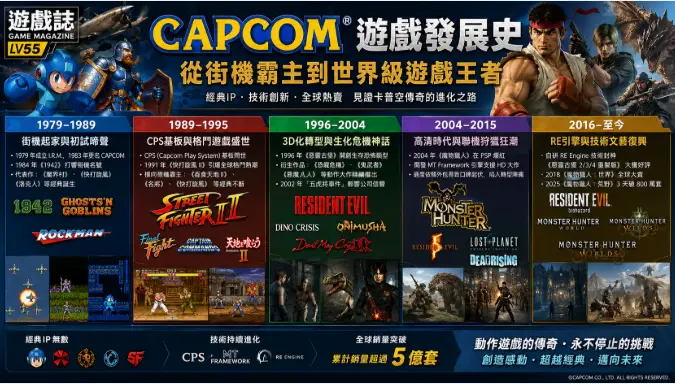
提起 CAPCOM,玩家自然會想到《快打旋風》、《洛克人》、《惡靈古堡》及《魔物獵人》等經典作品。自1979年成立以來,CAPCOM歷經街機黃金年代、3D革命、高清時代與RE Engine技術革新,不斷改寫全球動作遊戲的發展歷史,成為世界最具影響力的遊戲開發商之一。
Few companies have influenced action gaming as profoundly as CAPCOM. Since its founding in 1979, the Japanese developer has continuously reinvented itself through arcade innovation, fighting game revolutions, survival horror, and cutting-edge technology. From pixel graphics to the RE Engine, CAPCOM’s history mirrors the evolution of the video game industry itself.
中文
1979年,辻本憲三創立了I.R.M. Corporation,這就是CAPCOM的前身。經過數年的發展,公司於1983年正式改名為CAPCOM,名稱源自「Capsule Computers」,象徵將完整的遊戲體驗濃縮於一台小型電腦之中。成立初期,公司專注於街機遊戲市場,1984年推出《1942》,成功打開國際知名度,成為CAPCOM早期最具代表性的街機作品之一。隨後,《魔界村》憑藉極高難度與獨特美術風格建立品牌形象,而1987年的《洛克人》則成功打入家用主機市場,成為至今仍歷久不衰的動作遊戲代表。同年推出的初代《快打旋風(Street Fighter)》首次嘗試一對一格鬥玩法及壓力感應按鍵設計,雖然銷量未如預期,卻為日後格鬥遊戲革命埋下伏筆。1990年代初,CAPCOM正式迎來街機黃金年代。公司推出性能強大的Capcom Play System(CPS)街機基板,大幅提升畫面、音效與動畫流暢度。1991年,《快打旋風II》震撼全球,不但建立六鍵操作系統,更創造角色平衡、多角色選擇及連續對戰文化,被譽為現代格鬥遊戲的奠基之作,也讓世界各地遊戲中心掀起排隊挑戰熱潮。CAPCOM更利用CPS硬體推出《Final Fight(港譯《快打旋風》)》、《名將》、《吞食天地II》等大量橫向捲軸動作遊戲,奠定其「街機之王」地位。1996年,CAPCOM再次改寫遊戲歷史。由三上真司領軍開發的《惡靈古堡》正式推出,以固定鏡頭、資源管理、電影式運鏡及壓迫感十足的恐怖氣氛,開創了「生存恐怖(Survival Horror)」類型。《惡靈古堡》不但成為CAPCOM最重要的長壽品牌之一,也帶動《恐龍危機》、《鬼武者》及《惡魔獵人》等多個知名系列誕生,成功完成3D時代轉型。2002年,CAPCOM宣布GameCube獨佔「CAPCOM Five」計劃,包括《P.N.03》、《Viewtiful Joe》、《Dead Phoenix》、《Resident Evil 4》及《Killer7》,但其後因市場策略調整,大部分作品陸續移植至其他平台,引起玩家不滿,「卡婊」這個戲稱亦因此流傳多年。進入高清遊戲世代後,CAPCOM推出《魔物獵人》,首作於PlayStation 2登場,真正令系列爆紅的則是PSP版本。玩家透過面對面連線合作狩獵,迅速掀起日本國民級熱潮,令《魔物獵人》成為CAPCOM另一個代表性品牌。同時,公司自主開發MT Framework遊戲引擎,支援《惡靈古堡5》、《失落的星球》及《喪屍圍城》等大型HD作品。不過,CAPCOM亦曾積極與歐美工作室合作,希望拓展海外市場,《DmC:Devil May Cry》、《Lost Planet 3》等作品評價兩極,公司一度陷入品牌定位危機。真正的復興始於2017年。CAPCOM推出全新自研RE Engine,《惡靈古堡7》成為首款採用該引擎的大型作品,不僅畫面更細緻、載入速度更快,亦展現極佳的跨平台優化能力。隨後,《惡靈古堡2》、《惡靈古堡3》及《惡靈古堡4》重製版先後推出,不只是畫質升級,更重新設計戰鬥、探索與敘事節奏,被譽為近代遊戲重製的典範。2018年,《魔物獵人:世界》首次全面進軍全球主機及PC市場,打破掌機限制,成為CAPCOM史上最暢銷作品之一。2025年推出的《魔物獵人:荒野》更於上市三天突破八百萬套,再次刷新公司最快銷售紀錄。四十多年來,CAPCOM始終站在遊戲技術與創意設計的最前線。從街機時代建立動作遊戲標準,到開創生存恐怖,再到RE Engine引領新世代技術,CAPCOM證明唯有持續創新與勇於突破,才能在瞬息萬變的遊戲產業中歷久不衰,成為全球玩家心目中的傳奇遊戲品牌。
English Version
CAPCOM’s journey reflects the evolution of the modern video game industry. Founded in 1979 by Kenzo Tsujimoto as I.R.M. Corporation, the company officially adopted the name CAPCOM in 1983, combining the words “Capsule” and “Computers” to represent compact yet complete gaming experiences. During its early years, CAPCOM focused primarily on arcade development, earning worldwide attention with the release of 1942 in 1984. The vertically scrolling shooter established the company’s reputation beyond Japan, while Ghosts ‘n Goblins demonstrated its talent for challenging action games. Home console audiences soon embraced Mega Man, introducing one of gaming’s most enduring heroes. In 1987, the original Street Fighter experimented with one-on-one combat and pressure-sensitive controls. Although its commercial performance was modest, the game laid the essential foundation for a revolution yet to come. That revolution arrived in 1991 with Street Fighter II. Powered by the newly developed Capcom Play System (CPS) arcade hardware, the sequel transformed competitive gaming through its six-button control layout, diverse character roster, and carefully balanced mechanics. Arcades around the world quickly became gathering places for tournaments and fierce rivalries, helping establish competitive fighting games as a global phenomenon. The same hardware platform also produced legendary side-scrolling titles including Final Fight, Captain Commando, and Warriors of Fate, cementing CAPCOM’s dominance throughout the arcade era. As the industry entered the 3D generation, CAPCOM successfully reinvented itself once again. In 1996, director Shinji Mikami introduced Resident Evil, blending cinematic storytelling, fixed camera angles, limited resources, and psychological tension to create the survival horror genre. The enormous success of the franchise inspired additional series including Dino Crisis, Onimusha, and Devil May Cry, proving the company’s ability to innovate beyond traditional arcade action. Not every business decision was welcomed by fans. In 2002, CAPCOM announced the GameCube-exclusive “CAPCOM Five” initiative, featuring titles such as P.N.03, Viewtiful Joe, Dead Phoenix, Resident Evil 4, and Killer7. As several games were later released on additional platforms, many players questioned the company’s exclusivity promises, creating one of the most discussed controversies in its history. During the HD era, CAPCOM introduced Monster Hunter. Although the original PlayStation 2 release found only moderate success, the franchise exploded in popularity on the PSP thanks to local cooperative multiplayer, eventually becoming a cultural phenomenon throughout Japan. At the same time, the internally developed MT Framework engine powered major titles including Resident Evil 5, Lost Planet, and Dead Rising. CAPCOM also partnered with several Western studios in an effort to expand globally, but projects such as DmC: Devil May Cry and Lost Planet 3 received mixed reactions, prompting the company to reassess its creative direction. The turning point arrived in 2017 with the debut of the RE Engine. First showcased in Resident Evil 7, the new technology delivered exceptional graphics, efficient performance, and remarkable scalability across multiple platforms. CAPCOM followed this achievement with critically acclaimed remakes of Resident Evil 2, Resident Evil 3, and Resident Evil 4, demonstrating that modern remakes could become complete reimaginings rather than simple visual upgrades. Another milestone followed in 2018 when Monster Hunter: World expanded the series beyond handheld gaming and achieved record-breaking worldwide sales. That momentum continued with Monster Hunter Wilds, which established CAPCOM’s fastest-selling release after shipping more than eight million copies within its first three days. Today, CAPCOM stands among the world’s most respected game developers. From defining arcade action and competitive fighting games to pioneering survival horror and delivering industry-leading technology through the RE Engine, the company has consistently shaped the direction of interactive entertainment. More than four decades after its founding, CAPCOM remains a symbol of innovation, craftsmanship, and enduring creativity within the global gaming industry.