
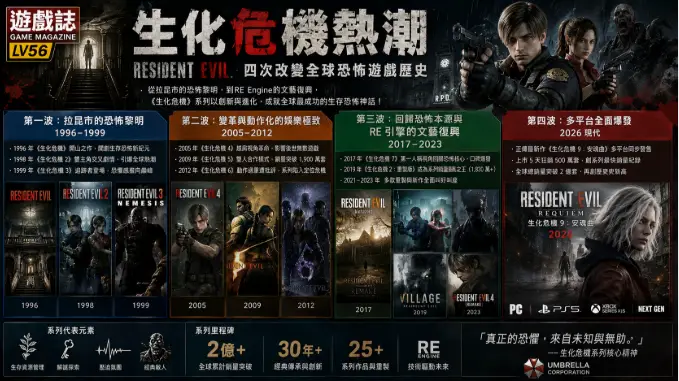
1996年,《生化危機》正式登場,從一座神秘洋館開始,逐步發展成全球最具代表性的恐怖遊戲系列。三十年來,它不僅帶動CAPCOM重返巔峰,更四度革新生存恐怖遊戲玩法,深遠影響整個遊戲產業。
Resident Evil has never been just another horror game. Since its debut in 1996, the franchise has repeatedly reinvented itself while redefining survival horror for new generations. From cinematic suspense to modern remakes powered by the RE Engine, its influence continues to shape the future of interactive entertainment.
中文
1996年,日本遊戲公司CAPCOM推出《生化危機》(日本版名稱為《BIOHAZARD》,海外則命名為《Resident Evil》),原本只是公司一次全新的恐怖遊戲嘗試,卻意外開創了一個影響全球三十年的經典品牌。雖然1992年的《Alone in the Dark》已建立早期3D恐怖冒險遊戲雛形,但《生化危機》首次正式以「Survival Horror(生存恐怖)」作為宣傳定位,並成功將這個類型推向全球市場。由三上真司率領團隊打造的初代作品,以固定鏡頭、有限資源、密室解謎與電影式運鏡營造出前所未有的壓迫感,玩家踏入史賓賽洋館後,每一次開門、每一發子彈、每一場遭遇戰都充滿未知與恐懼,而經典的「喪屍回頭」鏡頭更成為遊戲史上最具代表性的畫面之一。《生化危機》的成功不僅讓CAPCOM建立全新招牌,也讓生存恐怖正式成為獨立遊戲類型。1998年,《生化危機2》將故事舞台擴展至遭病毒吞噬的拉昆市,玩家分別扮演里昂·甘迺迪與克蕾兒·雷德菲爾,透過雙主角交錯劇情體驗同一場災難,規模與敘事手法全面升級,迅速成為PlayStation時代最具代表性的作品之一。翌年的《生化危機3》加入追跡者(Nemesis)系統,這名幾乎無法擊倒的生化兵器會隨時出現追擊玩家,把心理壓力提升至全新境界,也成為系列最令人難忘的敵人之一。2005年,《生化危機4》再次掀起革命。CAPCOM大膽捨棄固定鏡頭,全面採用越肩式第三人稱視角(Over-the-Shoulder Camera),重新設計瞄準、戰鬥與探索方式。雖然越肩視角並非首次出現,但《生化危機4》真正將其發揚光大,建立現代第三人稱射擊遊戲的設計標準,深深影響後來的《戰爭機器》、《最後生還者》等眾多作品,也被譽為遊戲史上最偉大的作品之一。2009年的《生化危機5》加入雙人合作模式,進一步擴大系列影響力,成為CAPCOM歷來最暢銷作品之一。然而,2012年的《生化危機6》過度追求好萊塢式動作場面,大量槍戰、爆炸與英雄式演出雖然帶來華麗視覺效果,卻削弱了系列最核心的恐怖氛圍與資源管理玩法,引起不少老玩家批評,也讓CAPCOM重新思考系列未來方向。真正的轉捩點出現在2017年。《生化危機7》完全回歸恐怖本源,首次改採第一人稱視角,把玩家帶進封閉而陰森的貝克農場,再次強調探索、解謎、有限資源與心理壓迫感。同時,CAPCOM推出自主研發的RE Engine,憑藉優異的光影技術、角色表情與跨平台效能,成功建立公司新世代遊戲技術核心。《生化危機7》更創下連續多年穩定銷售的驚人成績,證明恐怖遊戲依然擁有強大生命力。2019年推出的《生化危機2:重製版》則開啟另一波黃金時代。CAPCOM並非只是提升解析度,而是利用RE Engine全面重製戰鬥系統、角色演出、場景設計與敘事節奏,使經典作品煥然一新,成為近代遊戲重製的代表作。其後,《生化危機3:重製版》、《生化危機:村莊》及《生化危機4:重製版》均獲得玩家高度評價,再次證明CAPCOM在經典重製上的深厚實力。踏入2026年,《生化危機9:安魂曲》同步登陸PC、PlayStation、Xbox及新一代主機平台,上市後迅速刷新系列最快銷售紀錄,並推動《生化危機》系列全球累積銷量突破兩億套的重要里程碑。從一座充滿秘密的洋館,到橫跨遊戲、電影、動畫、漫畫與小說的全球娛樂品牌,《生化危機》早已超越單一作品的範疇。三十年來,它四度改變生存恐怖遊戲的發展方向,也見證CAPCOM如何一次又一次以創新與技術突破,持續站在全球遊戲產業的最前線。
English Version
Few franchises have transformed the video game industry as often as Resident Evil. Released by CAPCOM in 1996 under the title BIOHAZARD in Japan and Resident Evil overseas, the series began as an ambitious horror experiment and eventually became one of gaming’s most influential franchises. While Alone in the Dark had already explored early three-dimensional horror concepts in 1992, Resident Evil was the first major title to officially promote itself as “Survival Horror,” establishing a genre that would define countless games for decades. Directed by Shinji Mikami, the original game combined cinematic camera angles, limited resources, environmental puzzles, and psychological tension inside the mysterious Spencer Mansion. Every bullet mattered, every door concealed danger, and the unforgettable zombie turning toward the player became one of the most iconic moments in gaming history. Two years later, Resident Evil 2 dramatically expanded both the scale and ambition of the series. Set throughout the devastated Raccoon City, players experienced the outbreak through the interconnected stories of Leon S. Kennedy and Claire Redfield. The dual-scenario structure, larger environments, stronger storytelling, and memorable characters elevated the franchise into one of PlayStation’s defining experiences. Resident Evil 3 introduced Nemesis, a relentless bio-weapon capable of appearing almost anywhere, creating constant tension and changing how players viewed enemy encounters in horror games. The franchise reinvented itself once again in 2005 with Resident Evil 4. Abandoning the traditional fixed-camera system, CAPCOM adopted the now-famous over-the-shoulder perspective, rebuilding combat, aiming, and exploration from the ground up. Although the camera style had appeared previously in limited forms, Resident Evil 4 refined and popularized it so successfully that it became the standard for modern third-person action games. Its influence can be seen in titles such as Gears of War and The Last of Us, and it remains widely regarded as one of the greatest games ever created. Resident Evil 5 expanded the experience further by introducing cooperative multiplayer, becoming one of CAPCOM’s best-selling releases. However, Resident Evil 6 leaned heavily toward blockbuster action, replacing suspense with explosive set pieces and large-scale combat. While commercially successful, the shift divided longtime fans and prompted CAPCOM to reconsider the franchise’s identity. The series found its true rebirth in 2017 with Resident Evil 7. Returning to intimate horror, the game adopted a first-person perspective and placed players inside the disturbing Baker family estate, restoring vulnerability, resource management, exploration, and psychological fear to the center of gameplay. It also introduced CAPCOM’s powerful RE Engine, which delivered realistic lighting, expressive facial animation, and outstanding performance across multiple platforms. The engine soon became the technological foundation for the company’s biggest productions. In 2019, Resident Evil 2 Remake demonstrated the full potential of this new technology. Rather than simply updating graphics, CAPCOM rebuilt the classic adventure with modern mechanics, redesigned environments, enhanced storytelling, and refined pacing, setting a new benchmark for how classic games should be reimagined. Resident Evil 3 Remake, Resident Evil Village, and Resident Evil 4 Remake continued that momentum, reinforcing CAPCOM’s reputation as the industry leader in high-quality remakes. By 2026, the launch of Resident Evil Requiem marked another milestone, releasing simultaneously across PC, PlayStation, Xbox, and next-generation hardware. Its record-breaking launch helped push the Resident Evil franchise beyond 200 million copies sold worldwide, further cementing its status as CAPCOM’s flagship property. From a haunted mansion to a multimedia empire spanning games, films, animation, novels, and comics, Resident Evil has become far more than a successful series. For three decades, it has repeatedly redefined survival horror while proving that innovation and respect for its roots can coexist, ensuring its place among the greatest franchises in video game history.

-150x150.webp "遊戲誌 LV56|生化危機30年:四次改寫生存恐怖遊戲歷史|Game Magazine LV56 | 30 Years of Resident Evil: Four Revolutions That Redefined Survival Horror")