
遊戲誌 LV49(技術與表現)|3D 遊戲如何改變世界|How 3D Games Changed the World

3D遊戲的誕生讓虛擬空間從平面走向立體,改變玩家的感知與互動方式。它不只影響娛樂,也深刻影響科技、文化與創意產業。
The rise of 3D games transformed virtual spaces from flat surfaces into immersive worlds, reshaping how players perceive and interact. Its influence extends far beyond entertainment into technology, culture, and creativity.
中文
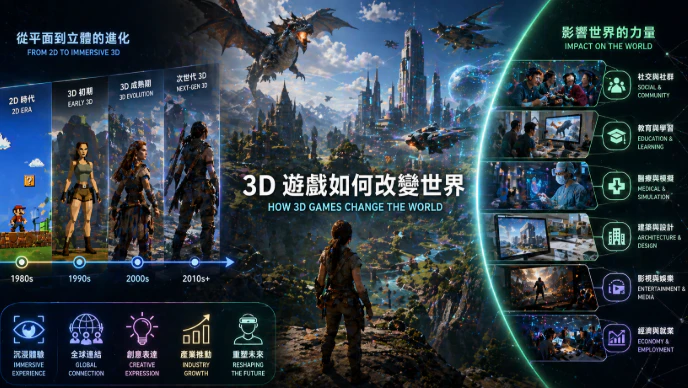
3D遊戲的出現,徹底改寫了人類與數位世界的關係,從早期的平面畫面轉向具有深度與空間感的虛擬環境,玩家不再只是觀看,而是進入其中,這種轉變讓遊戲從一種娛樂形式演變為一種沉浸式體驗。當3D技術逐步成熟,鏡頭運動、角色建模與物理模擬開始構建出更真實的世界,玩家可以自由探索、觀察與互動,空間不再只是背景,而成為遊戲設計的核心元素。這種空間感的建立,也影響了其他媒體形式,例如電影與動畫在敘事與視覺上借鑑遊戲的鏡頭語言,使娛樂產業之間產生交互影響。同時,3D遊戲推動了硬體與圖形技術的發展,從顯示卡到即時渲染技術,都因為遊戲需求而快速進步,這些技術進一步被應用於建築設計、醫療模擬與教育訓練等領域,使遊戲的影響延伸到現實世界。隨著開放世界與沙盒設計的興起,3D遊戲提供了更高的自由度,玩家可以在虛擬空間中創造、實驗甚至建立社群,遊戲不再只是被動消費,而是參與式的創作平台。此外,3D遊戲改變了人們對空間與存在的理解,虛擬世界與現實世界之間的界線逐漸模糊,特別是在虛擬實境與擴增實境技術的發展下,玩家可以更直接地「置身」於數位環境之中,這種沉浸感重新定義了體驗的概念。文化層面上,3D遊戲成為全球共通的語言,不同地區的玩家透過同一個虛擬世界交流與互動,形成跨文化的社群與共同記憶。經濟上,遊戲產業因3D技術而快速擴張,帶動相關產業鏈發展,從內容創作到技術服務都產生新的機會。總體而言,3D遊戲不只是視覺上的進步,而是一種改變人類感知、創作與交流方式的力量,它將虛擬與現實連接起來,並持續影響未來科技與文化的走向。
English Version
The emergence of 3D gaming fundamentally redefined the relationship between humans and digital environments, transforming flat interfaces into spaces with depth, scale, and presence. Instead of merely observing, players began to inhabit these worlds, turning games into immersive experiences rather than simple pastimes. As 3D technology evolved, advancements in camera movement, character modeling, and physics simulation enabled the creation of increasingly believable environments, where space itself became a central component of design. This spatial awareness influenced other forms of media, with film and animation adopting game-inspired visual language and interactive perspectives. At the same time, 3D games accelerated the development of hardware and graphics technologies, driving innovations in GPUs and real-time rendering that later found applications in architecture, medical simulation, and education. The rise of open-world and sandbox designs further expanded the role of players, allowing them not only to explore but also to create and experiment within virtual environments. Games became platforms for participation, expression, and even community building. Beyond entertainment, 3D gaming reshaped how people understand space and presence, blurring the boundaries between virtual and physical realities—especially with the growth of virtual and augmented reality technologies. This immersive dimension redefined what it means to experience digital content. Culturally, 3D games have become a shared global language, connecting players across regions and forming communities that transcend geographical boundaries. Economically, they have fueled rapid growth within the gaming industry and its surrounding ecosystems, creating opportunities in both creative and technical fields. Ultimately, 3D games represent more than a visual upgrade—they are a transformative force that continues to influence how we perceive, create, and interact with both virtual and real worlds.