
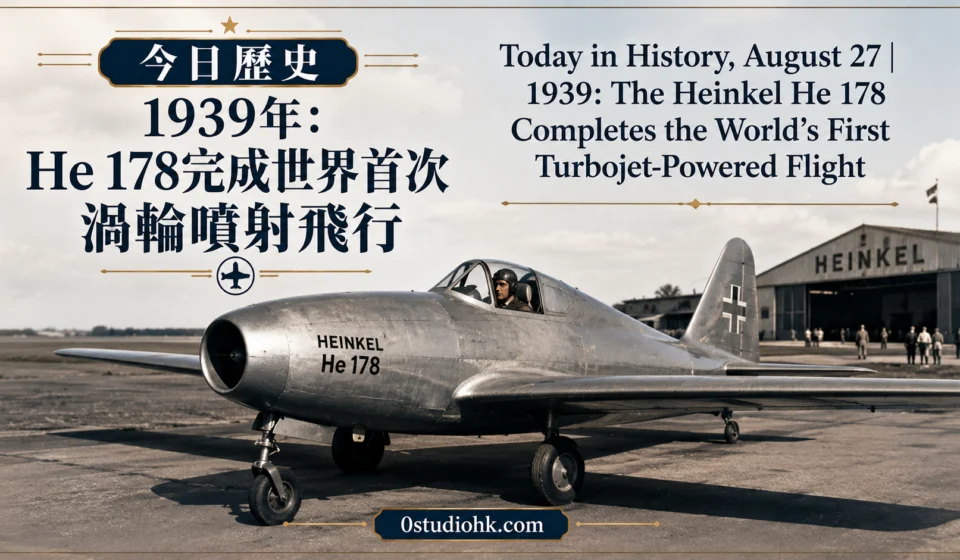
今日歷史|1939年:He 178完成世界首次渦輪噴射飛行 | Today in History, August 27 | 1939: The Heinkel He 178 Completes the World’s First Turbojet-Powered Fligh
1939年8月27日,德國Heinkel(亨克爾)研製的He 178由飛行員埃里希・瓦西茨(Erich Warsitz)駕駛升空,成為世界上第一架由渦輪噴射發動機推動並成功飛行的飛機。這次約7分鐘的試飛,標誌著航空動力技術踏入噴射時代的重要一步。
On August 27, 1939, the German Heinkel He 178, piloted by Erich Warsitz, became the first aircraft in the world to fly under turbojet power. The approximately seven-minute flight marked a major milestone in the transition from conventional piston engines to jet propulsion.
中文版本
1939年8月27日,航空史迎來一個重要時刻。德國Heinkel(亨克爾)公司的實驗飛機 He 178 首次升空,由飛行員埃里希・瓦西茨(Erich Warsitz)駕駛,成為世界上第一架成功以渦輪噴射發動機作為主要動力飛行的飛機。美國國家航空太空博物館確認,這次飛行由漢斯・馮・歐海恩(Hans von Ohain)設計的 HeS 3B 渦輪噴射發動機提供動力。
在He 178出現以前,飛機主要依靠活塞式發動機帶動螺旋槳。這種方式經過多年發展已經相當成熟,但當飛行速度不斷提高,傳統螺旋槳推進逐漸遇到新的空氣動力學限制。工程師開始尋找不同的方法,希望可以直接利用高速氣流產生推力。
漢斯・馮・歐海恩正是研究這條道路的重要人物之一。他從1930年代開始研究渦輪噴射原理,透過壓縮空氣、燃燒燃料,再利用高速氣流通過渦輪及噴嘴產生推力。美國國家航空太空博物館指出,他的研究最終發展出HeS系列發動機,而 HeS 3B於1939年8月27日推動He 178完成世界首次渦輪噴射飛行。
He 178本身是一架實驗性飛機,目的並不是立即成為民航客機,而是測試全新的噴射推進技術。飛機的外形與後來的噴射客機有很大不同,但它所採用的基本概念,卻成為日後航空工程的重要發展方向。
首飛由埃里希・瓦西茨負責。根據Smithsonian的資料,飛機從Heinkel位於德國Marienehe的試飛場起飛,飛行期間速度超過400英里每小時,整個飛行約7分鐘後降落。
這次試飛也並非完全沒有意外。Smithsonian記載,飛機起飛時發動機曾經吸入一隻鳥,但並沒有阻止He 178完成這次具有歷史意義的飛行。
真正重要的是,He 178證明了一件此前仍然屬於實驗階段的事情:飛機可以完全依靠渦輪噴射發動機產生推力並持續飛行。
這與傳統螺旋槳飛機的工作方式有根本上的不同。活塞式飛機需要發動機帶動螺旋槳,螺旋槳再推動空氣產生前進力量;渦輪噴射發動機則利用高速氣流直接產生反作用推力。
這個概念後來逐步改變了航空業。
不過,He 178的歷史意義並不代表噴射飛機在一夜之間便取代了螺旋槳飛機。從實驗機到真正成熟的噴射航空,中間仍然經歷了大量工程研究,包括發動機可靠性、燃料效率、材料、機翼設計及高速飛行控制等問題。
因此,1939年8月27日更適合被視為噴射航空的重要起點之一,而不是現代航空在當天已經完成。
He 178的出現也證明,航空科技的突破很多時候並不是單純把原有技術做得更大或更強,而是改變整個推進方式。從螺旋槳轉向渦輪噴射,代表工程師開始以另一種方式思考飛行。
後來,噴射發動機技術持續進步,逐漸應用於更多種類的飛機。現代大型民航客機、高速飛機及許多其他航空器,都採用了不同形式的燃氣渦輪發動機。
今天,人們可以乘坐噴射客機在數小時內跨越洲際。這種高速、長距離的航空旅行已經成為現代世界的重要交通方式。但如果回望1939年8月27日,當時的一架小型實驗飛機,已經展示了一條完全不同的航空技術道路。
He 178並不是現代噴射客機的直接成品,但它證明了噴射推進可以真正讓飛機飛上天空。這項突破為後來的噴射航空發展提供了重要的技術經驗,也成為航空工程史上一個值得記住的里程碑。
English Version
On August 27, 1939, aviation history entered a new era. The German Heinkel He 178, piloted by Erich Warsitz, became the first aircraft in the world to successfully fly under turbojet power. The aircraft was powered by the HeS 3B turbojet engine, developed by engineer Hans von Ohain.
Before the He 178, most aircraft relied on piston engines driving propellers. This technology had already become highly developed, but as aircraft designers sought greater speed, conventional propeller propulsion increasingly faced aerodynamic limitations. Engineers therefore began exploring completely different ways of producing thrust.
Hans von Ohain was one of the pioneers of this new approach. Beginning his research in the 1930s, he worked on a propulsion system based on compressing air, burning fuel and producing high-speed exhaust gases to generate thrust. His work eventually led to the HeS series of turbojet engines. The National Air and Space Museum confirms that the HeS 3B powered the Heinkel He 178 during the world’s first flight of a turbojet-powered aircraft on August 27, 1939.
The He 178 was an experimental aircraft rather than a production airliner. Its purpose was to test the new propulsion concept. Its appearance was very different from today’s passenger jets, but the basic idea behind its propulsion system would become increasingly important in the future of aviation.
Erich Warsitz was selected to conduct the historic flight. According to Smithsonian, the aircraft took off from the Heinkel airfield at Marienehe in Germany, reached a speed of more than 400 miles per hour and remained airborne for approximately seven minutes before landing.
The flight was not completely without problems. Smithsonian records that the engine sucked in a bird during takeoff. Despite this incident, the aircraft completed the historic flight successfully.
The most important achievement of the He 178 was that it demonstrated something that had previously existed mainly as an experimental engineering concept: an aircraft could fly using a turbojet engine as its source of propulsion.
This represented a fundamental difference from conventional propeller aircraft. A piston-powered aircraft uses its engine to turn a propeller, while a turbojet produces thrust through the movement of high-speed gases through the engine.
The achievement did not mean that jet aircraft immediately replaced propeller aircraft. Considerable engineering work was still required before jet propulsion became reliable and practical for widespread aviation. Engineers had to improve engine reliability, fuel efficiency, materials, aerodynamics and aircraft design.
For this reason, August 27, 1939, is best understood as one of the major starting points of the jet age, rather than the moment when modern aviation was already complete.
The He 178 demonstrated that a completely different approach to aircraft propulsion was possible. Instead of continually improving the propeller, engineers could develop an entirely new system based on the turbine and jet principle.
Jet propulsion subsequently continued to develop and was eventually adopted for many different types of aircraft. Modern commercial airliners, high-speed aircraft and numerous other aviation systems rely on gas-turbine technology.
Today, passengers can cross oceans in a matter of hours aboard jet airliners. High-speed international air travel has become a normal part of modern life. Yet this capability has roots in early experimental aircraft such as the Heinkel He 178.
The He 178 was not a modern passenger jet, nor did it immediately transform aviation. Its importance lies in demonstrating that jet propulsion could successfully lift an aircraft into the air. That achievement provided an important milestone in the development of aviation technology and helped open the path toward the modern jet age.
總結
1939年8月27日,Heinkel He 178完成世界首次渦輪噴射飛行,由此成為航空史上噴射時代的重要里程碑。
On August 27, 1939, the Heinkel He 178 completed the world’s first turbojet-powered flight, marking an important milestone on the road to the modern jet age.