
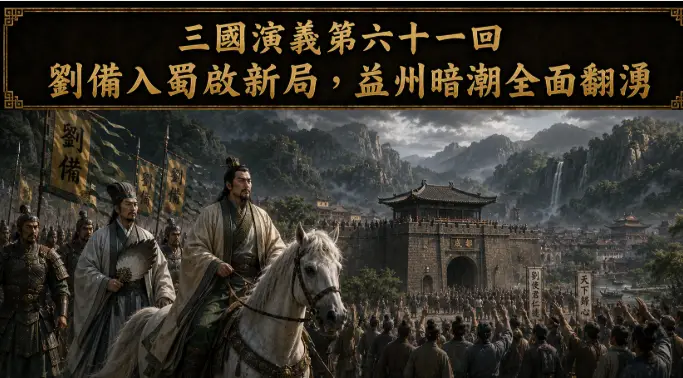
三國演義第六十一回:劉備入蜀啟新局,益州暗潮全面翻湧 | Romance of the Three Kingdoms Chapter 61 Liu Bei Enters Shu
一張地圖改變天下,一次入蜀牽動命運。當劉備踏入益州,真正的局勢轉折,也悄然開始。
A single map reshapes destiny, and Liu Bei’s journey into Shu marks the beginning of a profound shift in the balance of power.
中文
蜀道群山重疊,雲霧深鎖。
益州之地,自古易守難攻。
對外,它像一道天然屏障。
對內,卻藏著難以言說的不安。
劉璋坐守成都多年,性情仁厚,重安穩而輕權變。
百姓雖得安定,但朝中上下,漸漸失去銳氣。
而北方局勢日益混亂,漢中張魯勢力不斷逼近。
危機,已悄悄壓向益州。
此時,有人提出一策。
迎劉備入蜀,共抗外敵。
這個建議,很快引起爭議。
有人支持,有人反對。
因為所有人都知道——
劉備絕非尋常客將。
他一旦入蜀,便未必願再離開。
然而,劉璋最終仍選擇答應。
不是因為完全信任。
而是因為局勢已逼他冒險。
消息傳至荊州。
劉備沉默良久。
他知道,這是機會。
也是考驗。
一旁的諸葛亮緩緩展開地圖。
山川道路、關隘城池,一一映入眼前。
「入蜀,便不可回頭。」
他語氣平靜。
因為所有人都明白,此行關係未來根基。
若成功,劉備將真正擁有立國之地。
若失敗,則可能萬劫不復。
於是,大軍開始西進。
沿途山道崎嶇,峽谷幽深。
蜀地濕氣瀰漫,與中原截然不同。
士兵行於懸崖古道之間,彷彿踏入另一個世界。
而劉備始終保持低調。
他以援軍身份入蜀,不急於擴張。
禮數周全,言談謙和。
甚至多次表示,只為協助劉璋。
這種態度,逐漸降低益州眾人的戒心。
然而,真正敏銳的人,已察覺變化。
劉備所到之處,人心漸向。
百姓稱頌,士人敬重。
相比劉璋的優柔,劉備身上多了一種能凝聚人心的力量。
而這種力量,比兵馬更危險。
成都城內,氣氛也開始變得微妙。
有些人開始期待改變。
有些人則開始恐懼。
夜色降臨。
成都燈火映照城樓。
遠方山風吹過,帶來濕冷氣息。
而在那風聲之中,一場真正改變蜀地命運的故事,已悄然揭開序幕。
English Version
The road into Shu was unlike any other region in the empire.
Mountains towered endlessly, rivers carved through narrow valleys, and thick mist concealed the paths that twisted through the landscape.
For centuries, Yi Province had survived through geography alone.
Its isolation protected it from chaos.
But isolation could also breed stagnation.
Liu Zhang ruled the province with caution and kindness. His administration valued peace over ambition, stability over expansion.
For ordinary people, that had once been enough.
But the world beyond Shu was changing rapidly.
Pressure from Zhang Lu in Hanzhong continued to grow, and the political balance across the realm was becoming increasingly unstable.
Within Yi Province, many officials feared that remaining passive would eventually lead to disaster.
One proposal gradually rose above the others: invite Liu Bei into Shu as an ally.
The suggestion divided the court immediately.
Supporters believed Liu Bei’s military reputation could strengthen the province’s defenses.
Opponents understood the hidden danger.
Liu Bei was not merely a wandering noble seeking temporary shelter.
He was a leader capable of building loyalty wherever he went.
Once inside Shu, removing him might become impossible.
Yet Liu Zhang accepted the risk.
Not because he fully trusted Liu Bei, but because circumstances left few alternatives.
When the invitation reached Jingzhou, Liu Bei recognized its significance immediately.
This was more than military cooperation.
It was access to a future.
Zhuge Liang studied the terrain carefully.
The mountains of Shu offered natural protection unlike anywhere else in China. Control of Yi Province would provide security, resources, and strategic independence.
But entering Shu also meant entering uncertainty.
Every alliance could become conflict.
Every welcome could become suspicion.
Liu Bei advanced cautiously.
His forces moved through dangerous mountain roads and narrow passes, adapting to terrain unfamiliar to soldiers from the plains.
Rather than projecting conquest, Liu Bei emphasized humility.
He presented himself as a supporter, not an occupier.
His conduct was respectful.
Measured.
Patient.
That approach slowly reduced resistance within Yi Province.
But influence spreads quietly.
Wherever Liu Bei traveled, people responded to him differently.
Officials admired his courtesy.
Soldiers respected his leadership.
Common citizens viewed him as approachable in ways Liu Zhang no longer seemed to be.
The contrast became impossible to ignore.
And with that contrast came tension.
Some in Shu began to hope for change.
Others feared exactly what that change might bring.
As night settled over Chengdu, the province remained outwardly calm.
But beneath the calm, the balance had already begun to shift.
Liu Bei had entered Shu as a guest.
History would decide whether he remained one.