三國演義第五十八回:馬超興兵報父仇,西涼鐵騎震動關中 | Romance of the Three Kingdoms Chapter 58 Ma Chao’s Revenge Campaign
赤壁之後,天下未定。當西涼鐵騎南下復仇,一場關乎血仇與權力的新戰火,再度席捲中原。
After Red Cliffs, peace remains distant. As Ma Chao rises in vengeance, the western frontier erupts into a new struggle of loyalty, revenge, and ambition.
中文
關中風沙漫天,戰鼓再起。
南方局勢尚未穩定,北方卻已燃起新的戰火。
曹操挾天子以令諸侯,聲勢依舊強盛。
然而,在西涼,另一股力量正在聚集。
那是馬超。
其父馬騰被害之後,血仇未解。
怒火與悲憤,化為復仇之志。
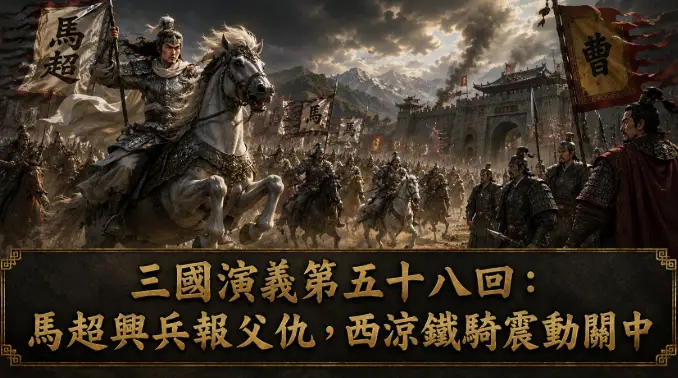
西涼鐵騎迅速集結。
旌旗如海,戰馬嘶鳴。
關中各地聞之震動。
馬超不只是勇將。
他更擁有足以號召西北豪強的聲望。
於是,韓遂等勢力相繼響應。
大軍東進,直逼潼關。
消息傳至許都,朝野震驚。
曹操沉默良久。
他知道,這場戰爭不同於過去。
西涼軍善騎射、行軍迅猛。
若處置失當,關中將全面動搖。
於是,他親率大軍西征。
兩軍隔河對峙,氣氛緊繃。
馬超年輕氣盛,鋒芒畢露。
他披銀甲、持長槍,立於陣前,如烈火般逼人。
而曹操則沉穩如山。
他不急於決戰。
因為他清楚,正面衝突未必有利。
真正的勝負,不只在戰場。
還在人心。
於是,他開始離間。
韓遂與馬超雖為盟友,卻並非真正同心。
年齡、背景、利益皆不同。
曹操正是看準這一點。
他故意釋放訊息,製造猜疑。
書信往來、態度轉變,一點點動搖聯軍。
而另一邊,馬超則逐漸焦躁。
他擅長衝鋒,卻不擅長等待。
戰局開始改變。
原本氣勢如虹的西涼軍,內部漸生裂痕。
信任一旦動搖,軍勢也隨之不穩。
最終,聯軍失去統一。
曹操乘勢出擊。
戰鼓震天,鐵騎衝殺。
潼關之戰,就此逆轉。
馬超雖勇,終究無法挽回局勢。
他率殘軍撤退,回望戰場。
風沙之中,滿是未竟之恨。
這場戰爭,不只是復仇失敗。
更是一場關於人心與權術的較量。
而曹操,再一次證明——
真正可怕的,不只是兵力。
而是洞悉人性的能力。
English Version
While the south struggled to stabilize after Red Cliffs, a new conflict erupted in the west.
This war was not born from ambition alone.
It was fueled by vengeance.
Ma Chao, son of Ma Teng, carried a fury that could not be restrained.
His father’s death transformed grief into purpose, and that purpose spread quickly across the western frontier.
Warriors gathered beneath his banner.
The cavalry of Liang Province moved like a storm across the plains, swift and intimidating.
To many, Ma Chao represented more than rebellion.
He represented resistance.
His reputation drew allies, including Han Sui and other regional powers. Together, they formed a coalition capable of threatening Cao Cao’s control over the northwest.
Their advance toward Tong Pass sent shockwaves through the political center.
Cao Cao recognized the danger immediately.
This was not a campaign that could be handled casually.
The western cavalry excelled in mobility and shock tactics. A direct confrontation under the wrong conditions could become disastrous.
So Cao Cao approached the conflict differently.
He remained patient.
Measured.
Careful not to fight the battle Ma Chao wanted.
When the two armies faced each other across the river, the contrast between their leaders became clear.
Ma Chao burned with intensity and momentum.
Cao Cao relied on restraint and observation.
And it was observation that gave him advantage.
Rather than focusing solely on military strength, Cao Cao studied the alliance itself.
The coalition opposing him was powerful—but fragile.
Its leaders differed in age, interests, and long-term goals.
Trust existed, but only conditionally.
Cao Cao exploited that weakness with precision.
Rumors were planted.
Messages were manipulated.
Small doubts were encouraged to grow.
Gradually, suspicion spread between Ma Chao and Han Sui.
The unity that had fueled their momentum began to fracture.
And once doubt enters an alliance, strength fades quickly.
Ma Chao sensed the shift, but too late.
His frustration increased.
His aggression became less controlled.
Cao Cao waited for exactly that moment.
Then he struck.
The battle at Tong Pass turned suddenly.
What had once appeared to be a powerful uprising collapsed under internal division.
Ma Chao escaped with what remained of his forces, carrying with him not only defeat, but unfinished rage.
The campaign revealed something essential about Cao Cao’s leadership.
He did not simply defeat armies.
He defeated cohesion itself.