
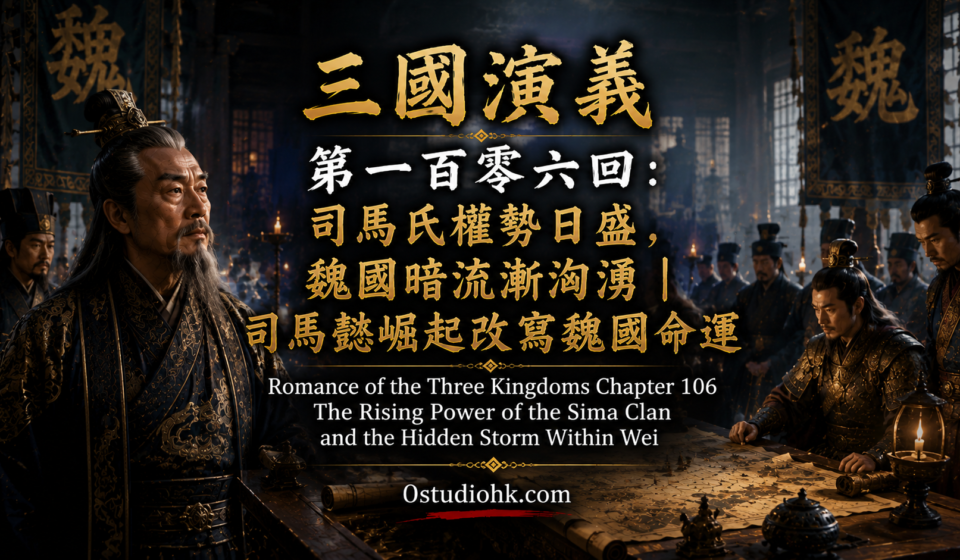
三國演義第一百零六回:司馬氏權勢日盛,魏國暗流漸洶湧|司馬懿崛起改寫魏國命運 | Romance of the Three Kingdoms Chapter 106: The Rising Power of the Sima Clan and the Hidden Storm Within Wei
諸葛亮逝世後,蜀漢失去擎天之柱,而魏國內部的權力格局亦開始悄然改變。司馬懿憑藉多年軍功與政治手腕,逐漸掌握魏國軍政大權。表面上的魏國依然強盛,朝堂之下卻已暗流湧動,一場更深遠的權力爭奪正在悄悄展開。
After Zhuge Liang’s death, Shu Han lost its greatest leader, while a different transformation was taking place within Wei. Through military success, patience, and political calculation, Sima Yi gradually increased his influence. Although Wei remained powerful on the surface, tensions beneath the imperial court were beginning to reshape the future of the kingdom.
中文
五丈原的秋風,早已吹遠。
諸葛亮的離世,令蜀漢上下悲痛不已。
然而,對魏國而言,這卻是一個新的開始。
最大的北伐威脅消失了。
但魏國朝廷之中,另一個更加深沉的變化,也正在悄悄發生。
司馬懿。
這位曾經在戰場上一次又一次與諸葛亮周旋的老將,如今聲望已達到前所未有的高度。
他沒有急著邀功。
也沒有在朝堂上大肆炫耀。
反而比以往更加沉默。
因為他知道。
真正的權力,從來不是喊出來的。
而是一步一步累積出來的。
魏明帝曹叡對司馬懿越來越倚重。
凡是關中軍務、邊防調度,甚至重要的軍事決策,都開始交給司馬懿處理。
司馬氏的勢力,也因此逐漸壯大。
朝廷之中,有人佩服。
有人羨慕。
也有人開始感到不安。
「司馬懿掌握的兵權,是否太大了?」
這樣的聲音,開始在朝堂角落裡出現。
然而司馬懿對此毫不在意。
他每日依舊研究軍報。
整理軍籍。
檢查糧草。
訓練將士。
表面上,他仍然是一位忠心耿耿的魏國重臣。
但沒有人知道。
他的目光,早已不只停留在戰場。
魏國真正的敵人,未必來自城外。
有時候。
最大的危機,就藏在朝堂之中。
司馬懿深知這一點。
所以他從不輕易表露自己的真正想法。
他等待。
也觀察。
更重要的是,他培養自己的力量。
司馬師、司馬昭等後輩,也逐漸進入魏國政治與軍事舞台。
司馬氏一族,開始形成一股不可忽視的力量。
有人開始注意到這個變化。
「司馬家的人,似乎越來越多。」
但司馬懿依然沉默。
他知道。
現在還不是時候。
只要魏國仍然強盛,只要皇權仍然穩固,他便不能輕舉妄動。
另一方面。
蜀漢雖然失去了諸葛亮,姜維卻開始承繼北伐之志。
魏國依然面對來自西方的壓力。
因此,朝廷更加需要司馬懿。
這反而令他的權力進一步擴大。
戰場上的功績。
朝廷中的信任。
軍隊中的威望。
家族中的人才。
一層又一層力量,逐漸集中到司馬氏手中。
而魏國表面上,依舊歌舞昇平。
城池依舊高大。
軍隊依舊強盛。
百姓依舊生活。
沒有人知道。
一場改變魏國命運的權力風暴,已經在暗處形成。
某夜。
司馬懿獨自站在府邸之中。
窗外月色冷清。
他望著遠方。
沒有說話。
多年來,他一直等待。
等待諸葛亮離世。
等待魏國需要他。
等待自己的力量足夠強大。
如今。
第一個最大的對手已經離開人世。
接下來。
真正的較量,或許不再是魏蜀之間。
而是魏國自己。
司馬懿慢慢轉身。
燭火映照著他的臉。
那雙眼睛依然平靜。
卻比任何時候都更加深沉。
歷史的齒輪,正在悄悄轉動。
蜀漢的北伐仍未停止。
而魏國內部的權力鬥爭,也即將進入新的階段。
沒有人知道最後誰會勝出。
但有一件事已經十分清楚。
司馬氏,正在崛起。
而這股力量一旦形成。
將足以改變整個魏國的命運。
English Version
The winds of Wuzhang Plains had long since faded.
Zhuge Liang was gone, and Shu Han mourned the loss of its greatest statesman.
Yet while Shu struggled to recover, another transformation was taking place within Wei.
The kingdom had survived the Northern Expeditions.
Its greatest military threat had disappeared.
But the disappearance of Zhuge Liang created a new political landscape.
At the center of that transformation stood Sima Yi.
For years, he had faced Zhuge Liang across the battlefield.
He had endured defeats, avoided traps, and patiently waited for opportunities.
Now his reputation had reached an extraordinary level.
Yet Sima Yi did not celebrate.
He remained quiet.
He understood something that many politicians did not.
Real power did not always announce itself.
It accumulated slowly.
Emperor Cao Rui increasingly relied upon Sima Yi.
Military affairs in the western regions were placed under his supervision.
Important defensive decisions were entrusted to him.
With every appointment, the influence of the Sima family grew.
Some officials admired him.
Others envied him.
And some began to worry.
“How much military authority should one man possess?”
Such questions quietly circulated through the imperial court.
Sima Yi appeared unconcerned.
Every day, he continued reviewing military reports.
He inspected troop records.
He studied supply systems.
He supervised the training of soldiers.
To the outside world, he remained a loyal servant of Wei.
But his understanding of power had become far broader than battlefield strategy.
He knew that a kingdom could face danger not only from enemies outside its walls.
Sometimes the greatest danger came from within the court itself.
For that reason, Sima Yi revealed very little of what he truly thought.
He watched.
He waited.
And he strengthened his position.
His sons, Sima Shi and Sima Zhao, gradually entered the political and military world as well.
The Sima family was becoming an increasingly powerful force within Wei.
Some officials noticed.
“The Sima family seems to be growing stronger every year.”
But Sima Yi remained patient.
He knew that the time for open confrontation had not yet arrived.
As long as the Wei imperial court remained stable, he had no reason to act recklessly.
Meanwhile, Shu Han had not abandoned its ambitions.
Jiang Wei had inherited Zhuge Liang’s unfinished Northern Expeditions.
Wei therefore still needed experienced commanders.
And the more Wei depended upon Sima Yi, the more authority he accumulated.
Military achievements.
Imperial trust.
Influence among the troops.
A growing family network.
Each layer strengthened the next.
Slowly, power was concentrating around the Sima clan.
Yet on the surface, Wei remained strong.
Its cities stood firm.
Its armies remained formidable.
Its government continued functioning normally.
Few people realized that a political storm was forming beneath the surface.
One quiet night, Sima Yi stood alone within his residence.
Moonlight fell across the courtyard.
He looked toward the distant horizon without speaking.
For years, he had waited.
He had waited for Zhuge Liang to disappear.
He had waited for Wei to depend upon him.
He had waited for his own influence to become strong enough.
Now the greatest rival of his military career was gone.
The next struggle might no longer be between Wei and Shu.
It might be within Wei itself.
Sima Yi slowly turned away from the window.
Candlelight illuminated his calm expression.
His eyes remained quiet.
But behind them was a depth that few people could understand.
History was beginning to turn.
Shu Han continued its Northern ambitions.
At the same time, the political balance inside Wei was quietly changing.
No one yet knew how the struggle would end.
But one fact was becoming increasingly difficult to ignore.
The Sima clan was rising.
And once that power fully emerged, it would change the destiny of Wei forever.