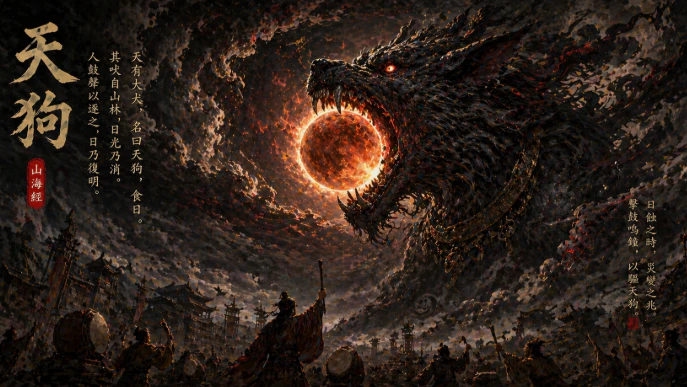
《山海經 023(神獸篇)》《山海經》天狗:吞日之影與災變的預兆 | Tiangou in Shan Hai Jing: The Celestial Hound and the Omen of Eclipses

天狗是《山海經》中與日蝕相關的神秘異獸,象徵天象異變與災難預兆,反映古人對天空與未知力量的敬畏與想像。
Tiangou, a mysterious creature in the Shan Hai Jing, is linked to solar eclipses and seen as a harbinger of cosmic disturbance, reflecting ancient awe toward celestial phenomena and the unknown.
中文
在蒼穹最深處,有一種無聲的存在潛伏於光與影之間,那便是天狗。人們無法在平常的日子裡看見牠,因為牠不屬於大地,而是遊走於天空與虛空之間,等待著某個特定的時刻降臨。當陽光正盛,萬物明亮之時,牠卻悄然靠近,如同陰影逐漸吞噬光芒,帶來一種難以言喻的不安。最初只是光線的微微變暗,鳥獸開始躁動,人們抬頭仰望,卻無法理解發生了什麼,而就在那一刻,天狗張開巨口,將太陽一口吞下,天地頓時陷入詭異的昏暗之中。傳說中,牠的形態似犬卻更為巨大,身影模糊而難以捉摸,彷彿由黑暗本身凝聚而成。牠的行動無聲無息,但影響卻遍及整個世界。古人認為這是災變的預兆,於是擊鼓鳴鐘,試圖以聲響驅趕這來自天上的吞噬者,希望能讓光重新回到人間。鼓聲震動空氣,聲浪傳向天際,彷彿在與某種不可見的力量對抗,而天狗則在這片混亂之中遲疑,最終將光芒吐出,讓太陽重新出現。於是,白晝恢復,萬物鬆了一口氣,但那短暫的黑暗卻深深刻印在人們心中。有人說,天狗並非單純的破壞者,而是宇宙運行的一部分,牠的出現提醒著人類,光明並非永恆,秩序也可能被打破。也有人認為,牠象徵著人心中的恐懼與未知,當人們面對無法解釋的現象時,便以神話賦予其形象。無論真相如何,天狗的傳說在世代之間流傳,成為對天空異象最直觀的詮釋。每當日蝕再次出現,人們仍會想起那隻吞日的巨獸,彷彿牠從未離開,只是在某個看不見的角落靜靜等待,等待下一次吞噬光明的時刻。
English Version
High above the visible sky, beyond the reach of ordinary sight, there exists a presence that moves silently between light and shadow—this is Tiangou. It cannot be seen during the calm rhythm of everyday life, for it does not belong to the earth. Instead, it drifts through the unseen layers of the heavens, waiting for the precise moment to emerge. When the sun shines at its brightest and the world feels secure in its clarity, something subtle begins to shift. Light dims almost imperceptibly, and unease spreads among animals and humans alike. Then, without warning, the celestial hound reveals itself, its immense form suggested only by the growing darkness. With a single motion, it consumes the sun, plunging the world into an eerie twilight. The creature is often described as dog-like, yet far larger and more elusive, as though shaped from shadow itself. Its presence is never loud, yet its impact is undeniable. Ancient people saw these moments as omens of disruption, fearing that the balance of the world had been broken. In response, they beat drums and rang bells, sending waves of sound upward in an attempt to drive the creature away. The noise echoed through the sky, as if challenging an invisible force. Gradually, the darkness would recede, and the sun would return, as though released from the beast’s grasp. Light flooded back into the world, restoring order, yet leaving behind a lingering sense of vulnerability. Some interpretations suggest that Tiangou is not merely a destroyer, but a necessary part of cosmic balance—a reminder that light is not constant and that stability can falter. Others view it as a manifestation of human fear, a symbolic way of understanding events beyond comprehension. Regardless of interpretation, its legend has endured, woven into the cultural memory of celestial events. Even today, during an eclipse, one can imagine that ancient presence stirring once more, hidden within the shifting shadows, waiting for its moment to return and briefly reclaim the sun.