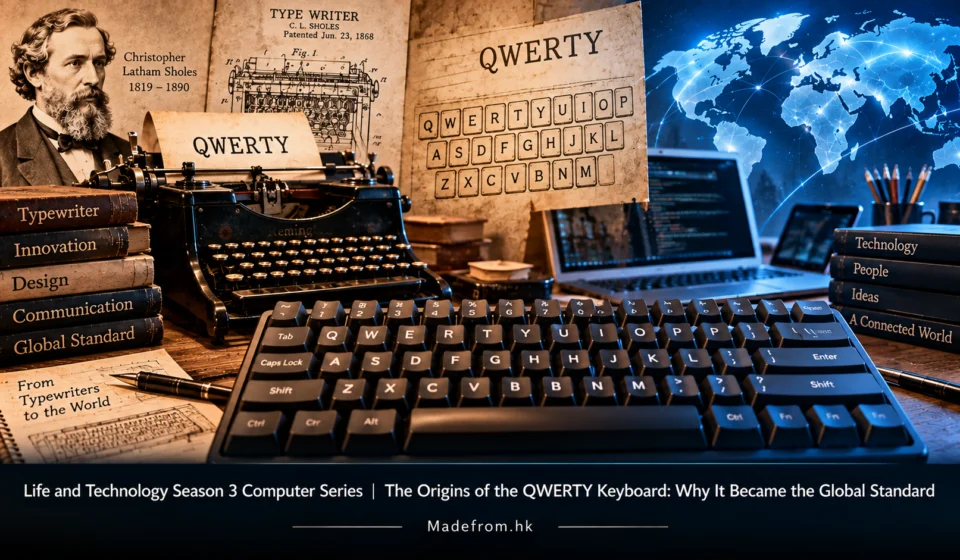
Life and Technology Season 3 Computer Series | The Origins of the QWERTY Keyboard: Why It Became the Global Standard
Every day, millions of people type English using QWERTY keyboards without questioning the unusual order of the letters. Its origins go back to 19th-century typewriters, where early mechanical limitations and changing user needs shaped a layout that eventually became a worldwide standard.
The QWERTY keyboard is one of the most familiar pieces of technology in everyday life, yet its arrangement is surprisingly old. Look at the top row of a standard English keyboard and the first six letters spell Q-W-E-R-T-Y. That unusual sequence gives the layout its name. Unlike an alphabetical keyboard, QWERTY was not created simply to make letters easier to find. Its origins lie in the mechanical typewriter era of the 19th century, long before personal computers, laptops, or smartphones existed. American inventor Christopher Latham Sholes became involved in developing a practical typewriter during the 1860s. Working with collaborators including Carlos Glidden and Samuel W. Soule, he experimented with machines capable of printing letters directly onto paper. The earliest prototypes did not use the modern QWERTY arrangement. Their keyboards went through several different configurations as the designers experimented with the mechanical system and considered how people would actually use the machine. The exact reason behind the final QWERTY arrangement remains a subject of historical debate. One long-standing explanation connects the layout to the mechanical design of early typewriters. These machines used metal type bars that moved toward the paper when a key was pressed. If certain combinations of keys were struck rapidly, nearby type bars could interfere with each other and become jammed. One theory therefore suggests that Sholes rearranged letters to separate frequently used combinations and reduce mechanical interference. Smithsonian collections support a version of this explanation, describing the early QWERTY arrangement as a way of preventing the type bars from clashing during operation. However, the story is more complicated than the popular “QWERTY was designed to slow typists down” explanation. More recent historical research has suggested that telegraph operators may also have influenced the development of the layout. Telegraph operators had to interpret Morse code rapidly and convert incoming messages into written language. Alphabetical keyboard arrangements were not necessarily convenient for this process. Sholes also sent early typewriter prototypes to court reporters and telegraph operators for testing, meaning that practical feedback from professional users may have influenced the evolving keyboard. In other words, QWERTY may not have been created through one simple decision. It appears to have emerged through repeated experimentation, redesign, and interaction with the people who actually used the machines. In 1874, the Sholes and Glidden typewriter reached the market through E. Remington & Sons and became one of the earliest commercially successful typewriters. By the time of the Remington Standard No. 2, the QWERTY arrangement had become firmly established, and the 1878 patent documentation showed the recognizable layout. As typewriters spread through offices, QWERTY became more than a mechanical arrangement. It became a learned skill. Typists were trained to use the keyboard, businesses employed people who had mastered the system, and typing schools helped create a standardized method of office work. Once millions of people had learned QWERTY, replacing it became increasingly difficult. The arrival of electric typewriters did not eliminate the layout. When computers began becoming popular in the 1970s and 1980s, there was no longer a mechanical typebar problem requiring QWERTY. A computer keyboard could theoretically use almost any arrangement. Yet by that point, the world had already developed an enormous investment in QWERTY. Users knew it, teachers taught it, manufacturers produced it, and software was designed around it. Changing the layout would mean forcing an entire population to learn a new system. This is an example of what is often called path dependence: decisions made in the past can continue shaping later technology even after the original technical reason has disappeared. QWERTY therefore survived the transition from mechanical typewriters to electronic keyboards. It then moved from desktop computers to laptops and eventually to smartphones and tablets. Even when the physical keys disappeared and became images on a touchscreen, the familiar QWERTY arrangement remained. Alternatives have certainly been developed. In the 1930s, August Dvorak and others promoted alternative keyboard layouts designed around different ideas about typing efficiency and finger movement. Other experimental layouts have appeared since then, but none has displaced QWERTY on a global scale. This does not necessarily mean that QWERTY is objectively the perfect keyboard. Its greatest advantage may simply be that so many people already know how to use it. Once a technology becomes deeply embedded in education, manufacturing, business, software, and everyday habits, replacing it becomes extremely difficult. Today, few people think about the history behind the keyboard when they type an email, search the internet, write a document, or send a message. Yet every time someone presses Q, W, E, R, T, and Y, they are using a design whose roots reach back more than 150 years. The typewriter has largely disappeared, computers have become smaller and faster, and smartphones have replaced physical keyboards with touchscreens, but the basic arrangement has survived. QWERTY is therefore more than a keyboard layout. It is an example of how technology, human behaviour, industrial standards, and historical habit can combine to shape the devices we use today. What began as a solution developed during the age of mechanical writing machines became part of the language of modern computing itself.
QWERTY began in the age of mechanical typewriters but survived every major transformation in computing. Its endurance shows how technology is shaped not only by engineering, but also by habits, standards, and the enormous power of familiarity.