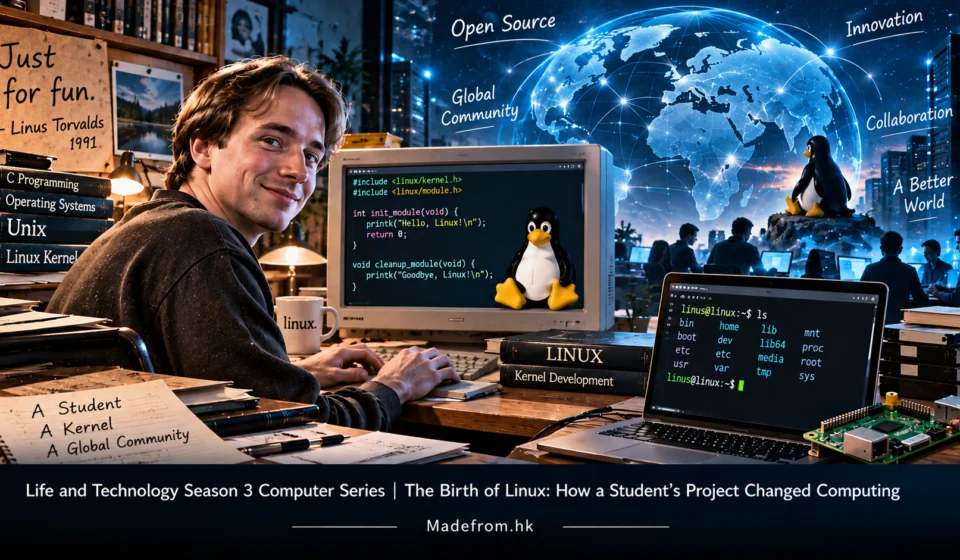
Life and Technology Season 3 Computer Series | The Birth of Linux: How a Student’s Project Changed Computing
In 1991, a Finnish university student began developing a small computer operating-system kernel as a personal project. What started as an experiment eventually became one of the most influential open-source technologies in computing, powering servers, networks, devices, and much of the modern internet.
If the personal computer revolution brought computing into homes and offices, the birth of Linux created a different path for the software world. In 1991, Finnish university student Linus Torvalds began developing his own operating-system kernel while studying at the University of Helsinki. He was working with an Intel 80386-based personal computer and wanted a system that would allow him to explore operating-system development in greater depth. At the beginning, this was not a commercial venture or an attempt to create a platform that would dominate global computing. It was essentially a student project driven by curiosity and technical interest. Unix was already an influential operating system, but many Unix systems were expensive and not easily accessible to ordinary personal-computer users. Torvalds was also familiar with Minix, a Unix-like system developed by Andrew S. Tanenbaum for educational purposes. Inspired by these technologies but interested in building something of his own, Torvalds began writing a new kernel. On 25 August 1991, he posted a message to the online newsgroup comp.os.minix describing his project and inviting people to share ideas. That modest announcement became one of the defining moments in Linux history. The first Linux release, version 0.01, appeared several weeks later. It was extremely limited compared with modern Linux systems, but it demonstrated that the project had genuine potential. One of the most important aspects of Linux was the way it evolved through open development. Torvalds eventually released the Linux kernel under the GNU General Public License, allowing developers to study, modify, and redistribute the source code under its licensing terms. This was very different from traditional proprietary software, where the source code was controlled by a single company. Developers around the world could participate in Linux development, fix problems, improve performance, and contribute new capabilities. What began as Torvalds’ personal project gradually became a global collaboration. There is also an important technical distinction behind the name Linux. Strictly speaking, Linux is the kernel—the central component responsible for managing hardware, memory, processors, devices, and other system resources. A complete operating system requires many additional components. The GNU Project provided a large collection of free software tools that became an important part of many Linux-based systems. For this reason, some complete systems are technically described as GNU/Linux. As the Linux kernel matured, different development communities began combining it with GNU tools and other software to create complete distributions. Debian, Red Hat Linux, and later Ubuntu became prominent examples. These distributions made Linux more practical for different types of users and helped it expand beyond its original environment. Although Linux began on a personal computer, its greatest impact initially came in the server world. Its stability, flexibility, ability to be customized, and licensing model made it attractive to businesses and technical organizations. Linux became widely used for web servers, databases, networking equipment, enterprise infrastructure, and other critical systems. As the internet expanded rapidly during the 1990s and beyond, Linux gained an even larger role. Today, Linux is deeply embedded in data centres, cloud-computing infrastructure, network services, and countless internet-based platforms. Its influence also extends far beyond conventional computers. Android uses the Linux kernel as part of its foundation, bringing Linux technology into billions of mobile and other devices. Routers, smart televisions, vehicles, industrial systems, networking equipment, embedded devices, and supercomputers can also rely on Linux-based technology. Perhaps Linux’s most lasting contribution is cultural as much as technical. It demonstrated that sophisticated software could be developed through a distributed community rather than being entirely controlled by one company. Open source does not simply mean that software has no rules; it means that source code can be made available for inspection, modification, and redistribution under defined licence conditions. The Linux development model became a powerful example for the wider open-source movement and influenced the way modern developers collaborate on software. The ideas surrounding distributed development, version control, and collaborative coding later became fundamental to many software projects and platforms. From a university student experimenting with an 80386 computer to technology that now operates across servers, cloud infrastructure, network equipment, mobile devices, and embedded systems, the Linux story demonstrates the extraordinary potential of open collaboration. Its importance lies not only in the operating-system technology itself, but also in the development culture it helped establish. Linux showed that a project could begin on a remarkably small scale and, when opened to a global community, grow into infrastructure capable of supporting much of the modern digital world.
Linux began as a student’s experiment but grew into a fundamental part of modern computing. Its open development model transformed software collaboration and helped create the infrastructure behind servers, cloud services, networks, mobile devices, and the internet.