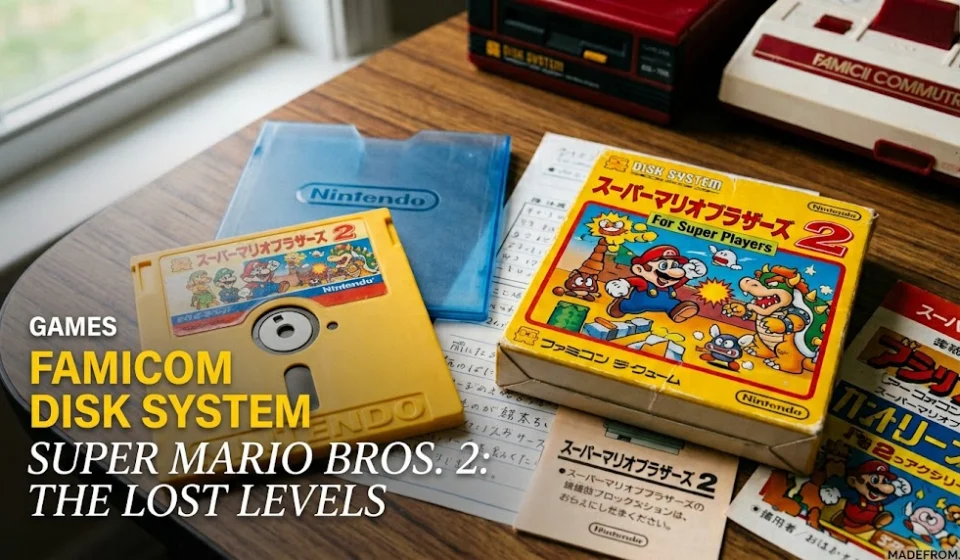
Famicom Disk System | Super Mario Bros. 2: The Lost Levels
In 1986, Nintendo released a very different sequel to Super Mario Bros. Designed for experienced players, it pushed the original formula to a much harder level and was later known in the West as The Lost Levels.
The story of Super Mario Bros. 2 is more complicated than its title suggests. Released in Japan on June 3, 1986 for the Famicom Disk System, the game was designed as a direct continuation of the original Super Mario Bros. Rather than radically changing the formula, Nintendo took the familiar platforming system and pushed its demands much further. Mario and Luigi once again travel through the Mushroom Kingdom, facing enemies and obstacles on the way to rescuing Princess Peach from Bowser. The visual presentation remained close to the original, and the basic gameplay engine was also retained. What changed was the philosophy behind the level design. The first Super Mario Bros. had introduced a huge audience to side-scrolling platform games, teaching players how to run, jump, avoid enemies and understand the rhythm of a Mario level. The sequel was aimed at people who had already mastered those fundamentals. Shigeru Miyamoto wanted to create a game that could challenge experienced players rather than simply offer another beginner-friendly adventure. The development situation was also different from the first game. Miyamoto was heavily involved in the development of The Legend of Zelda for the Famicom Disk System, so Takashi Tezuka took the leading role in directing the sequel. Miyamoto nevertheless continued to contribute to level design and adjustments when time allowed. The result was a game that looked familiar but behaved very differently. Players were expected to understand movement with much greater precision, learn the behavior of enemies and carefully judge jumps and hazards. The sequel therefore became closely associated with extreme difficulty. Nintendo initially planned to release the Japanese game in North America, but Nintendo of America reportedly considered the game too difficult for the recovering American video game market. Instead of simply localizing the Japanese sequel, Nintendo chose a completely different solution. A Japanese Famicom Disk System title called Yume Kōjō: Doki Doki Panic, developed through a collaboration involving Nintendo and Fuji Television, was adapted into a new Mario game. Its four original characters were replaced by Mario, Luigi, Princess Peach and Toad, while objects and visual elements were redesigned around the Mario universe. The result became the North American Super Mario Bros. 2 and was later released in Japan as Super Mario USA. This created one of the most unusual naming situations in Nintendo history. The Japanese Super Mario Bros. 2 and the Western Super Mario Bros. 2 were not actually the same game. For years, Western players therefore had a completely different experience of what they believed was the second Mario platform game. The original Japanese sequel eventually reached international audiences in 1993 through Super Mario All-Stars on the Super Nintendo, where it was given the subtitle The Lost Levels. The new name helped distinguish it from the Western Super Mario Bros. 2 and also captured the game’s unusual history. It was effectively a missing branch of the Mario series that had remained outside the Western market for several years. After its appearance in Super Mario All-Stars, The Lost Levels continued to return on later Nintendo platforms. It was released for the Game Boy Advance in 2004 as part of the Famicom Mini series, followed by appearances through Virtual Console on Wii, Nintendo 3DS and Wii U. In 2019, it became available through Nintendo Switch Online, and the game was also included in the 2020 limited-edition Game & Watch: Super Mario Bros. These later releases gradually transformed the game from an obscure Japanese sequel into a recognized part of Mario history. Its importance is not simply that it was the second Mario platform game. It demonstrates how Nintendo experimented with difficulty and player expectations immediately after the enormous success of the original. Instead of making every aspect more accessible, the developers asked what would happen if the same basic mechanics were presented to players who already understood them extremely well. That approach produced a game remembered for demanding precision and persistence. The history of Super Mario Bros. 2 also demonstrates how regional game markets could shape the identity of a major franchise. Japanese players received one sequel, while North American players received another game carrying the same title. Decades later, both versions became part of the broader Mario story. The Japanese game eventually found its place as The Lost Levels, while the Western game developed its own identity and became an important Mario title in its own right. Looking back, the original Super Mario Bros. 2 is therefore more than a difficult sequel. It is a snapshot of Nintendo during an important period of experimentation, when the company was exploring new hardware through the Famicom Disk System and testing how far a successful game formula could be pushed. What began as a demanding sequel for experienced players eventually became one of the most unusual chapters in the history of the Mario franchise.
Super Mario Bros. 2 remains unusual because its history split into two different versions. The Japanese sequel became The Lost Levels, turning an initially local experiment into a distinctive part of Mario’s international legacy.