
Skip to content
madefrom.hk madefrom.hk madefrom.hk

Rewriting culture, history and memories beyond language and borders.

madefrom.hk madefrom.hk madefrom.hk

Rewriting culture, history and memories beyond language and borders.

  • English
    • Comics
      • Strange Tales
      • Myths of the Constellations
    • DAY
  • 繁體中文
    • 學習筆記
    • 漫畫
      • 碧廬冤孽
  • Column
    • Knowledge Hub
      • 生活篇
      • 食品篇
      • 科技篇
      • 超市篇
    • Life & Technology
    • Hong Kong Guide
    • Today in History
    • City Stories
    • Anime & Manga
    • Game Magazine
    • Toy Club
    • Language of Flowers
    • Street Notes
    • All Things
    • Music Memories
    • Chinese Idioms
    • Cantonese Sayings
    • Movie Magazine
  • Original Stories
    • 不可思議故事
    • 十三號的約定
    • 星座宮神話
    • 香港山怪談
    • 香港都市靈異傳說
  • Adapted Stories
    • romance of the three kingdoms
    • hong kong places
    • dream of the red chamber
    • strange tales
    • The house on the borderland
    • usherhouse
    • Theblackcat
  • History
    • History in 80 Seconds
    • 當年報章摘要
    • 香港歷史
    • 世界名作家
    • World Biographies
  • Movies
    • USA
    • japan
    • Korea
    • Taiwan
    • HONGKONG
    • India
    • china
    • france
    • Tunisia
    • Germany
    • Jordan
    • Switzerland
    • sweden
    • Spain
    • Palestine
    • Norway
    • Argentina
    • Brazil
  • ACG
    • Winter 2026 Anime
    • Summer 2026 Anime
    • ACGHK
      • 2016
      • 2018
      • 2019
      • 2023
      • 2024
    • 創天綜合同人祭
      • 同人表演
    • 音樂
    • 電玩
      • 玩具資訊
      • 遊戲資訊
    • 遊戲
      • SNK Neo Geo
      • PlayStation 2
      • Arcade
      • NEWS
  • 旅行
    • Hong Kong Travel
      • 土瓜灣
      • 舊建築
      • 街道
      • 單車
      • 文化
      • 交通
      • 香港書展
      • 表演
      • 廟宇
      • 教堂
      • 香港書展
      • 分享會
      • 紀念活動
      • 文化活動
      • 活動
      • 寵物
      • 巴士
      • 電車
      • 機場
      • 飲食
        • 上環
        • 中環
        • 筲箕灣
        • 西環
        • 天后
        • 旺角
        • 荔枝角
        • 佐敦道
        • 太子
        • 大角咀
        • 深水埗
        • 油麻地
        • 長沙灣
        • 黃大仙
        • 尖沙咀
        • 油塘
        • 葵芳
        • 屯門
        • 元朗
        • 上水
        • 粉嶺
        • 荃灣
        • 渡輪
      • 心理測驗
    • Macau Travel
    • International Travel
    • 日本旅遊
    • Taiwan Travel
    • Thailand Travel
  • Archive
    • 文化生活
    • 莎拉有約
  • English
    • Comics
      • Strange Tales
      • Myths of the Constellations
    • DAY
  • 繁體中文
    • 學習筆記
    • 漫畫
      • 碧廬冤孽
  • Column
    • Knowledge Hub
      • 生活篇
      • 食品篇
      • 科技篇
      • 超市篇
    • Life & Technology
    • Hong Kong Guide
    • Today in History
    • City Stories
    • Anime & Manga
    • Game Magazine
    • Toy Club
    • Language of Flowers
    • Street Notes
    • All Things
    • Music Memories
    • Chinese Idioms
    • Cantonese Sayings
    • Movie Magazine
  • Original Stories
    • 不可思議故事
    • 十三號的約定
    • 星座宮神話
    • 香港山怪談
    • 香港都市靈異傳說
  • Adapted Stories
    • romance of the three kingdoms
    • hong kong places
    • dream of the red chamber
    • strange tales
    • The house on the borderland
    • usherhouse
    • Theblackcat
  • History
    • History in 80 Seconds
    • 當年報章摘要
    • 香港歷史
    • 世界名作家
    • World Biographies
  • Movies
    • USA
    • japan
    • Korea
    • Taiwan
    • HONGKONG
    • India
    • china
    • france
    • Tunisia
    • Germany
    • Jordan
    • Switzerland
    • sweden
    • Spain
    • Palestine
    • Norway
    • Argentina
    • Brazil
  • ACG
    • Winter 2026 Anime
    • Summer 2026 Anime
    • ACGHK
      • 2016
      • 2018
      • 2019
      • 2023
      • 2024
    • 創天綜合同人祭
      • 同人表演
    • 音樂
    • 電玩
      • 玩具資訊
      • 遊戲資訊
    • 遊戲
      • SNK Neo Geo
      • PlayStation 2
      • Arcade
      • NEWS
  • 旅行
    • Hong Kong Travel
      • 土瓜灣
      • 舊建築
      • 街道
      • 單車
      • 文化
      • 交通
      • 香港書展
      • 表演
      • 廟宇
      • 教堂
      • 香港書展
      • 分享會
      • 紀念活動
      • 文化活動
      • 活動
      • 寵物
      • 巴士
      • 電車
      • 機場
      • 飲食
        • 上環
        • 中環
        • 筲箕灣
        • 西環
        • 天后
        • 旺角
        • 荔枝角
        • 佐敦道
        • 太子
        • 大角咀
        • 深水埗
        • 油麻地
        • 長沙灣
        • 黃大仙
        • 尖沙咀
        • 油塘
        • 葵芳
        • 屯門
        • 元朗
        • 上水
        • 粉嶺
        • 荃灣
        • 渡輪
      • 心理測驗
    • Macau Travel
    • International Travel
    • 日本旅遊
    • Taiwan Travel
    • Thailand Travel
  • Archive
    • 文化生活
    • 莎拉有約
Close

Search

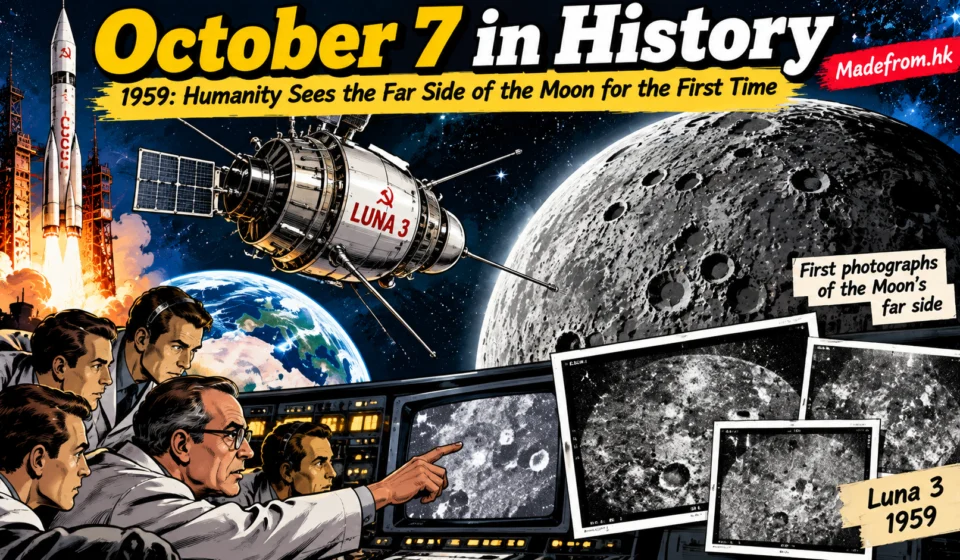
On October 7, 1959, the Soviet spacecraft Luna 3 captured the first photographs of the Moon’s far side, revealing a region that had never before been directly observed from Earth.
DAYEnglish

October 7 in History|1959: Humanity Sees the Far Side of the Moon for the First Time

2026-10-07

Humanity has observed the Moon for thousands of years. It has inspired myths, calendars, poetry and scientific curiosity across many civilizations. Yet for most of human history, people could see only the hemisphere that faces Earth. The other side remained beyond direct observation.


That changed on October 7, 1959, when the Soviet spacecraft Luna 3 photographed the Moon’s far side and transmitted images back to Earth. According to NASA’s historical account of deep-space exploration, the spacecraft took 29 photographs covering approximately 70 percent of the far side. Although the images were relatively poor by modern standards, they provided humanity with its first direct photographic views of this previously unseen lunar landscape.

The mission represented a major milestone in space exploration. It was not simply a photographic achievement; it opened an entirely new area of scientific investigation.

Why Can We Not See the Moon’s Far Side from Earth?

The Moon has two hemispheres, but the far side is not permanently dark. The reason we cannot normally see it from Earth is that the Moon’s rotation period is almost the same as its orbital period around our planet.

As the Moon travels around Earth, it also rotates on its axis. Because these movements are synchronized, approximately the same hemisphere continually faces Earth. This phenomenon is known as tidal locking.

The far side receives sunlight just as the near side does. It experiences lunar day and night as the Moon moves through its orbit. The difference is simply that observers on Earth cannot directly see that hemisphere.

Before the development of spaceflight, scientists could only speculate about the far side’s surface. Was it similar to the familiar side of the Moon? Did it contain the same broad, dark plains? How many craters would be found there?

These questions could not be answered through ordinary Earth-based observation alone.

How Did Luna 3 Make History?

In 1959, the United States and the Soviet Union were competing to demonstrate their scientific and technological capabilities in space. This competition, commonly known as the Space Race, encouraged ambitious missions that pushed the limits of contemporary engineering.

Luna 3 was designed to travel past the Moon, photograph the far side and transmit its observations back to Earth. The mission required several difficult operations to work together: navigation through space, photographic imaging, recording the results and transmitting the information over a great distance.

The technology was primitive compared with today’s spacecraft. Communication was limited, the images were difficult to process, and the mission had to operate without the sophisticated computers and navigation systems used in modern exploration.

Nevertheless, Luna 3 succeeded in returning the first photographs of the Moon’s far side. The mission demonstrated that a region hidden from direct view on Earth could be explored using spacecraft and remote observation.

What Did the Photographs Reveal?

The photographs provided the first evidence that the far side looked different from the hemisphere familiar to observers on Earth.

The Moon’s near side contains large, dark plains known as lunar maria. These features formed when ancient volcanic activity allowed lava to fill extensive impact basins.

The far side, by contrast, has many more craters and relatively few large maria. This difference suggests that the two hemispheres experienced different geological histories.

The first photographs were not detailed enough to answer every scientific question. However, they established that the far side was not simply a mirror image of the near side.

For astronomers and planetary scientists, this was an important discovery. The Moon became a more complex world whose surface could reveal clues about its formation, ancient impacts and geological evolution.

From the First Photographs to Modern Lunar Exploration

Luna 3 began a process that would continue for decades. Later spacecraft produced increasingly detailed maps of the lunar surface and helped scientists investigate its composition, structure and history.

In 1969, NASA’s Apollo 11 mission achieved the first crewed landing on the Moon. Neil Armstrong and Buzz Aldrin walked on the lunar surface, marking another defining moment in human space exploration.

Landing on the Moon and exploring its far side, however, presented different challenges. Because the far side cannot maintain a direct radio line of sight to Earth, spacecraft operating there require suitable communication arrangements, such as relay satellites.

Modern lunar orbiters can photograph the surface at high resolution, allowing researchers to study craters, geological formations and potential landing sites in much greater detail.

In January 2019, China’s Chang’e 4 mission achieved the first soft landing on the lunar far side. Its lander and rover conducted observations on the surface, extending the story that had begun with Luna 3 six decades earlier.

The progression from remote photography to a successful landing illustrates how scientific exploration develops over time. An early mission may answer only a few questions, but its findings can establish the foundation for much more ambitious work.

Why October 7, 1959, Still Matters

The significance of October 7, 1959, lies in the fact that humanity obtained its first direct photographic evidence of a hemisphere of the Moon that had never previously been seen from Earth.

Scientific progress often begins with a simple question: if something cannot be observed from our current position, can we find another way to reach it?

Luna 3 demonstrated how spacecraft, cameras and radio communications could extend human observation beyond the limitations of our own planet. The images were imperfect, but they changed scientific understanding and created new opportunities for future missions.

Today, researchers can study distant planets, map the surfaces of moons and investigate objects across the Solar System. These capabilities were built through decades of experimentation, engineering and scientific discovery.

On October 7, 1959, the Moon itself did not change. What changed was humanity’s understanding of it.

That is why this date deserves a place in the historical record. Sometimes, a major breakthrough does not involve discovering an entirely new world. It involves finally seeing a world that has always existed, but remained beyond our reach.


October 7, 1959, marked a turning point in lunar exploration when Luna 3 returned the first photographs of the Moon’s far side, expanding humanity’s understanding of our nearest celestial neighbour.

Views: 1
延伸閱讀
8月25日 今日歷史:伽利略展示望遠鏡開啟天文新紀元 Today in History (August 25): Galileo Demonstrates Telescope
1609年8月25日,伽利略向威尼斯參議院展示折射望遠鏡,開啟人類探索宇宙的新紀元。 On August 25, 1609, Galil…
7月22日今日歷史|登月成功後人類迎向新時代 Today in History, July 22 | Humanity Entered a New Space Age
7月22日在人類歷史中承接了多項重大事件,其中最令人難忘的是阿波羅11號完成登月後,人類開始真正思考太空探索的新方向。這一天不只是一次任…
5月14日歷史上的今天|建國與變革的重要時刻 On This Day: May 14 and the Moments of Nationhood and Change
5月14日見證多個影響世界格局的重要時刻,從國家建立到科技進步,展現歷史如何在變革中持續推動人類前行。May 14 marks pivo…
1990年Hubble Space Telescope發射升空|人類觀測宇宙的新里程碑 | Hubble Space Telescope Launched (1990) – A New Era in Observing the Universe | 歷史一刻,80秒速覽 April 24 
一個望向宇宙的窗口,讓人類重新認識自己的位置。A window into the cosmos that transformed how…

Tags:

astronomyLuna 3Lunar HistoryOctober 7Space Exploration
Other Articles
Previous

Strange Tales|Biting a Ghost | English Comic Edition

Myths of the Constellations | Episode 6: After the Fracture | English Comic Edition — Seraphina stands before a recovering Aries city as a colossal celestial ram spirit rises above the fractured sky.
Next

Myths of the Constellations|Episode 6|After the Fracture|English Comic Edition

  • Patreon
  • Facebook
  • Instagram
  • YouTube
  • Bluesky
  • Tumblr
  • LinkedIn

Register|Lost your password?

  • Terms of Service
  • Privacy Policy
  • Contact
  • About Us
  • Register
  • Login
  • Password Reset
  • Advertising
  • Column Sponsorship
  • plus member

Content & Corrections

This website covers films, animation, games, cultural columns, and other related content and information. Our information is primarily based on publicly available sources, official announcements, and editorial research. Content may be revised or updated when new information becomes available.
If you notice any errors, believe that information needs to be corrected, or have updated official information that may be added, please contact us by email:
📧 [email protected]
We will review the information and make updates as soon as possible after verification.
Thank you for your help and understanding.

  • 《莎拉有約》第十二集|讓看不見的人「看見」世界:認識口述影像與共融社會 主持 : 莎拉 訪問嘉賓 : 梁凱程博士
  • Myths of the Constellations | Episode 8 | The First Crossing | English Comic Edition
  • AI 自媒體學習筆記|第一季・第01篇 做自媒體,第一步不是拍片,而是找對主題
  • 《碧廬冤孽:旋緊之螺》第二集:天使與禁忌
  • Strange Tales | House Sprite | English Comic Edition

ACG HK anime Chinese Mythology Dream of the Red Chamber Hong Kong History On This Day Romance of the Three Kingdoms Silent film world history 三國演義 世界歷史 中國古典小說 中國神話 今日歷史 劉備 動畫 動畫電影 古典文學 台灣旅遊 專欄 小說連載 山海經 廣東話歇後語 影評 恐怖電影 推薦 日本動畫 日本電影 曹操 林黛玉 歷史上的今天 澳門 紅樓夢 經典電影 美國電影 聊齋志異 賈寶玉 電影 電影劇情介紹 飲食 香港文化 香港旅遊 香港歷史 香港都市傳說 香港電影

Copyright 2021 - 2026 — 0studiohk.com | madefrom.hk. All rights reserved.