
Skip to content
madefrom.hk madefrom.hk madefrom.hk

多元內容出版平台,涵蓋漫畫、原創故事、文學改編、香港文化、歷史、科技及影音作品,連結本地與世界各地的故事。

madefrom.hk madefrom.hk madefrom.hk

多元內容出版平台,涵蓋漫畫、原創故事、文學改編、香港文化、歷史、科技及影音作品,連結本地與世界各地的故事。

  • English
    • Comics
      • Strange Tales
      • Myths of the Constellations
    • Games
      • Famicom Disk System
    • Column
      • Life & Technology
      • Toy Club
      • DAY
    • History
      • Old Newspaper Digests
      • History in 80 Seconds
    • Audiobooks
    • Adapted Stories
      • romance of the three kingdoms
      • hong kong places
      • dream of the red chamber
      • strange tales
      • The house on the borderland
      • usherhouse
      • Theblackcat
  • 繁體中文
    • 漫畫
      • 碧廬冤孽
      • 十三號的約定
    • 學習筆記
    • 專欄
      • 生活與科技
    • 歷史
      • 當年報章摘要
    • ACG
      • Winter 2026 Anime
      • Summer 2026 Anime
      • ACGHK
        • 2016
        • 2018
        • 2019
        • 2023
        • 2024
      • 創天綜合同人祭
        • 同人表演
      • 音樂
      • 電玩
        • 玩具資訊
        • 遊戲資訊
    • 原創小說
      • 不可思議故事
      • 十三號的約定
      • 星座宮神話
      • 香港山怪談
      • 香港都市靈異傳說
    • 旅行
      • Macau Travel
      • International Travel
      • 日本旅遊
      • Taiwan Travel
      • Thailand Travel
      • Hong Kong Travel
        • 土瓜灣
        • 舊建築
        • 街道
        • 單車
        • 文化
        • 交通
        • 香港書展
        • 表演
        • 廟宇
        • 教堂
        • 香港書展
        • 分享會
        • 紀念活動
        • 文化活動
        • 活動
        • 寵物
        • 巴士
        • 電車
        • 機場
        • 飲食
          • 上環
          • 中環
          • 筲箕灣
          • 西環
          • 天后
          • 旺角
          • 荔枝角
          • 佐敦道
          • 太子
          • 大角咀
          • 深水埗
          • 油麻地
          • 長沙灣
          • 黃大仙
          • 尖沙咀
          • 油塘
          • 葵芳
          • 屯門
          • 元朗
          • 上水
          • 粉嶺
          • 荃灣
          • 渡輪
    • 心理測驗
    • 節目重溫
      • 文化生活
      • 莎拉有約
  • 遊戲
    • SNK Neo Geo
    • PlayStation 2
    • Arcade
    • NEWS
  • Column
    • Knowledge Hub
      • 生活篇
      • 食品篇
      • 科技篇
      • 超市篇
    • Hong Kong Guide
    • Today in History
    • City Stories
    • Anime & Manga
    • Game Magazine
    • 遊戲誌
    • Language of Flowers
    • Street Notes
    • All Things
    • Music Memories
    • Chinese Idioms
    • Cantonese Sayings
    • Movie Magazine
  • History
    • 香港歷史
    • 世界名作家
    • World Biographies
  • Movies
    • USA
    • japan
    • Korea
    • Taiwan
    • HONGKONG
    • India
    • china
    • france
    • Tunisia
    • Germany
    • Jordan
    • Switzerland
    • sweden
    • Spain
    • Palestine
    • Norway
    • Argentina
    • Brazil
  • English
    • Comics
      • Strange Tales
      • Myths of the Constellations
    • Games
      • Famicom Disk System
    • Column
      • Life & Technology
      • Toy Club
      • DAY
    • History
      • Old Newspaper Digests
      • History in 80 Seconds
    • Audiobooks
    • Adapted Stories
      • romance of the three kingdoms
      • hong kong places
      • dream of the red chamber
      • strange tales
      • The house on the borderland
      • usherhouse
      • Theblackcat
  • 繁體中文
    • 漫畫
      • 碧廬冤孽
      • 十三號的約定
    • 學習筆記
    • 專欄
      • 生活與科技
    • 歷史
      • 當年報章摘要
    • ACG
      • Winter 2026 Anime
      • Summer 2026 Anime
      • ACGHK
        • 2016
        • 2018
        • 2019
        • 2023
        • 2024
      • 創天綜合同人祭
        • 同人表演
      • 音樂
      • 電玩
        • 玩具資訊
        • 遊戲資訊
    • 原創小說
      • 不可思議故事
      • 十三號的約定
      • 星座宮神話
      • 香港山怪談
      • 香港都市靈異傳說
    • 旅行
      • Macau Travel
      • International Travel
      • 日本旅遊
      • Taiwan Travel
      • Thailand Travel
      • Hong Kong Travel
        • 土瓜灣
        • 舊建築
        • 街道
        • 單車
        • 文化
        • 交通
        • 香港書展
        • 表演
        • 廟宇
        • 教堂
        • 香港書展
        • 分享會
        • 紀念活動
        • 文化活動
        • 活動
        • 寵物
        • 巴士
        • 電車
        • 機場
        • 飲食
          • 上環
          • 中環
          • 筲箕灣
          • 西環
          • 天后
          • 旺角
          • 荔枝角
          • 佐敦道
          • 太子
          • 大角咀
          • 深水埗
          • 油麻地
          • 長沙灣
          • 黃大仙
          • 尖沙咀
          • 油塘
          • 葵芳
          • 屯門
          • 元朗
          • 上水
          • 粉嶺
          • 荃灣
          • 渡輪
    • 心理測驗
    • 節目重溫
      • 文化生活
      • 莎拉有約
  • 遊戲
    • SNK Neo Geo
    • PlayStation 2
    • Arcade
    • NEWS
  • Column
    • Knowledge Hub
      • 生活篇
      • 食品篇
      • 科技篇
      • 超市篇
    • Hong Kong Guide
    • Today in History
    • City Stories
    • Anime & Manga
    • Game Magazine
    • 遊戲誌
    • Language of Flowers
    • Street Notes
    • All Things
    • Music Memories
    • Chinese Idioms
    • Cantonese Sayings
    • Movie Magazine
  • History
    • 香港歷史
    • 世界名作家
    • World Biographies
  • Movies
    • USA
    • japan
    • Korea
    • Taiwan
    • HONGKONG
    • India
    • china
    • france
    • Tunisia
    • Germany
    • Jordan
    • Switzerland
    • sweden
    • Spain
    • Palestine
    • Norway
    • Argentina
    • Brazil
Close

Search

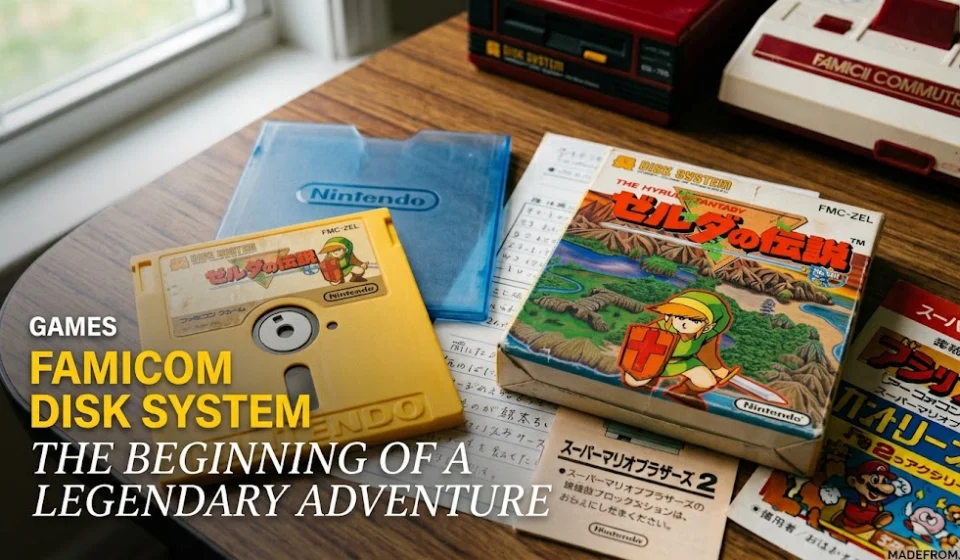
Famicom Disk System | The Legend of Zelda: The Beginning of a Legendary Adventure
EnglishFamicom Disk SystemGames

Famicom Disk System | The Legend of Zelda: The Beginning of a Legendary Adventure

2026-10-14

In 1986, The Legend of Zelda introduced a new kind of console adventure, combining exploration, combat, puzzles and hidden discoveries into one mysterious world.


When The Legend of Zelda arrived in Japan on February 21, 1986, it represented a different direction for home console games. Released for the Famicom Disk System, the first Zelda was built around exploration rather than simply moving from one stage to the next. Players entered the fantasy land of Hyrule as Link, a young hero searching for the eight fragments of the Triforce of Wisdom while preparing to confront the demon king Ganon and rescue Princess Zelda. The story provided the framework, but the real attraction was the world itself. Hyrule was designed as a place that encouraged curiosity. A player might discover a cave, encounter a suspicious section of terrain, find a hidden passage or obtain an item whose purpose was not immediately obvious. Instead of presenting every solution directly, the game encouraged experimentation and observation. This approach gave the adventure a sense of mystery that was unusual for many console games of its era. The game was created by Nintendo’s development team under the direction of Shigeru Miyamoto and Takashi Tezuka. Nintendo’s later interviews reveal that Zelda was actually being developed alongside Super Mario Bros., with Zelda’s development beginning earlier. Because Zelda was intended for the Famicom Disk System, however, the team completed Super Mario Bros. first before releasing Zelda with the new disk hardware. Miyamoto later described the concept in terms of a world of swords and magic combined with an adventure based around treasure hunting and discovery. The Disk System itself played an important role in making this type of game possible. Compared with the ROM cartridges used by the Famicom at the time, the disk format offered additional memory capacity and, crucially, the ability to save game data. For an adventure game built around exploration, multiple dungeons and a growing collection of equipment, being able to preserve progress made a significant difference to the experience. Nintendo later explained that the Disk System’s storage and save capabilities were closely connected to the design of the original Zelda. The player’s journey through Hyrule was deliberately open-ended. Link could acquire a sword, search for equipment, enter underground dungeons, defeat enemies and gradually uncover the larger structure of the world. Some discoveries required the player to remember locations or understand how an item could be used. Others depended on noticing something unusual in the environment. The game therefore rewarded attention as much as reflexes. Nintendo also provided a substantial instruction booklet containing information about the story, gameplay and hints. Miyamoto later explained that the booklet was intended not only to teach players how to play, but also to strengthen the atmosphere of the adventure and fantasy world. The original Japanese version used the subtitle “The Hyrule Fantasy,” reflecting the developers’ intention to create a larger fantasy setting rather than simply another isolated action game. The world of Hyrule became the foundation for an entire franchise, while characters such as Link, Zelda and Ganon gradually became some of Nintendo’s most recognizable figures. More than a year after its Japanese debut, The Legend of Zelda reached North America and Europe on the Nintendo Entertainment System. Because the Famicom Disk System was never released outside Japan, the international version was distributed on cartridge. The North American version was notable for using battery-backed memory to save game progress, helping make persistent save data a familiar feature of console games. The Japanese disk version and international cartridge version were not completely identical. Nintendo has documented differences in sound, fonts and some enemy placements. The Disk System version could also take advantage of an additional audio channel, giving the Japanese release a somewhat different sound character. Another important feature was the Second Quest. After completing the main adventure, players could enter a rearranged version of the game featuring different dungeon layouts and item locations, along with more demanding encounters. This effectively gave experienced players another reason to explore Hyrule after finishing the first journey. What made the original Zelda particularly influential was the relationship it created between the player and the game world. Instead of treating the screen as a fixed obstacle course, Nintendo created a space that invited players to investigate. The player was expected to remember discoveries, experiment with equipment, search for hidden routes and gradually construct an understanding of Hyrule. The graphics were limited by the technology of the period, yet the design created an unusually strong sense of scale and mystery. Every unexplored corner suggested another secret. Every new item raised another question. Every dungeon represented another challenge. That basic philosophy became one of the defining principles of the Zelda series. The first game therefore occupies an important place in the history of console adventure games. It showed that a home console could provide more than short bursts of action: it could create a world in which players explored at their own pace and solved problems through curiosity and persistence. What began in 1986 as a Famicom Disk System launch title eventually became one of Nintendo’s most enduring franchises. The original adventure was technically modest compared with later Zelda games, but its central idea remained remarkably powerful: give players a world, give them the tools to explore it, and allow the discovery itself to become part of the game.

The original Zelda transformed console adventure by making discovery part of the experience. Its small pixel world became the foundation for a franchise built on exploration, mystery and the freedom to find answers.

Views: 16
延伸閱讀
Famicom Disk System | Super Mario Bros. 2: The Lost Levels
In 1986, Nintendo released a very different sequel to Super Mario Br…
Famicom Disk System: Nintendo’s Floppy Disk Era
In 1986, Nintendo introduced the Famicom Disk System, bringing rewri…
Original Stories | Myths of the Constellations | Episode 2 | The Silent Guardian | English Comic Edition
Beyond the Aries Palace, a silent guardian watches over an ancient l…
生活與科技 第三季 電腦篇 003|第一代手提電腦:流動電腦時代的開始 | Life and Technology Season 3 Computer Series | The First Generation of Portable Computers
當電腦開始由固定桌面走向可攜帶化,人類的工作與生活模式亦開始出現巨大改變。第一代手提電腦雖然笨重,但它開啟了流動計算的新時代,亦成為現代…

Tags:

Famicom Disk System
Other Articles
Previous

AI 自媒體學習筆記|第一季・第04篇 Keyword 與長尾關鍵字:從搜尋需求尋找方向

Myths of the Constellations Episode 10: The Weight of the First Step – Cover. Seraphina, the fiery Aries guardian, stands beneath a cosmic sky as the celestial ram and glowing constellations symbolize patience, responsibility, and a new balance in the universe. Madefrom.hk.
Next

Myths of the Constellations | Episode 10 | The Weight of the First Step

  • Patreon
  • Facebook
  • Instagram
  • YouTube
  • Bluesky
  • Tumblr
  • LinkedIn

Register|Lost your password?

  • Terms of Service
  • Privacy Policy
  • Contact
  • About Us
  • Register
  • Login
  • Password Reset
  • Advertising
  • Column Sponsorship
  • plus member

Content & Corrections

This website covers films, animation, games, cultural columns, and other related content and information. Our information is primarily based on publicly available sources, official announcements, and editorial research. Content may be revised or updated when new information becomes available.
If you notice any errors, believe that information needs to be corrected, or have updated official information that may be added, please contact us by email:
📧 [email protected]
We will review the information and make updates as soon as possible after verification.
Thank you for your help and understanding.

  • Myths of the Constellations | Episode 10 | The Weight of the First Step
  • Famicom Disk System | The Legend of Zelda: The Beginning of a Legendary Adventure
  • AI 自媒體學習筆記|第一季・第04篇 Keyword 與長尾關鍵字:從搜尋需求尋找方向
  • 無敵なカタチ|Invincible Form|From a Forgotten Dream to a Wrestler Loved by Children | JAPAN Film | Trailer | 2026
  • 7th Heaven (1927): Frank Borzage’s Classic Silent Romance | USA Film | Trailer

ACG HK anime Chinese Mythology Dream of the Red Chamber Hong Kong History On This Day Romance of the Three Kingdoms Silent film world history 三國演義 世界歷史 中國古典小說 中國神話 今日歷史 劉備 動畫 動畫電影 古典文學 台灣旅遊 專欄 小說連載 山海經 廣東話歇後語 影評 恐怖電影 推薦 日本動畫 日本電影 曹操 林黛玉 歷史上的今天 澳門 紅樓夢 經典電影 美國電影 聊齋志異 賈寶玉 電影 電影劇情介紹 飲食 香港文化 香港旅遊 香港歷史 香港都市傳說 香港電影

Copyright 2021 - 2026 — 0studiohk.com | madefrom.hk. All rights reserved.