September 22 in History|From Michael Faraday and the Post Office to the Birth of ITV
September 22 connects scientific discovery, postal communication and television, showing how technology has repeatedly changed the way people understand and connect with the world.
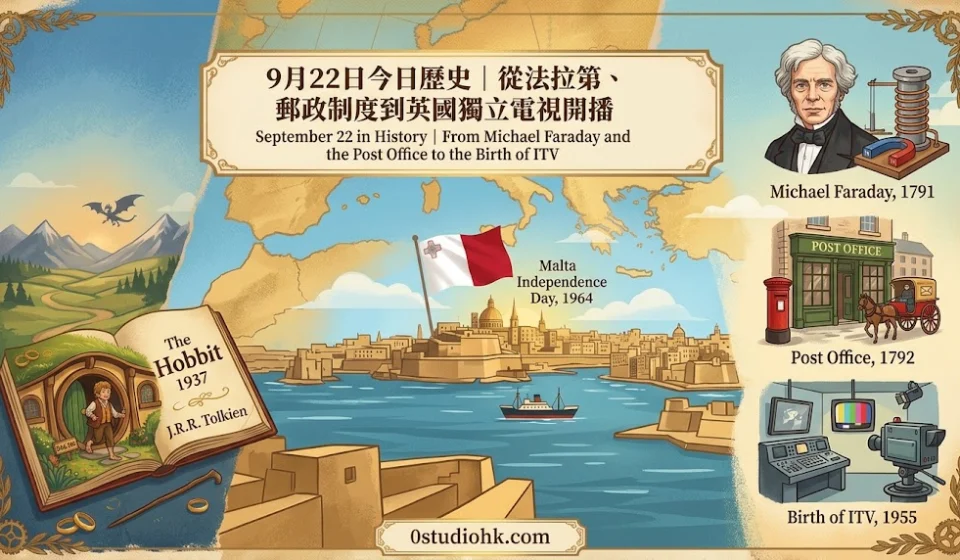
September 22 brings together three very different parts of modern history: scientific discovery, organised communication and mass media. On September 22, 1791, Michael Faraday was born in Newington Butts, London. Faraday came from a modest family. His father was a blacksmith, and his formal education was limited. As a young man, Faraday worked in a bookshop and later became an apprentice bookbinder. His access to books and scientific reading gradually developed into a deep interest in the natural world. The Royal Society of Chemistry describes Faraday as one of the most influential figures in the history of science, particularly because of his work on electricity, magnetism and electrochemistry. Faraday’s scientific importance was not simply that he produced a particular invention. His experiments helped people understand the relationship between electricity and magnetism. One of his most important contributions was electromagnetic induction: a changing magnetic field can produce an electric current in a conductor. This principle later became fundamental to technologies such as electrical generators and transformers. Modern society depends heavily on electricity, from lighting and household appliances to industrial machinery and communication systems, and Faraday’s work formed part of the scientific foundation that made practical electrical technology possible. His story is also interesting because it challenges the assumption that scientific achievement always begins with privileged education. Faraday had little formal schooling, but he developed his knowledge through reading, observation, lectures and experiments. The American Physical Society notes that he became interested in science while working as a bookbinder and reading scientific books, eventually attending lectures by the chemist Humphry Davy. His journey shows that access to knowledge can sometimes become as important as formal qualifications. A person who begins with limited opportunities can still develop ideas that influence generations, provided there is a way to learn, experiment and continue asking questions. Another important September 22 event takes us away from the laboratory and into the history of communication. On September 22, 1789, the United States Congress passed an Act for the Temporary Establishment of the Post Office. The legislation continued the postal system that had existed under the Articles of Confederation and placed the postmaster general under presidential direction. Four days later, George Washington appointed Samuel Osgood as the first Postmaster General under the new Constitution. Modern communication makes it easy to forget how difficult long-distance communication once was. There were no smartphones, email services or instant messaging platforms. A letter depended on people, horses, roads, post offices and established routes. The Smithsonian’s National Postal Museum records that when the 1789 system was established, the United States had a population of almost four million, around 75 post offices and approximately 2,400 miles of post roads. By modern standards, this was a very small network, but its significance was much larger than its physical size. A reliable postal system helped connect governments, businesses, newspapers, families and communities. It transformed communication from something that depended heavily on private arrangements into a public infrastructure that could gradually expand across a country. The history of postal services also demonstrates an important pattern in technological development. Communication does not simply become faster; it changes the structure of society. When letters could travel more reliably, people could maintain relationships across greater distances. Businesses could exchange information with customers and suppliers. Newspapers could reach wider audiences. Government institutions could communicate with officials and citizens more systematically. Over time, postal roads expanded and the network became increasingly integrated with other forms of transportation. Later developments such as railways, telegraphy, telephones, radio and television continued the same basic process: reducing the practical distance between people. September 22 also marks an important moment in British television history. On September 22, 1955, Independent Television, better known as ITV, began broadcasting in the United Kingdom. According to ITV’s own historical record, the first broadcast began at 7:15 p.m. and included coverage from outside London’s Guildhall, where a dinner marking the launch of ITV was being held. It was followed by the first television advertisement shown in Britain, for Gibbs SR Toothpaste. The arrival of ITV changed British television because it introduced a major commercial television service alongside the BBC. Advertising became an important part of the new broadcasting model, providing revenue that could support programme production. For viewers, the arrival of another television service meant more choice. For programme makers, it created another major organisation capable of producing news, drama, comedy, entertainment, documentaries and regional programming. Over the following decades, ITV became deeply connected with British popular culture. Its programmes reached millions of households and contributed to the development of television genres that remain familiar today. The significance of September 22, 1955 therefore goes beyond the launch of a television channel. It marked a change in the relationship between broadcasters, advertisers and audiences. Television was becoming not simply a technology for transmitting pictures but a major cultural and commercial environment. The arrival of commercial television also changed the rhythm of domestic life. Families could choose from more programmes, broadcasters competed for viewers, advertisers could communicate directly with households, and television gradually became one of the most important ways in which people experienced news and entertainment. Looking at these three stories together reveals a common theme. Faraday’s experiments explored how electricity and magnetism work. The postal system created an organised way for information to travel across distance. ITV used broadcasting technology to bring information and entertainment into millions of homes. None of these developments were identical, but all of them changed the practical distance between people and information. Faraday worked with forces that could not be seen directly. Postal workers carried physical messages from one place to another. Television later allowed the same programme to be experienced by large numbers of people at almost exactly the same time. Today, digital communication has taken this process even further. A message, photograph or video can cross the world in seconds. Because this has become normal, it is easy to forget that communication was once slow, expensive and dependent on physical transportation. A letter could take days or weeks to arrive. A newspaper required printing and distribution. Television introduced simultaneous mass viewing, while the internet eventually moved communication towards an environment where information could be accessed almost immediately and from almost anywhere. Each generation tends to regard its own communication technology as ordinary, but history shows that every new system once represented a major change. September 22 provides a useful reminder of that process. A young man with limited formal education could become one of the most important scientists in the history of electricity. A postal law could help establish a communication network for a growing nation. A new television service could change the way an entire country experienced information and entertainment. These events may seem unrelated when viewed separately, but together they tell a story about how knowledge and culture travel. Science allows people to understand forces that shape technology. Infrastructure allows messages to move across physical distance. Media allows ideas, stories and information to reach large audiences. The history of communication is therefore not only a history of machines. It is also a history of human relationships. Every improvement in communication changes how families keep in touch, how businesses operate, how governments function, how news spreads and how culture is shared. From handwritten letters to television broadcasts, and from television to smartphones and the internet, the basic human desire remains surprisingly consistent: people want to send something beyond their immediate surroundings and know that someone else, somewhere else, can receive it. That is why September 22 is worth remembering. It connects Faraday’s scientific curiosity, the development of organised postal communication and the beginning of ITV broadcasting through a simple but powerful idea: human progress is often about finding new ways to make knowledge, messages and culture travel further. The tools have changed dramatically, but the purpose remains familiar.
September 22 follows a clear line from science to communication and media: Faraday explored electricity and magnetism, postal systems carried messages further, and ITV brought moving images into homes. Technology ultimately changes the distance between people and information.